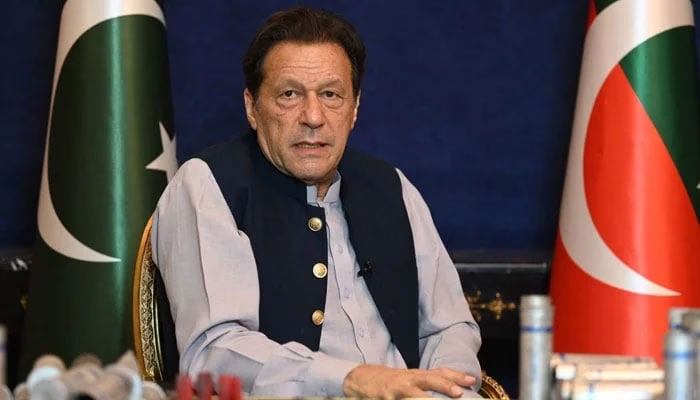
The ongoing Imran Khan Toshakhana-2 case has taken a significant turn as the former prime minister has approached the Islamabad High Court seeking suspension of his sentence and release on bail on medical and humanitarian grounds. The petition, filed through his legal team, argues both legal merits and serious health concerns as reasons for relief.
Imran Khan, founder of the Pakistan Tehreek-e-Insaf (PTI), was sentenced in December last year to 17 years in prison in the Toshakhana-2 reference. His wife, Bushra Bibi, received the same sentence. The case revolves around allegations of acquiring luxury state gifts at undervalued prices and later selling them for profit.
In his latest plea before the Islamabad High Court, Imran Khan’s counsel has requested suspension of the sentence until the final decision on appeal. The petition highlights that the former premier is 73 years old and suffering from a severe medical condition affecting his right eye. According to the application, a blood clot has significantly damaged his vision, leaving him with only 15% sight in that eye.
Lawyers argued that the medical complication is serious and cannot be adequately treated within jail premises. They contended that these health concerns, combined with what they describe as a strong legal case on merits, justify bail on humanitarian grounds. The petition also referenced observations made during a recent hearing before the Supreme Court, suggesting that medical issues have recently intensified.
The Imran Khan Toshakhana-2 case has remained politically charged since its inception. The investigation was initially launched by the National Accountability Bureau (NAB) in connection with the alleged purchase of an expensive Bulgari jewellery set from the Toshakhana repository. The couple was arrested in July 2024 and remained in custody for 37 days at Adiala Jail during the investigation.
Following completion of inquiries, NAB filed a formal reference before an accountability court. However, after amendments to NAB laws were restored by the Supreme Court, the matter was transferred to the Federal Investigation Agency’s Anti-Corruption Court. After approximately 80 hearings conducted inside Adiala Jail, Special Judge Central Shahrukh Arjumand delivered the verdict.
Under the judgement, Imran Khan and Bushra Bibi were convicted on two separate charges. They were sentenced to 10 years each under sections 34 and 409 of the Pakistan Penal Code, along with an additional seven years under section 5 of the Prevention of Corruption Act, 1947. The court also imposed a combined fine of Rs16.4 million. While announcing the punishment, the judge noted Imran’s advanced age and Bushra Bibi’s status as a woman.
In addition to seeking relief in the Toshakhana matter, the former premier has also moved a separate application requesting an early hearing of his plea in the Al-Qadir Trust case, often referred to as the £190 million reference. His legal team maintains that both cases form part of a broader pattern of political victimisation following his removal from office.
The petition claims that since leaving power, Imran Khan and his spouse have faced multiple prosecutions across various forums. It further alleges that institutions such as NAB, the Federal Investigation Agency (FIA), and the Election Commission of Pakistan (ECP) have been used for political purposes. According to the plea, investigative bodies have been “manipulated as political tools” by opponents to pursue targeted legal action.
Supporters of the PTI chief argue that the Imran Khan Toshakhana-2 case represents selective accountability, while critics maintain that legal proceedings must follow their course regardless of political standing. The case has deepened political divisions in Pakistan, with debates intensifying over accountability laws, judicial independence, and the treatment of former office holders.
Legal experts note that suspension of sentence is not uncommon when appeals are pending, particularly in cases involving health issues. However, courts also weigh the gravity of charges and public interest considerations before granting bail. The Islamabad High Court’s decision will therefore be closely watched, as it could influence the broader political climate.
As proceedings continue, the Imran Khan Toshakhana-2 case remains one of the most high-profile legal battles in Pakistan’s recent history. The coming weeks are likely to determine whether the former prime minister secures temporary relief or continues serving his sentence while appeals are heard.
For now, the matter stands at a critical juncture, with legal, political, and humanitarian dimensions converging in a case that continues to dominate national discourse.