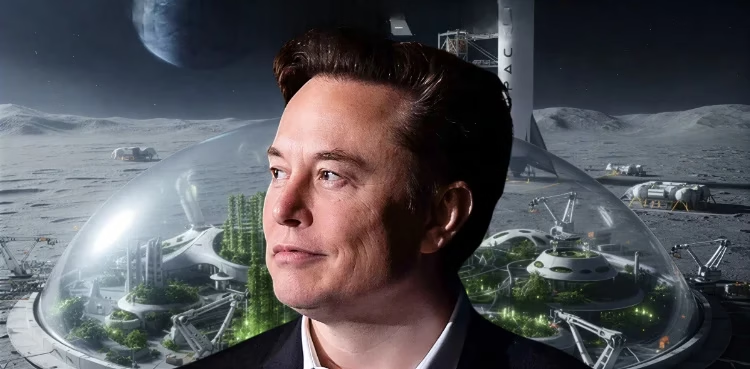
Tech billionaire Elon Musk says SpaceX is pivoting toward a bold near-term objective: establishing a permanent human presence on the Moon — a step he frames as faster and more achievable than building a city on Mars.
Musk described the plan as a “moon-first” strategy, centered on creating what he called a self-growing lunar city — infrastructure capable of expanding with minimal Earth dependence. According to a SpaceX update he referenced, the company believes a foundational lunar settlement could be achievable within roughly 10 years, compared with the longer timeline required for Mars.
Why the Moon first?
The reasoning is practical:
- Shorter travel distance makes logistics, emergency response, and resupply far easier than Mars
- Lower mission risk compared with deep-space interplanetary travel
- A testing ground for closed-loop life support, construction, and autonomy
- Strategic step toward Musk’s long-term goal: safeguarding civilization beyond Earth
Musk summarized the philosophy bluntly: securing humanity’s future requires achievable milestones — and the Moon offers a faster proving ground.
Mars remains the long game
Despite the lunar pivot, Musk has not abandoned Mars. He reiterated ambitions of sending humans there within the next decade, describing the Moon as a stepping stone rather than a replacement objective. Technologies proven on the Moon — habitat construction, energy systems, resource utilization — would feed directly into Mars missions.
Timeline signals
Reports suggest SpaceX is targeting an uncrewed lunar mission around 2027, which could mark the beginning of infrastructure deployment. While timelines in spaceflight are fluid, the announcement signals a meaningful shift in emphasis toward near-term lunar engineering.