The recent wave of violence across multiple districts highlights a critical reality: Balochistan political violence is not about capturing territory or defeating the state militarily. What unfolded was a coordinated act of political signalling—short, dispersed, and symbolic designed to shock, attract attention, and shape narratives rather than to hold ground.
At its core, this was a shock-and-signal operation. The attacks were brief, loud, and spread across geography to create the illusion of scale. Security forces were compelled into simultaneous responses, which amplified visibility. But visibility, not victory, was the objective.
Two Fights, Many Distractions
Despite activity reported across numerous districts, the operational reality was far more limited. Quetta and Kalat were the primary engagements. Other locations Nushki, Dalbandin, Gwadar, Pasni, Mastung, and Buleda/Tump functioned as harassment actions. These included attempted raids, long-range fire, grenade attacks, and brief highway disruptions.
This distinction matters. It was not twelve battles. It was two focal points and multiple distractions. Quetta carried political symbolism; Kalat aimed at institutional disruption. Together, they maximised headlines while staying within limited insurgent capacity hallmarks of Balochistan political violence as a communication tool.
Reach Without Control
The multi-node activation across a wide belt suggests a distributed cell network acting in parallel. These were discrete tactical actions, not a massed force. There was shared timing and narrative intent, but no evidence of real-time command-and-control across locations.
The attackers demonstrated reach, not control. They showed they could strike across districts, but not that they could seize, hold, or defend terrain. This remains an asymmetric insurgency. It is not a revolutionary force seeking to replace the state by military means.
Psychological Impact Over Military Effect
The attacks followed a hit-and-withdraw pattern, low-to-mid intensity, including an attempted suicide strike. The goal was psychological: induce fear, generate headlines, and fuel recruitment. The metric of “success” here is attention captured, not territory gained.
This is why misreading Balochistan political violence as a conventional military escalation is dangerous. Overreaction risks validating insurgent narratives and widening the gap between state and society. Treating signalling as seizure converts tactical noise into strategic grievance.
State Response and What It Signals
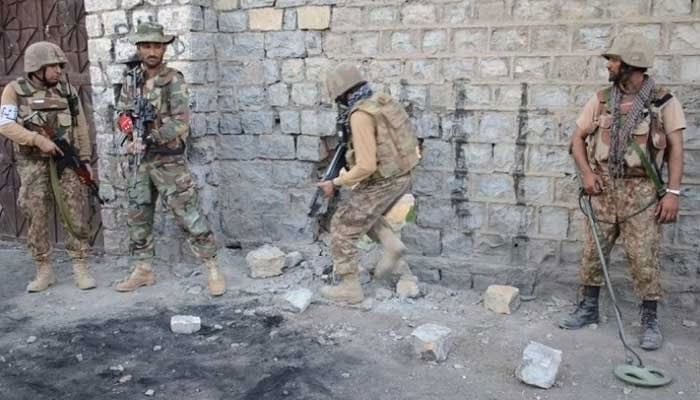
Security forces responded rapidly and effectively, regaining control and neutralising the operation within an hour. This underscores that the state’s writ was not broken. The events did not represent a collapse of control; they represented an attempt to contest legitimacy through spectacle.
The real battlefield, however, was information. Social media amplification and narrative compression exaggerated scale and urgency. In shock-and-signal operations, both silence and overstatement help the insurgent. Precision starves them.
The Information Playbook That Works
Effective response to Balochistan political violence requires disciplined communication:
- Establish a single, time-bound public brief: what happened, where, when and what didn’t.
- Publish confirmed facts only; clearly label what remains unverified.
- Correct exaggerations quickly, without chest-thumping or narrative inflation.
- Disrupt cells and facilitation networks, not optics and hype.
This approach denies insurgents the oxygen they seek while preserving public trust.
Political Violence, Not War
It is essential to name the phenomenon accurately. What unfolded fits the definition of political violence: violence used to communicate, mobilise, and contest legitimacy not to seize territory or defeat the state militarily. Its success is measured in narrative traction, not battlefield outcomes.
Mislabeling it as war risks militarising a problem that also requires political answers. Precision in diagnosis enables proportionate, effective responses.
Closing the Grievance Gap
Finally, no security response is complete without addressing the political space insurgency exploits. Balochistan political violence thrives where grievances persist and where misreading by the state reinforces alienation. Containing gunfire is necessary, but insufficient.
The task ahead is exacting but clear: contain the violence, starve the narrative, dismantle facilitation networks, and close the grievance gap. When the state responds with clarity, restraint, and credibility, shock-and-signal operations lose their power.