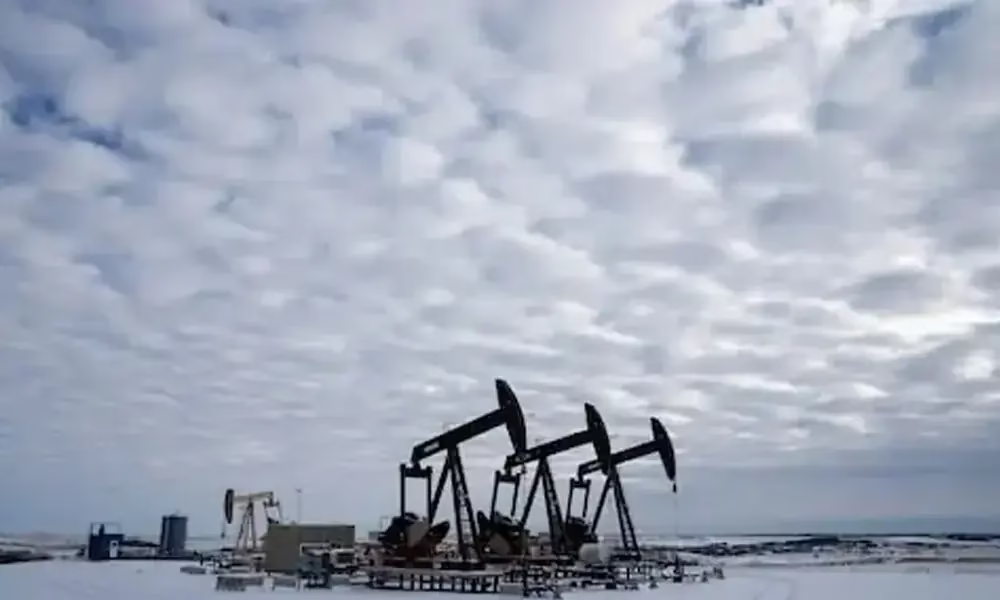
Brent oil prices moved sharply higher on Thursday, climbing to a near six-month high as rising geopolitical tensions in the Middle East unsettled global energy markets. Investor anxiety has intensified over the possibility of a US military confrontation with Iran, a key oil producer and a critical player in regional energy supply routes. As uncertainty grows, oil markets are once again reacting to geopolitical risk rather than just supply-demand fundamentals.
Geopolitical Risk Fuels Market Anxiety
The latest jump in Brent oil prices is largely driven by fears surrounding Iran and the potential fallout of a military escalation. Iran is OPEC’s fourth-largest producer, pumping around 3.2 million barrels per day, and any disruption to its output could have immediate global consequences. More importantly, analysts warn that Iran could retaliate by threatening the Strait of Hormuz, a narrow waterway through which roughly 20 million barrels of oil pass daily.
Even the possibility of disruption in this vital chokepoint is enough to send prices higher. Energy markets are highly sensitive to risk in the region, and traders tend to price in worst-case scenarios when tensions rise sharply.
Strong Monthly Performance for Crude
On Thursday, Brent oil prices jumped nearly 4% to trade above $71 per barrel, marking their highest level since early August. This surge puts Brent on track for a monthly gain of more than 16%, the strongest January performance in four years. Such a rapid climb highlights how quickly sentiment can shift when geopolitical uncertainty enters the equation.
US West Texas Intermediate (WTI) crude followed a similar path, rising around 4% to reach a four-month high. Together, both benchmarks reflect a tightening market outlook and heightened concern over future supply stability.
US-Iran Tensions at the Center
The renewed pressure from Washington on Tehran has added a significant risk premium to oil markets. Reports suggesting that the US administration is considering targeted military options have unsettled investors. While no action has been confirmed, markets tend to react strongly to signals rather than outcomes.
This uncertainty has directly contributed to the rise in Brent oil prices, as traders factor in the potential for sudden supply disruptions. Even limited conflict could impact exports, shipping routes, or regional stability, all of which influence oil pricing.
Analysts See Further Upside Risk
Several market analysts believe the current rally may not be over yet. Some estimates suggest that geopolitical tensions alone have added $3 to $4 per barrel to current prices. If the situation escalates further, forecasts indicate Brent could push toward the $72 per barrel level in the coming months.
That said, analysts also caution that oil markets are notoriously volatile. While risk premiums can inflate prices quickly, they can also unwind just as fast if tensions ease or diplomacy takes center stage.
Supply Disruptions Add to Tightness
Beyond geopolitics, temporary supply disruptions have added further support to Brent oil prices. In Kazakhstan, operations at the massive Tengiz oilfield are being gradually restored after electrical fires reduced output. Although production is expected to normalize within a week, the short-term loss of barrels has tightened supply.
In the United States, severe winter weather recently disrupted oil and gas production. While producers are bringing wells back online, these temporary outages contributed to the perception of a tighter global market, reinforcing upward price pressure.
A Tighter Market Than Expected
Market observers note that the combination of geopolitical risk and unexpected supply disruptions has changed the outlook for oil in the near term. Earlier expectations of a comfortably supplied market have given way to concerns about short-term shortages.
This shift has played a major role in supporting Brent oil prices, as traders reassess balances and hedge against further disruptions. Even brief interruptions can have an outsized impact when inventories are not overly abundant.
What This Means for the Global Economy
Rising oil prices have broader implications beyond the energy sector. Higher crude costs can feed into inflation, increase transportation expenses, and pressure economies already dealing with tight monetary conditions. For oil-importing countries, sustained increases in Brent oil prices can strain trade balances and weaken currencies.
At the same time, oil-exporting nations may benefit from stronger revenues, at least in the short term. This dynamic often reshapes economic and political priorities across regions.
Volatility Likely to Continue
Brent oil prices are likely to remain volatile as long as geopolitical tensions persist. Any signals of de-escalation could quickly cool the rally, while further escalation may drive prices even higher. In the short term, headlines will continue to dominate market direction more than traditional fundamentals.
The oil market is firmly in risk-assessment mode, with traders watching developments in the Middle East closely. Whether prices stabilize or extend their gains will depend largely on how the geopolitical situation unfolds in the coming weeks.