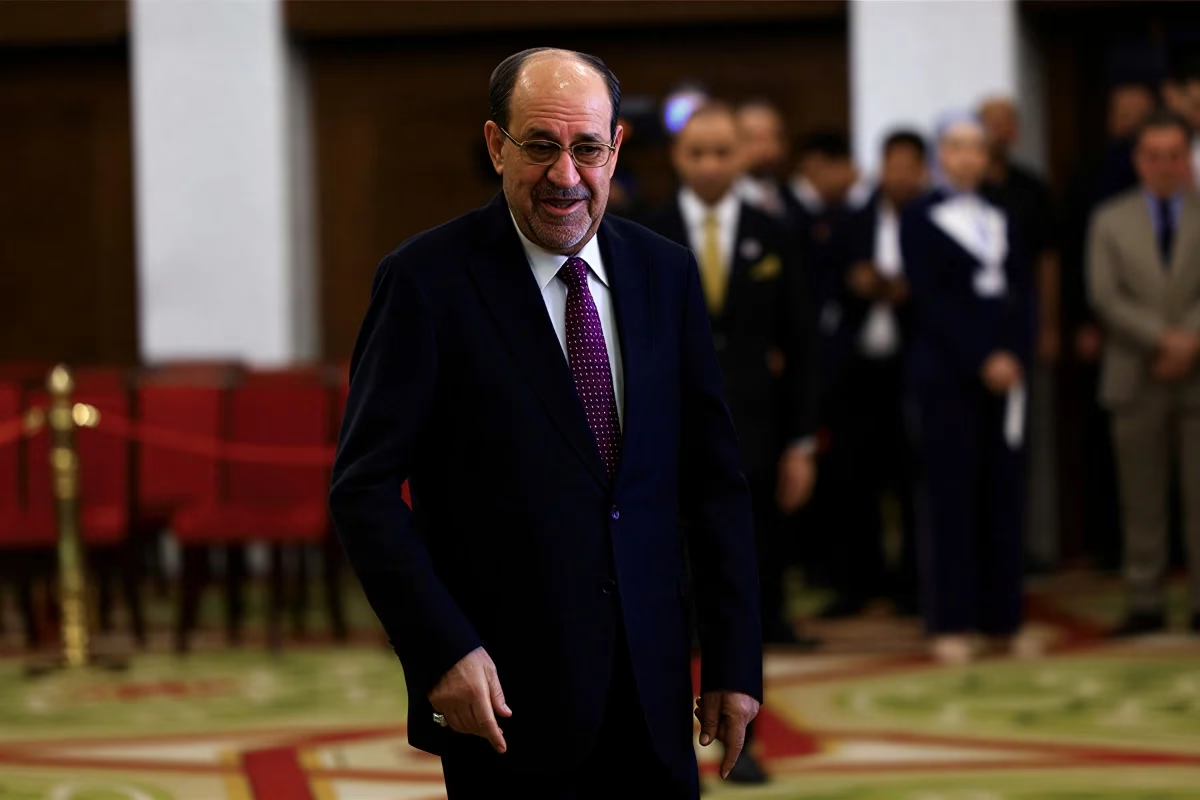
Former Iraqi prime minister Nouri al-Maliki US interference has become a central issue in Iraq’s evolving political landscape after strong remarks from both Baghdad and Washington. On Wednesday, Maliki publicly rejected what he described as American meddling in Iraq’s internal affairs, responding to a warning from US President Donald Trump that Washington would cut off assistance if Maliki returned as prime minister.
In a post on X, Maliki stated that he would continue working until we reach the end, in a manner that serves the supreme interests of the Iraqi people.His message was clear: decisions about Iraq’s leadership, he said, are a sovereign matter and should not be influenced by foreign pressure. The Nouri al-Maliki US interference debate has since intensified, highlighting deeper questions about sovereignty, external influence, and Iraq’s political future.
Maliki’s Firm Stand on Sovereignty
Maliki categorically rejected American intervention, calling it an attack on Iraq’s independence and a violation of national sovereignty. According to him, the selection of Iraq’s prime minister is a purely domestic decision that does not accept foreign interference. He reaffirmed his resolve to continue his political struggle in line with the Shiite Coordination Framework, the powerful parliamentary bloc that nominated him as its candidate.
This stance resonates with many Iraqi political figures who argue that Iraq, after decades of conflict and foreign involvement, must be allowed to decide its own leadership. For Maliki and his supporters, the Nouri al-Maliki US interference issue is not just about one individual, but about setting boundaries on how much influence external powers should have over Iraqi politics.
Trump’s Warning and US Position
The controversy escalated a day earlier when President Trump wrote on Truth Social that if Maliki were restored as prime minister, the United States would “no longer help Iraq.” Trump claimed that without US assistance, Iraq would have “zero chance of success, prosperity, or freedom.” He also sharply criticized Maliki’s previous tenure from 2006 to 2014, blaming his leadership for pushing the country into “poverty and total chaos.”
From Washington’s perspective, these warnings are tied to long-standing concerns about Iranian influence in Iraq. US officials have repeatedly signaled discomfort with Iraqi leaders or blocs perceived to be closely aligned with Tehran. In this context, the Nouri al-Maliki US interference debate reflects broader geopolitical tensions between the US and Iran, with Iraq often caught in the middle.
Political Background and Nomination
Following Iraq’s parliamentary elections in November 2025 and the withdrawal of interim Prime Minister Mohammed Shia al-Sudani from the race, the Shiite Coordination Framework nominated Maliki as its prime ministerial candidate. The decision was influenced by Maliki’s extensive political and administrative experience, as well as his continued influence within Iraq’s Shiite political sphere.
As head of the State of Law Coalition and a senior figure in the Islamic Dawa Party, Maliki remains a powerful player. He also maintains ties with groups that support Iran’s regional objectives, which has fueled US concerns. Still, his supporters argue that his experience is precisely what Iraq needs during a period of regional instability and economic challenges.
US–Iraq Relations Under Strain
The US stance on Maliki aligns with recent diplomatic signals. Reports indicate that Secretary of State Marco Rubio recently warned Iraqi leaders that a government perceived to be under Iranian influence could struggle to maintain positive relations with Washington. US officials have also cautioned that aid or cooperation could be reconsidered if such groups dominate the next administration.
These warnings have added pressure to Iraq’s political process and intensified the Nouri al-Maliki US interference narrative. Critics of Washington argue that such threats undermine Iraq’s democratic institutions, which were established after 2003 to allow Iraqis to choose their leaders freely.
Maliki’s Controversial Legacy
Maliki served as prime minister during one of Iraq’s most turbulent periods. His tenure included intense sectarian tensions, the withdrawal of US troops in 2011, and the emergence of ISIS in 2014. While critics blame his policies for weakening state institutions, supporters credit him with maintaining state authority during years of chaos.
His current position reflects a broader sentiment among some Iraqi factions that continued US pressure represents an unacceptable intrusion into national affairs. For them, the Nouri al-Maliki US interference dispute is part of a longer struggle to assert Iraq’s autonomy on the regional and global stage.
A Defining Moment for Iraq
As political negotiations continue, the standoff between Maliki and Washington underscores the fragile balance Iraq must navigate between asserting sovereignty and managing critical international relationships. Whether Maliki ultimately returns to power or not, the debate has already exposed fault lines within Iraq’s political system and its foreign policy orientation.
At its core, the Nouri al-Maliki US interference controversy is about more than one leader. It raises fundamental questions about who gets to shape Iraq’s future—and whether that future will be decided primarily in Baghdad or influenced by pressures from abroad.