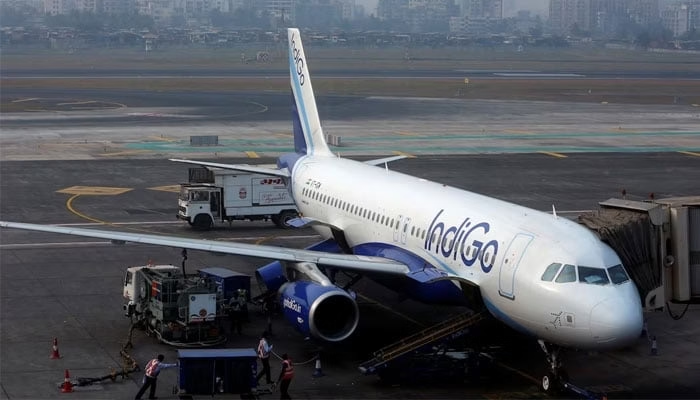
The Pakistan airspace ban on Indian aircraft has been extended for another month, reinforcing ongoing aviation restrictions between the two neighboring countries. According to a fresh notice to airmen (Notam) issued by the Pakistan Airports Authority (PAA), the ban will now remain in force until February 24, 2026, reflecting continued diplomatic and security tensions in the region.
Extension Confirmed by PAA
As per the latest Notam, the Pakistan airspace ban on Indian aircraft will apply from January 25, 2025, through February 24, 2026, until 5:00am Pakistan Standard Time. The restriction covers all Indian-registered aircraft, including those that are owned, operated, or leased by Indian entities. Military aircraft are also included in the ban, making it comprehensive in scope.
The PAA clarified that this decision is an extension of an existing restriction that has already been in place for the past nine months. By renewing the ban, Pakistan has signaled that it sees no immediate change in circumstances that would allow a rollback of the policy.
Background of the Airspace Restrictions
The Pakistan airspace ban on Indian aircraft was initially imposed as a tit-for-tat response after India suspended the Indus Water Treaty, a key water-sharing agreement between the two countries. This suspension followed heightened bilateral tensions triggered by the deadly Pahalgam attack in Indian Illegally Occupied Jammu and Kashmir (IIOJK).
In retaliation, Pakistan closed its airspace to Indian airlines, a move that had significant operational and financial consequences for Indian aviation. Shortly afterward, on April 30, India responded by shutting its own airspace to Pakistani airlines, further escalating aviation-related restrictions between the two sides.
Escalation and Military Developments
The situation surrounding the Pakistan airspace ban on Indian aircraft cannot be separated from the broader military and political developments that followed. On May 6 and 7, India launched what Pakistan described as unprovoked attacks on multiple Pakistani cities. These strikes marked a serious escalation in hostilities between the two nuclear-armed neighbors.
In response, Pakistan’s armed forces carried out a large-scale retaliatory operation named “Operation Bunyanum Marsoos.” During this operation, Pakistan targeted several Indian military installations across different regions. According to Pakistani sources, seven Indian fighter jets, including three Rafale aircraft, along with dozens of drones, were shot down.
After at least 87 hours of intense conflict, a ceasefire agreement was reached on May 10, reportedly brokered by the United States. While open hostilities subsided, measures like the Pakistan airspace ban on Indian aircraft have remained firmly in place, indicating that trust between the two sides is still fragile.
Impact on Aviation Industry
The aviation fallout from the Pakistan airspace ban on Indian aircraft has been uneven. India’s aviation sector has faced substantial losses, as Indian airlines have been forced to reroute flights to avoid Pakistani airspace. These longer routes increase fuel consumption, extend travel times, and raise operational costs, particularly for flights to Europe, the Middle East, and North America.
On the other hand, Pakistani aviation has experienced minimal disruption. Analysts note that Pakistan International Airlines (PIA) and other local operators do not rely as heavily on Indian airspace for their international routes, limiting the economic impact on Pakistan’s side.
A Familiar Strategy in Times of Tension
This is not the first time the Pakistan airspace ban on Indian aircraft has been used as a strategic tool during periods of heightened tension. Similar restrictions were imposed during the 1999 Kargil conflict and again in 2019 following the Pulwama crisis. In both instances, Indian airlines bore the brunt of the impact due to their heavy dependence on Pakistani airspace for westbound flights.
These precedents suggest that airspace closures are viewed by Pakistan as a pressure mechanism that delivers a clear message without immediately escalating into direct military confrontation.
Diplomatic Signals and Future Outlook
By extending the Pakistan airspace ban on Indian aircraft, Islamabad appears to be signaling that while the ceasefire remains in place, broader issues between the two countries are far from resolved. The continuation of aviation restrictions reflects unresolved disputes over security, water rights, and regional stability.
For now, there has been no indication from either side about a possible easing of airspace restrictions. Much will depend on diplomatic engagement, confidence-building measures, and the overall security environment in the coming months.
The extension of the Pakistan airspace ban on Indian aircraft until February 24, 2026, underscores the persistence of strained relations between Pakistan and India. While active fighting has ceased, policies like these highlight the long-term nature of the standoff. Until meaningful diplomatic progress is achieved, airspace restrictions are likely to remain a visible symbol of ongoing mistrust between the two neighbors.