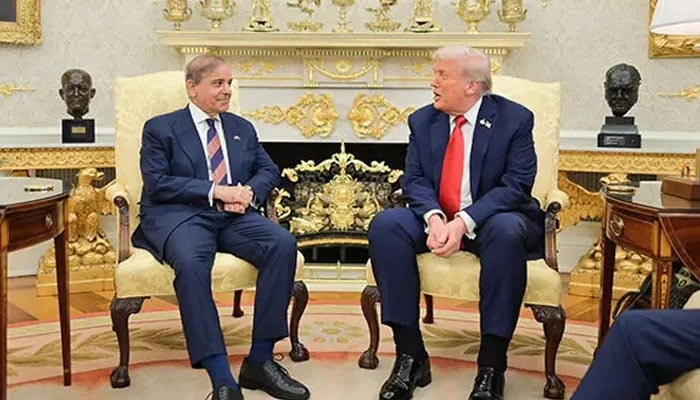
Pakistan’s potential role in future diplomacy took a significant turn after Prime Minister Shehbaz Sharif received an invitation from US President Donald Trump to join a new international initiative focused on Gaza. The proposed Pakistan Gaza Peace Board participation highlights Islamabad’s continued engagement with global peace efforts related to Palestine and the wider Middle East.
According to Pakistan’s Foreign Office, the invitation reflects recognition of Pakistan’s longstanding diplomatic stance on the Palestinian issue. The spokesperson confirmed that Pakistan remains committed to international initiatives aimed at restoring peace and stability in Gaza, in line with United Nations resolutions and international law. The Pakistan Gaza Peace Board involvement, if accepted, would align with Islamabad’s consistent call for dialogue, reconstruction, and a just resolution to the conflict.
Pakistan’s Position on Gaza and Palestine
Pakistan has repeatedly emphasized that any solution to the Gaza crisis must be political, inclusive, and based on the rights of the Palestinian people. Officials have clarified that while Pakistan is open to playing a constructive diplomatic role, it has no intention of deploying troops to Gaza or participating in any military disarmament efforts.
Deputy Prime Minister and Foreign Minister Ishaq Dar previously stated that Pakistan’s civil and military leadership are fully aligned on this position. This clarity reinforces the idea that the Pakistan Gaza Peace Board role would be diplomatic and humanitarian rather than military in nature.
What Is the Board of Peace on Gaza?
The Board of Peace on Gaza is a US-led initiative announced by President Trump as part of his post-war vision for the region. The board aims to address governance, reconstruction, economic development, and regional cooperation in Gaza after years of devastating conflict.
Trump has declared himself the chair of the board and has invited several global leaders to join, including representatives from Egypt, Turkey, Canada, and Argentina. High-profile figures such as US Secretary of State Marco Rubio, former UK Prime Minister Tony Blair, and senior negotiators Jared Kushner and Steve Witkoff have also been named to the panel.
If Pakistan joins, the Pakistan Gaza Peace Board presence would add a strong voice from the Muslim world with a history of advocating for Palestinian rights at international forums.
International Reactions and Participation
Several countries have already responded positively to Trump’s invitation. Argentina’s president publicly welcomed the opportunity, while Canada and Turkey confirmed they were considering or accepting roles as founding members. Egypt, a key regional player, said it was reviewing the request.
The diversity of invited countries suggests that the board is intended to have broad international representation. However, the initiative has also sparked debate, particularly because of controversial figures involved and concerns over how decisions will be made.
For Pakistan, joining the Pakistan Gaza Peace Board would require careful consideration of its principles, objectives, and alignment with Pakistan’s foreign policy.
Funding and Membership Conditions
One aspect of the board that has drawn attention is its proposed funding structure. According to a draft charter, countries seeking extended membership beyond three years may be required to contribute up to $1 billion in cash funds.
While no official statement has been made regarding Pakistan’s financial commitments, analysts note that Islamabad would likely focus on diplomatic engagement rather than large-scale financial contributions. Any decision regarding the Pakistan Gaza Peace Board would involve assessing economic, political, and strategic implications.
Why This Matters for Pakistan
Pakistan’s possible inclusion in the board signals growing international acknowledgment of its diplomatic relevance on Middle Eastern issues. Over the years, Pakistan has maintained strong ties with Muslim countries while also engaging constructively with Western powers.
Participation in the Pakistan Gaza Peace Board could allow Islamabad to advocate for humanitarian relief, reconstruction support, and a two-state solution that ensures long-term peace. It could also strengthen Pakistan’s voice in shaping post-conflict governance discussions for Gaza.
At the same time, Pakistan will likely remain cautious about any initiative that could be perceived as sidelining Palestinian self-determination or deviating from UN-backed frameworks.
A Balanced Diplomatic Path Forward
While the invitation itself is significant, Pakistan has not yet announced a final decision. Diplomats suggest that Islamabad will evaluate the board’s mandate, leadership structure, and policy direction before committing.
The Pakistan Gaza Peace Board opportunity reflects Pakistan’s broader foreign policy approach: engaging diplomatically, supporting peaceful solutions, and avoiding military entanglements. As the situation in Gaza continues to evolve, Pakistan’s response will be closely watched by regional and international observers.
Whether or not Pakistan formally joins, the invitation underscores its enduring relevance in discussions surrounding peace, justice, and stability in one of the world’s most complex and sensitive regions.