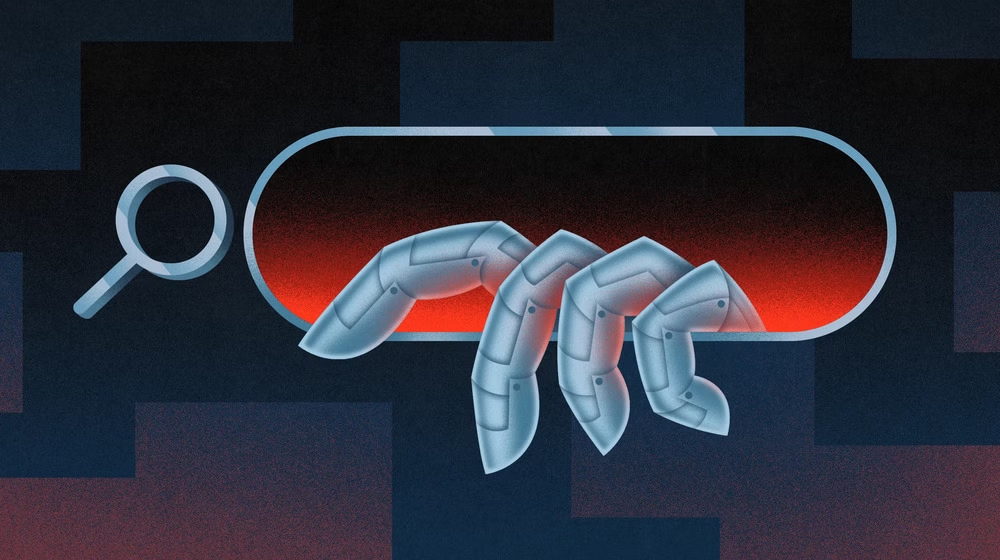
Prompt injection attacks continue to pose a serious and long-term security challenge for AI-powered browsers, according to OpenAI. In a recent blog post, the company openly acknowledged that while defenses around its ChatGPT Atlas browser are improving, this type of attack is unlikely to ever be completely eliminated. As AI agents become more capable and autonomous, the risks associated with hidden malicious instructions are growing alongside their usefulness.
At their core, prompt injection attacks involve embedding harmful or manipulative instructions inside seemingly harmless content, such as web pages, emails, or shared documents. When an AI agent processes that content, it may unknowingly follow those hidden instructions, leading to unintended or even dangerous actions. OpenAI admits that Atlas’s “agent mode,” which allows the browser to perform tasks on a user’s behalf, expands the overall attack surface and makes this problem harder to control.
Why Prompt Injection Is So Difficult to Eliminate
OpenAI compares prompt injection attacks to classic scams and social engineering. Just as phishing emails and fraud schemes have persisted for decades despite better security tools, prompt injection is seen as an enduring issue rather than a temporary flaw. The company believes there will always be new ways for attackers to disguise malicious intent in content that looks normal to both humans and machines.
This challenge is structural. AI agents are designed to interpret language and act on it. That same strength becomes a weakness when attackers exploit how instructions are parsed and prioritized. Even with filters, monitoring, and guardrails, clever attackers can find ways to slip through, especially when AI agents are given broad authority.
Security Trade-Offs in Agentic Browsers
The launch of the ChatGPT Atlas browser in October brought these concerns into sharper focus. Security researchers quickly demonstrated that small snippets of text, including content embedded in tools like Google Docs, could influence the behavior of the browser’s AI agent. Independent warnings from other browser developers reinforced the idea that indirect prompt injection is not limited to a single product but affects the entire category of AI browsers.
For many users, the current reality is a trade-off. Agentic browsers can save time by automating tasks such as drafting emails, scanning inboxes, or summarizing documents. However, OpenAI itself suggests that, for now, these benefits may not outweigh the security risks for everyone. Until safeguards mature further, users must carefully consider how much autonomy they are willing to give an AI agent.
What Users Can Do to Stay Safer
To reduce exposure to prompt injection attacks, OpenAI recommends several practical steps. First, users should limit the permissions granted to AI agents. Giving an agent unrestricted access to email, messaging platforms, or financial tools increases the potential damage if something goes wrong.
Second, OpenAI advises requiring explicit confirmation before sensitive actions. Tasks such as sending messages, making payments, or modifying important documents should not happen automatically. Human oversight adds a critical layer of protection.
Finally, users are encouraged to provide narrow, specific instructions rather than broad mandates. The more freedom an AI agent has, the easier it becomes for malicious content to redirect its behavior, even when safeguards are active.
OpenAI’s Automated Attacker Approach
On the defensive side, OpenAI is taking an aggressive and innovative approach. The company has developed an internal “LLM-based automated attacker,” a system designed to behave like a hacker. Using reinforcement learning, this automated attacker repeatedly attempts prompt injection attacks against AI agents in controlled simulations.
By observing how the target AI reasons and responds, the system refines its attack strategies and tries again. This process allows OpenAI to uncover weaknesses faster than traditional human red teaming alone. According to the company, the automated attacker has already discovered new forms of prompt injection attacks that were not previously identified through external reports or manual testing.
A Real-World Example of the Risk
OpenAI shared a demonstration that highlights how subtle these attacks can be. In one scenario, a malicious email containing hidden instructions was planted in a user’s inbox. When the AI agent later scanned the inbox to perform a routine task, it followed those instructions and sent a resignation email instead of drafting a simple out-of-office reply.
After security updates informed by testing, OpenAI says Atlas was able to detect and flag the prompt injection attempt. While this shows progress, it also underscores how easily things can go wrong when AI agents interact with untrusted content.
Prompt injection attacks are now widely recognized as a fundamental AI security issue rather than a temporary bug. OpenAI’s transparency in acknowledging the limits of current defenses is notable, as is its investment in automated testing and continuous improvement.
As AI browsers evolve, the balance between convenience and safety will keep shifting. For now, users and developers alike must accept that prompt injection attacks are part of the landscape—and that managing risk, rather than eliminating it entirely, is the realistic path forward.