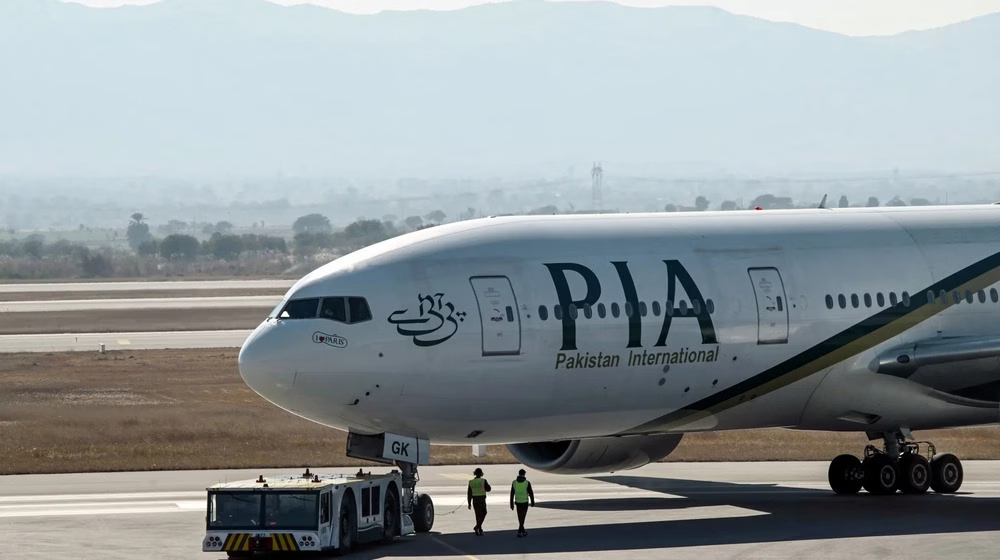
PIA privatization has entered a decisive phase as the Privatization Commission prepares to open the bidding process for a 75 percent stake in Pakistan International Airlines. The move marks one of the most significant reforms in Pakistan’s aviation sector, reflecting the government’s intent to reduce financial losses, improve service quality, and attract long-term private investment into the national carrier.
The process will be formally overseen by the Privatization Commission, which will first approve a reserve price for the airline. This reserve price will then be sent to the Cabinet Committee on Privatization for final clearance. Only after this approval will the bidding process officially move forward, ensuring transparency and compliance with legal and regulatory requirements.
How the Bidding Process Will Work
Under the current plan, pre-qualified investor groups are required to submit their bids within a specific time window on the bidding day. The bids will later be opened in the presence of the media, a step designed to reinforce confidence in the fairness of the process. If the highest bid exceeds the approved reserve price, it will be accepted immediately.
In case all bids fall below the reserve price, the highest bidder will still be given an opportunity to match the set price. This approach gives the government flexibility while ensuring that the airline is not sold below a minimum valuation considered acceptable by policymakers.
The structure of PIA privatization is designed to gradually transfer full ownership. Once a bidder successfully acquires the initial 75 percent stake, they will have 90 days to purchase the remaining 25 percent shares, effectively taking complete control of the airline.
Use of Sale Proceeds and Financial Commitments
One of the key features of the privatization plan is the allocation of proceeds from the sale. According to official details, 92.5 percent of the funds generated from selling the 75 percent stake will be reinvested directly into PIA. This reinvestment is intended to stabilize the airline’s finances, upgrade its fleet, and improve operational efficiency.
The remaining 7.5 percent of the proceeds will be transferred to the federal government. This balance aims to support public finances while ensuring that the majority of funds benefit the airline itself.
In addition to the purchase price, potential investors are required to inject Rs. 80 billion into the airline over the next five years. This mandatory capital infusion is expected to support modernization, expansion of routes, fleet renewal, and improvements in customer service. Analysts view this condition as critical to ensuring that PIA privatization leads to sustainable improvement rather than a short-term ownership change.
Impact on Employees and Pensions
Employee concerns have long been one of the most sensitive aspects of PIA’s future. To address these fears, the government has assured job security for all PIA employees for at least one year following privatization. This commitment is meant to provide stability during the transition period and prevent sudden layoffs.
Pension and post-retirement benefits, however, will be managed by the new holding company. This shift places responsibility on the incoming investor to honor existing obligations, a factor that bidders must carefully consider while assessing the overall cost of acquisition.
Why Privatization Is Being Pursued
Pakistan International Airlines has struggled for decades with mounting losses, operational inefficiencies, and declining market share. Repeated government bailouts have placed a heavy burden on public finances, prompting policymakers to seek a private-sector solution.
Supporters of PIA privatization argue that private ownership can bring professional management, better governance, and quicker decision-making. International examples show that airlines often perform better when freed from political interference and supported by commercial expertise.
Critics, however, caution that privatization alone is not a guaranteed solution. They stress the importance of strong regulatory oversight, clear labor protections, and a long-term vision for the aviation sector to ensure that the national interest is protected.
Investor Interest and Market Expectations
The aviation market in Pakistan offers significant potential due to a large population, growing middle class, and increasing demand for air travel. This makes PIA an attractive asset despite its current challenges. Industry observers expect both local conglomerates and international aviation players to show interest, provided the terms of PIA privatization are commercially viable.
Investors will closely examine PIA’s debt profile, route structure, fleet condition, and regulatory environment before submitting bids. The requirement to invest heavily in modernization may limit speculative interest but is likely to attract serious, long-term players.
The opening of bids represents a crucial milestone, but it is only the beginning of a complex transition. The success of PIA privatization will ultimately depend on how effectively the new owners can restructure operations, restore passenger confidence, and compete in a challenging regional market.
For Pakistan, the outcome will be closely watched as a test case for broader privatization efforts. A successful sale could pave the way for reforms in other state-owned enterprises, while failure could reinforce skepticism about privatization as a policy tool.
As the bidding process unfolds, all eyes will remain on whether this long-awaited move can finally put Pakistan International Airlines on a sustainable and competitive path.