The May 9 riots verdict has marked another major turning point in Pakistan’s political and legal landscape, as an anti-terrorism court (ATC) handed down prison sentences to several senior Pakistan Tehreek-e-Insaf (PTI) leaders. The decision adds to the growing list of convictions linked to the violent unrest that erupted following the arrest of PTI founder and former prime minister Imran Khan in May 2023.
ATC Announces Verdict Inside Kot Lakhpat Jail
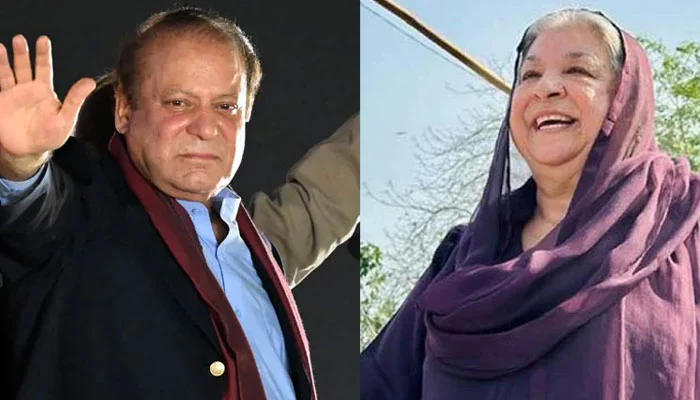
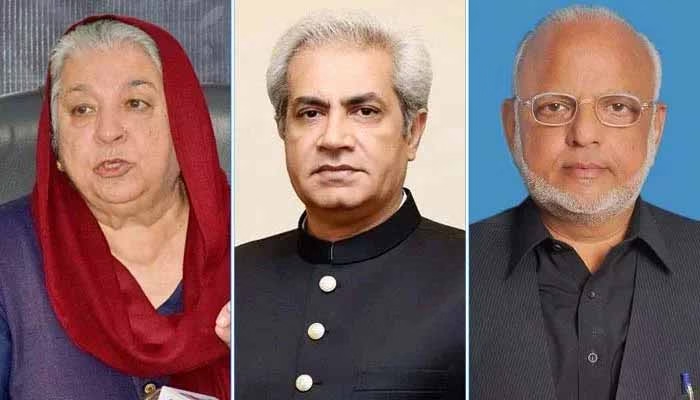
On Friday, ATC Judge Manzar Ali Gul announced the May 9 riots verdict inside Kot Lakhpat Jail, sentencing Dr Yasmin Rashid, Omer Sarfraz Cheema, Mian Mehmoodur Rashid, Ejaz Chaudhry, and three other accused to 10 years of imprisonment each. The ruling came after months of trial proceedings and the recording of final statements from 21 accused individuals.
In contrast, the court acquitted senior PTI leader and former foreign minister Shah Mahmood Qureshi, along with 13 others, citing insufficient evidence to establish their involvement in the specific case under trial.
Case Details and Prosecution Arguments
The case was registered by Lahore’s Race Course Police Station and centered on the attack on the GOR-1 gate during the May 9 violence. According to the first information report (FIR), the accused were involved in damaging government property, including smashing security cameras, breaking glass panels, destroying police wireless equipment, and assaulting law enforcement personnel.
The prosecution argued that the attack was carried out by a mob allegedly led by PTI leader Hammad Azhar. During the trial, the prosecution presented testimony from 56 witnesses to support its claims. The court also noted that four accused were declared proclaimed offenders after failing to appear despite repeated summons.
Allegations Against PTI Leadership
Prosecutors maintained that PTI leaders played a direct role in inciting party workers, encouraging rebellion, and fueling violence during the unrest. The May 9 riots verdict reflects the court’s acceptance of these arguments in this particular case, holding several senior figures responsible for their alleged role in mobilizing supporters who targeted sensitive installations.
This case is the fifth to result in convictions for Dr Yasmin Rashid, Omer Sarfraz Cheema, Mian Mehmoodur Rashid, and Ejaz Chaudhry, highlighting the scale of legal challenges facing the party’s leadership.
Acquittal of Shah Mahmood Qureshi
The acquittal of Shah Mahmood Qureshi stood out as a significant development. As one of PTI’s most prominent leaders and a former foreign minister, his clearance in this case may offer some relief to the party. However, analysts note that the acquittal does not necessarily end his legal troubles, as multiple cases related to the May 9 events are still pending against various party figures.
Political Fallout and Disqualifications
The May 9 riots verdict is part of a broader pattern of convictions that have reshaped Pakistan’s political landscape. Last month, the Election Commission of Pakistan (ECP) de-notified several PTI lawmakers, including opposition leaders in the Senate and National Assembly, following their convictions in related cases.
These disqualifications came shortly after a special ATC in Faisalabad sentenced multiple PTI leaders, including Omar Ayub, Shibli Faraz, and Zartaj Gul, to 10 years in prison over a separate case linked to the May 9 violence.
What Happened on May 9?
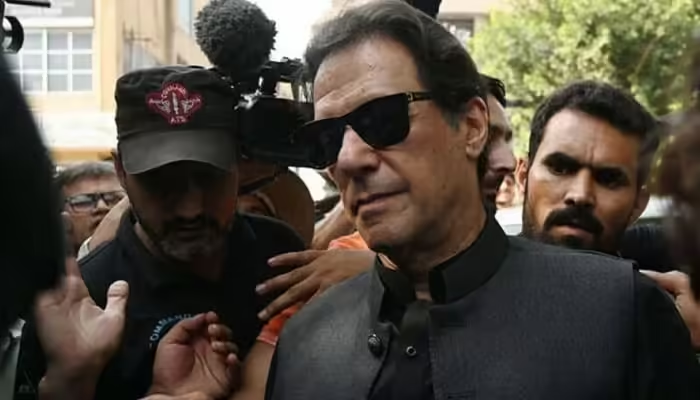
The May 9 riots erupted after Imran Khan was arrested from the premises of the Islamabad High Court in a graft case. Thousands of PTI supporters took to the streets, storming public buildings and military installations across the country.
High-profile targets included the Corps Commander House in Lahore and the General Headquarters (GHQ) in Rawalpindi. The unrest marked one of the most serious episodes of civil disturbance in recent years, prompting the state to launch widespread arrests and prosecutions.
Impact on PTI’s Future
The May 9 riots verdict further compounds the legal and political challenges facing PTI. With scores of leaders sentenced to prison and others awaiting trial, the party’s organizational strength and parliamentary presence have been significantly weakened.
Former prime minister Imran Khan remains behind bars in multiple cases, while many party workers and mid-level leaders continue to face legal proceedings. Supporters argue that the cases are politically motivated, while the government maintains that accountability is necessary to uphold the rule of law.
The sentencing of senior PTI leaders under the May 9 riots verdict underscores the judiciary’s firm stance on violence against state institutions. As more cases reach their conclusion, the long-term implications for Pakistan’s political stability and PTI’s role in national politics are becoming increasingly clear. Whether these developments lead to political reconciliation or deeper polarization remains to be seen.