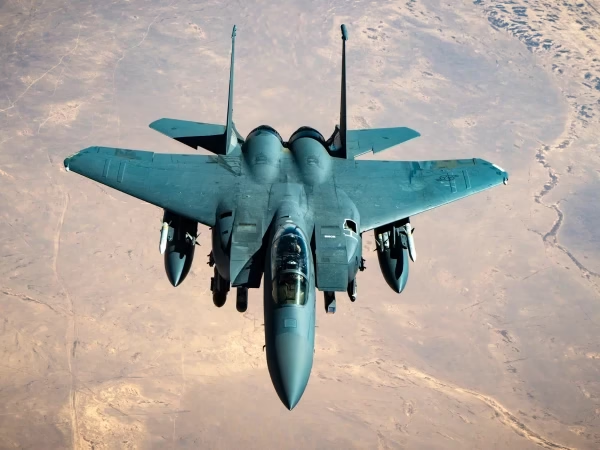
The United States has launched a new wave of US airstrikes in Syria, targeting ISIS positions in central parts of the country following a deadly attack on American personnel. The operation marks one of the most forceful responses in recent months and signals Washington’s renewed determination to dismantle ISIS infrastructure and deter future attacks on US forces deployed in the region.
Background to the Operation
The latest US airstrikes in Syria were carried out after a lone attacker targeted American troops stationed in the country last week. The assault resulted in the deaths of two US soldiers and an American civilian translator, while several others were wounded. The incident triggered outrage in Washington and prompted President Donald Trump to pledge a decisive and uncompromising response.
According to US media reports, fighter jets and military helicopters struck multiple ISIS targets, including weapons depots, command centers, and logistical facilities. The strikes were concentrated in central Syria, an area that has long been used by ISIS remnants to regroup and plan attacks despite the group’s territorial defeat in previous years.
Operation Hawkeye Strike Explained
US Secretary of Defense Pat Hegseth confirmed that the offensive, named Operation Hawkeye Strike, was designed to cripple ISIS’s operational capabilities. He stated that the primary objective was to destroy the group’s infrastructure, eliminate weapons stockpiles, and disrupt its ability to carry out further attacks against US forces and allied partners.
Pentagon officials emphasized that the strikes were based on precise intelligence and aimed at minimizing civilian casualties. According to military sources, several high-value ISIS targets were successfully neutralized during the initial phase of the operation.
President Trump’s Response
Following the airstrikes, President Trump addressed the nation through a statement on his social media platform, Truth Social. He said that heavy and sustained attacks on ISIS positions were ongoing and warned that any group targeting American personnel would face consequences “far harsher than before.”
President Trump also noted that the Syrian government was fully cooperating with US operations against ISIS. This coordination is seen as a significant development, reflecting shared concerns over the resurgence of extremist activity in certain parts of Syria.
Syrian Government’s Position
Syrian authorities have publicly stated that they will continue military operations against ISIS alongside international efforts. While political relations between Washington and Damascus remain complex, both sides appear aligned in their objective to prevent ISIS from regaining strength.
Analysts believe that this coordination could lead to more sustained pressure on ISIS cells operating in remote desert regions, where the group has managed to survive through hit-and-run tactics and surprise attacks.
Why ISIS Remains a Threat
Despite losing its self-declared caliphate, ISIS continues to pose a security challenge in Syria and the wider region. Small, decentralized cells still operate in rural and desert areas, targeting military personnel, infrastructure, and local communities.
The recent attack on US troops underscores the persistent threat posed by these remnants. Security experts say that US airstrikes in Syria are intended not only as retaliation but also as a deterrent, sending a clear message that attacks on American forces will not go unanswered.
Regional and Global Implications
The escalation has drawn international attention, with allies closely monitoring the situation. While many Western nations support continued action against ISIS, there are concerns about the potential for broader regional instability if violence intensifies.
At the same time, the US has reiterated that its presence in Syria is focused on counterterrorism and regional stability, not territorial control. Officials stress that the goal of US airstrikes in Syria is to prevent ISIS from exploiting security gaps and threatening both local populations and international interests.
What Comes Next?
Military experts suggest that Operation Hawkeye Strike may continue in phases, depending on intelligence assessments and ISIS activity on the ground. Increased surveillance, targeted raids, and further airstrikes are all possibilities if the threat level remains high.
For now, the US has made it clear that protecting its troops and dismantling extremist networks remains a top priority. The recent operation demonstrates Washington’s willingness to act swiftly and forcefully when its forces are attacked.
The latest US airstrikes in Syria represent a strong response to a deadly attack and a renewed push to weaken ISIS’s remaining capabilities. As the situation develops, the effectiveness of these strikes will depend on sustained pressure, regional cooperation, and continued intelligence-driven operations. While ISIS no longer controls vast territory, events like these show that the fight against extremism in Syria is far from over.