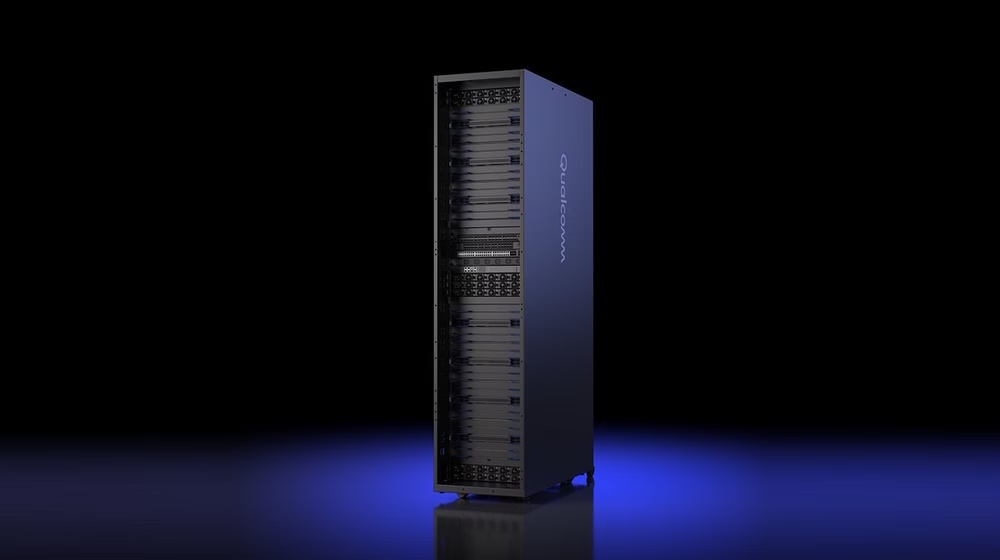
Qualcomm has officially entered the artificial intelligence data center market with the launch of its Qualcomm AI200 and AI250 accelerators, positioning itself as a strong new competitor to industry giants like Nvidia and AMD. This bold move marks a major shift for the company, which has traditionally dominated the mobile and wireless chip segments. With the introduction of these new AI accelerators, Qualcomm aims to bring energy efficiency and scalability to large-scale AI computing environments.
The Qualcomm AI200 and AI250 accelerators were announced as part of the company’s strategic expansion into high-performance computing. According to CNBC, these chips are designed to power data centers supporting artificial intelligence workloads — from model training to real-time inference.
A Strategic Shift from Mobile to Data Center Technology
Qualcomm’s move into AI infrastructure represents a significant transformation for a company best known for its Snapdragon mobile processors. By leveraging its experience with Hexagon neural processing units (NPUs) — the same technology that powers AI tasks on smartphones — Qualcomm aims to scale its innovations to the data center level.
Durga Malladi, Qualcomm’s general manager for data center and edge technologies, explained that the company’s journey into the server-grade AI market was deliberate and calculated. We first wanted to prove ourselves in other domains, and once we built our strength over there, it was pretty easy for us to go up a notch into the data center level, he said.
This evolution underscores Qualcomm’s long-term vision: using its proven mobile AI architecture as a foundation for tackling high-performance, energy-efficient AI computing challenges at scale.
The Power Behind Qualcomm’s New AI Chips
The Qualcomm AI200 and AI250 accelerators are expected to set new benchmarks in efficiency and performance. The AI200 is slated for release in 2026, while the AI250 will follow in 2027. Both chips will be available in full liquid-cooled server rack systems, each capable of hosting up to 72 accelerators working in unison.
This rack-based design mirrors the setup of Nvidia and AMD’s top-tier GPU systems, providing scalability for massive AI workloads such as generative AI model training and large-scale data analysis. However, Qualcomm’s key differentiator lies in power efficiency — an increasingly important factor as AI models become larger and more energy-intensive.
The company claims its new chips will offer high memory capacity and lower power consumption, making them ideal for AI labs and enterprises seeking greener, more cost-effective computing solutions.
Competing in a Crowded AI Market
The launch of the Qualcomm AI200 and AI250 accelerators places the company in direct competition with Nvidia’s H100 and AMD’s MI300 accelerators, both of which dominate the AI data center market. Nvidia currently leads the global market for AI chips, holding a massive share due to its powerful GPUs that fuel leading AI models like ChatGPT and Gemini.
However, with Qualcomm’s entry, the competition is poised to intensify. The company’s focus on energy efficiency and thermal management could attract data centers looking to reduce operational costs without compromising on performance. Liquid cooling, a key feature in Qualcomm’s new racks, enables higher processing density and better system stability — vital for the growing demands of AI computation.
A Natural Progression from Edge to Cloud
Qualcomm’s strength has long been in edge computing — enabling AI tasks to be performed directly on devices like smartphones, vehicles, and IoT systems. The introduction of the AI200 and AI250 accelerators extends that edge expertise into the cloud, offering seamless integration between edge devices and central data centers.
By utilizing the Hexagon NPU design, Qualcomm ensures that its AI chips can handle diverse workloads efficiently. This continuity allows developers to build and deploy AI applications that scale smoothly from handheld devices to cloud environments.
This unified approach could become a game-changer, especially for industries relying on distributed AI systems, such as autonomous vehicles, smart cities, and next-generation robotics.
Efficiency as the Core Advantage
Energy efficiency has become a critical metric in the AI industry. As global data centers consume increasing amounts of power, the need for sustainable AI hardware is more pressing than ever. Qualcomm’s design philosophy for the AI200 and AI250 accelerators focuses on minimizing energy waste while maintaining high computational throughput.
The company’s long history of optimizing chips for low-power mobile devices gives it a unique advantage. By applying those same principles to large-scale AI hardware, Qualcomm could redefine efficiency standards for the data center sector.
Qualcomm’s Role in the Future of AI Infrastructure
The Qualcomm AI200 and AI250 accelerators represent more than just new products — they signify Qualcomm’s broader ambition to influence the future of AI infrastructure. By entering the data center chip race, the company is diversifying its portfolio and establishing itself as a key player in one of the world’s fastest-growing technology markets.
As the demand for generative AI, machine learning, and big data analysis continues to soar, the competition among semiconductor companies is expected to intensify. Qualcomm’s approach — combining efficiency, scalability, and mobile-derived innovation — positions it well to capture a significant share of this evolving landscape.
Qualcomm’s transition from mobile chipmaker to AI powerhouse could reshape industry dynamics and provide data centers with a much-needed alternative to existing GPU-based systems.
The Qualcomm AI200 and AI250 accelerators are more than just technological advancements — they represent Qualcomm’s commitment to redefining performance, efficiency, and sustainability in the AI era. As their launch approaches, the tech world will be watching closely to see whether these accelerators can truly challenge Nvidia and AMD’s dominance and usher in a new age of intelligent computing.