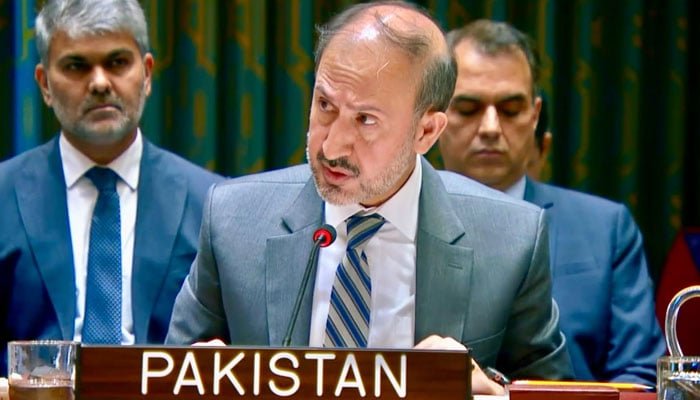
Pakistan has urged the United Nations Security Council to establish strict international rules to prevent artificial intelligence from accelerating a destabilising arms race. Raising concerns over Pakistan AI Nuclear Control at a high-level UN meeting, Pakistani Ambassador Syed Haider Shah stressed that decisions regarding the use of nuclear weapons must remain exclusively under human authority.
Speaking during a debate on emerging technologies and conflict resolution, the country’s permanent representative to the UN called for military restraint, confidence-building measures and stronger international regulations. He warned that the growing use of AI in military operations could increase the risk of miscalculation and leave governments with less time to make critical decisions during international crises.
Pakistan also called for an absolute prohibition on using artificial intelligence capabilities to target nuclear command, control and communications systems.
Pakistan Warns Against AI-Driven Arms Race
Addressing the 15-member Security Council under Latvia’s presidency, Ambassador Haider Shah said the rapid development of emerging technologies must not intensify existing military competition.
He emphasised that international efforts were needed to ensure technological progress did not undermine global peace and security.
According to the Pakistani envoy, military applications of AI require appropriate safeguards, particularly when decisions involve national security and the potential use of nuclear weapons.
He called for military restraint and confidence-building arrangements to reduce the possibility of miscalculation between countries.
The ambassador also highlighted the dangers of compressed decision-making timelines. When AI systems become involved in military operations, the time available for human officials to assess information and respond to a developing crisis could become significantly shorter.
Such circumstances could increase the possibility of unintended escalation, particularly during periods of heightened international tension.
Nuclear Launch Decisions Must Remain Under Human Control
A central part of Pakistan’s position was that artificial intelligence must never replace human judgment in decisions involving nuclear weapons.
Ambassador Haider Shah said the authority to decide whether nuclear weapons should be used must remain with human beings alone.
He also called for a complete ban on deploying AI capabilities to target nuclear command, control and communications systems, commonly known as NC3.
These systems are essential to the management and communication of nuclear forces. Any disruption or attack affecting them could create serious risks during a military crisis.
Pakistan believes that protecting these systems is particularly important as countries increasingly integrate advanced technologies into their defence structures.
The Pakistan AI Nuclear Control position reflects concerns that automated military processes could create dangerous situations if human decision-makers lose sufficient time or control over critical operations.
The Pakistani envoy argued that international safeguards should address both the development and deployment of emerging technologies and their wider consequences for global security.
Pakistan Calls for Inclusive UN Regulations
Haider Shah said discussions about emerging technologies should take place through representative and inclusive international forums under the United Nations.
He stressed that all relevant issues surrounding technological development, military applications and broader security implications should be considered comprehensively.
Pakistan’s position supports a multilateral approach in which countries have an opportunity to participate in shaping international rules.
This approach is particularly significant because the development of advanced AI capabilities is concentrated in a relatively small number of countries and private companies.
Without internationally accepted safeguards, differences in military capabilities and regulatory standards could create additional security challenges.
Pakistan therefore called for global frameworks that can address the risks associated with AI while ensuring that technological developments do not weaken international stability.
UN Secretary-General Warns About AI on Battlefields
United Nations Secretary-General Antonio Guterres also raised serious concerns about the growing use of artificial intelligence in armed conflicts.
At the beginning of the meeting, he warned that modern wars were increasingly becoming testing grounds for AI-enabled targeting technologies.
According to Guterres, algorithms are now influencing several stages of military operations, including intelligence gathering and target selection.
He stressed that the fundamental principle of human control over the use of force must not be weakened by technological developments.
The UN chief said that when civilians are killed or human rights are violated, responsibility cannot simply be shifted to an algorithm.
He also reiterated that autonomous weapons capable of independently selecting and attacking targets should have no place in the future.
Guterres called for urgent negotiations on a legally binding international instrument governing lethal autonomous weapons systems.
Guterres Calls for Confidence-Building Measures
Beyond battlefield applications, the secretary-general warned that artificial intelligence was accelerating the spread of misinformation and contributing to an uncontrolled technological race driven by commercial interests and geopolitical competition.
He also highlighted concerns surrounding the resources required to support AI development.
The growing demand for critical minerals, along with the substantial energy and water consumption of AI data centres, is creating additional pressure on communities and countries.
Guterres said the Security Council had a special responsibility to ensure that competition over emerging technologies did not threaten international peace and security.
He further argued that countries with the greatest AI capabilities carried the greatest responsibility for managing associated risks.
The UN chief called for immediate confidence-building measures, including direct communication channels between countries to prevent misunderstandings from developing into major international crises.
Growing Need for International AI Safeguards
The discussions at the Security Council highlighted increasing international concern over the military implications of artificial intelligence.
Both Pakistan and the UN secretary-general emphasised that technological progress must not remove human responsibility from decisions involving the use of force.
The Pakistan AI Nuclear Control proposal places particular importance on keeping nuclear launch authority under human control and protecting critical command systems from AI-enabled targeting.
As military applications of artificial intelligence continue to develop, the challenge for the international community will be to establish effective rules before technological competition creates new threats to global security.
The debate has reinforced calls for international cooperation, military restraint and legally binding safeguards to ensure that humans, rather than autonomous systems, remain responsible for decisions involving life and death.