
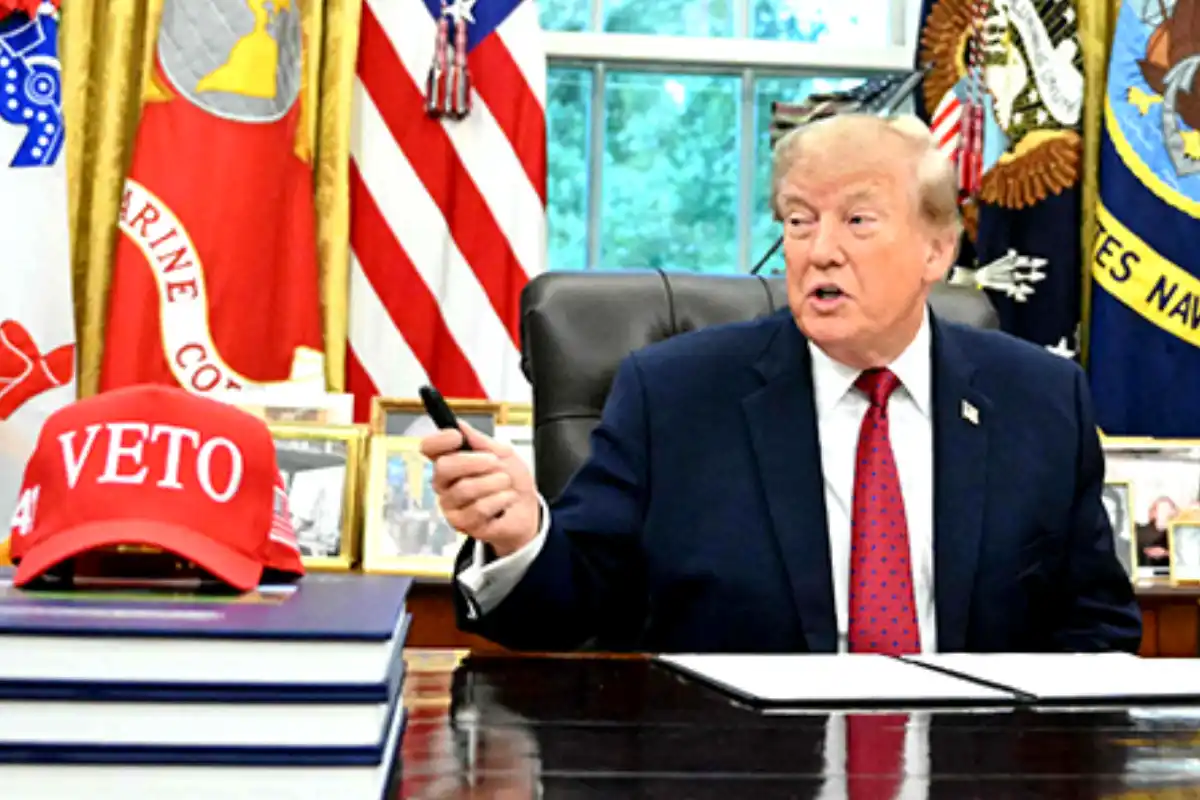
US President Donald Trump has displayed a red cap bearing the word “VETO” on his desk in the Oval Office following his Republican Party’s defeat in the US midterm elections. The Trump VETO cap has attracted attention because it highlights the president’s intention to use his constitutional authority to block legislation, even as Democrats gain control of Congress.
According to US media reports, displaying the cap was among Trump’s first activities in the Oval Office after the election results. The message appeared to reinforce his earlier comments that losing the congressional majority would not prevent him from exercising presidential powers.
During the same meeting, Trump signed an executive order declaring the Cabinet Room a national monument. The red cap was also prominently placed on his desk, making it a noticeable feature of the Oval Office setting.
Trump Emphasises His Presidential Veto Power
Trump had previously indicated that a Democratic majority in Congress would not remove his ability to reject legislation. His latest display of the Trump VETO cap appears to underline that position.
The president’s message comes at a politically significant moment, as the Republican Party faces the consequences of its midterm election defeat. With Democrats holding a majority in Congress, the legislative relationship between the White House and lawmakers could become more challenging.
Control of Congress plays an important role in determining which bills advance, how government spending is approved and which legislative priorities receive attention.
A change in the balance of power can therefore affect a president’s ability to implement policies through legislation. However, the president retains several constitutional powers, including the authority to approve or reject bills passed by Congress.
Trump’s reference to his veto authority suggests that he intends to remain an influential part of the legislative process despite the change in congressional control.
What Does the Presidential Veto Mean?
Under the US Constitution, the president has the power to veto legislation passed by Congress. A veto allows the president to reject a bill and return it to the chamber where it originated, usually accompanied by an explanation of the objections.
This authority is an important part of the system of checks and balances established by the US Constitution.
Congress, however, is not completely powerless when a president rejects a bill. Lawmakers can attempt to override a presidential veto if they secure a two-thirds majority in both the House of Representatives and the Senate.
This means that while the president can prevent a bill from becoming law through an ordinary approval process, Congress retains a constitutional mechanism to challenge that decision.
The veto power can become particularly important when the White House and Congress are controlled by opposing political parties.
How Democratic Control Could Affect Trump’s Presidency
A change in congressional control can create additional obstacles for a president seeking to advance legislative priorities.
When the president’s party controls both chambers, passing legislation can generally be more straightforward, although disagreements within the ruling party can still create difficulties.
However, when the opposition controls Congress, negotiations become more important. Lawmakers may introduce legislation that differs from the president’s priorities, investigate government policies and challenge proposed spending arrangements.
For Trump, the Republican defeat could therefore lead to a more complicated relationship with Congress.
The Trump VETO cap carries particular significance in this environment because it draws attention to one of the president’s most direct constitutional tools for responding to legislation he opposes.
Rather than simply accepting bills passed by a Democratic-controlled Congress, Trump can use his veto authority to demand changes or prevent legislation from taking effect.
Nevertheless, exercising this power does not guarantee that the president will always prevail. Congress can attempt to override a veto if sufficient support exists in both chambers.
A Political Message from the Oval Office
The Oval Office has long been an important setting for presidential announcements, meetings and symbolic displays. Objects placed on the president’s desk can also attract public attention, particularly during politically sensitive periods.
The Trump VETO cap appears to serve as a visible reminder of the authority available to the president following his party’s electoral setback.
Its appearance also reflects the political tensions that can emerge when the White House and Congress have different priorities.
While the cap itself does not change the balance of power in Washington, its message is connected to the constitutional relationship between the executive and legislative branches.
The Republican Party’s midterm defeat could reshape the legislative environment for the remainder of Trump’s presidency. Democratic control of Congress may influence debates over government policy, spending and future legislation.
At the same time, Trump’s constitutional veto authority remains available whenever a bill reaches his desk.
The Trump VETO cap has therefore become a symbolic representation of the president’s position after the election setback. Whether this authority becomes a central feature of future political confrontations will depend on the legislation introduced by Congress and the negotiations between lawmakers and the White House.
The US political system gives both the president and Congress tools to influence the lawmaking process, meaning cooperation and constitutional checks will remain important in the months ahead.