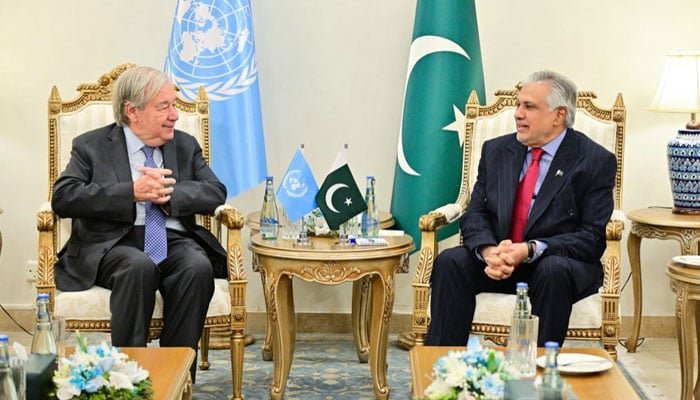
United Nations Secretary-General Antonio Guterres has praised Pakistan mediation efforts between the United States and Iran, describing Islamabad as a trusted intermediary whose credibility with countries on opposing sides helped create conditions for dialogue and de-escalation. Speaking in Islamabad alongside Deputy Prime Minister and Foreign Minister Ishaq Dar, Guterres said Pakistan’s diplomatic efforts contributed to the Islamabad Memorandum of Understanding, the subsequent ceasefire and a framework for future negotiations.
Guterres Praises Pakistan’s Diplomatic Role
Guterres said the ability of countries to maintain trust with opposing parties was particularly important during international conflicts. He described Pakistan’s initiative in relation to the US-Iran conflict as remarkable and said Islamabad had demonstrated the value of mediation at a time of deep international divisions.
The UN chief’s comments came during his visit to Pakistan, where he held discussions with senior officials on regional peace, security and wider international issues.
Pakistan’s role in the US-Iran dialogue has already produced several diplomatic developments. The Islamabad MoU was signed in June, followed by high-level discussions involving the United States, Iran, Pakistan and Qatar. Official records show that Pakistan continued to facilitate the process as a mediator.
Islamabad MoU Created Framework for Talks
Ishaq Dar said Pakistan’s efforts helped bring Washington and Tehran into direct dialogue after decades of limited engagement. He described Islamabad’s contribution as a diplomatic effort based on sovereign equality, territorial integrity, non-interference, self-determination and the peaceful settlement of disputes.
The Pakistan mediation initiative resulted in the Islamabad Memorandum of Understanding, which was presented as a framework for further negotiations. Technical-level talks later took place with Pakistan and Qatar participating as mediators.
The talks also established mechanisms for political oversight and working groups dealing with issues including nuclear matters, sanctions, monitoring and dispute resolution.
UN Chief Calls for Return to Diplomacy
While praising Pakistan, Guterres also urged all parties involved in the regional conflict to end hostilities and return to diplomatic engagement.
He called for the restoration of navigational rights and freedoms in accordance with international law. His comments reflected broader UN concerns about the consequences of regional conflicts for civilians, trade and international stability.
Guterres also warned that international attention on the conflicts in Ukraine and the Gulf should not overshadow the situation in Palestine.
He described the scale of death and destruction in Gaza as unprecedented during his tenure as secretary-general and called for an end to Palestinian suffering and implementation of the peace plan. He also expressed concern about developments in the West Bank, saying they could undermine prospects for a two-state solution.
Pakistan Raises Palestine and Kashmir
During the discussions, Dar reiterated Pakistan’s position on Palestine and Jammu and Kashmir.
He said Pakistan had consistently supported diplomatic efforts aimed at peace in Gaza and recalled its participation with seven other Arab and Muslim countries in engagement with US President Donald Trump.
Dar also raised Pakistan’s concerns over Jammu and Kashmir and welcomed continued references to the UN framework and Security Council resolutions concerning the dispute.
He argued that international resolutions relating to both Kashmir and Palestine should be implemented.
The deputy prime minister also criticised India’s decision to place the Indus Waters Treaty in abeyance, describing it as contrary to international law and calling for an end to what he termed the “weaponising” of water.
Afghan Refugees and Security Concerns
Afghanistan was another major issue during the discussions. Guterres highlighted Pakistan’s longstanding humanitarian role in hosting Afghan refugees, noting that millions of Afghans had received protection in Pakistan over several decades.
He said the UN would cooperate with Pakistan to uphold protection principles and ensure that any return of Afghan refugees was voluntary, safe and dignified.
Dar, meanwhile, raised Pakistan’s security concerns regarding the alleged use of Afghan territory for terrorist attacks against Pakistan.
Guterres acknowledged Pakistan’s long struggle with terrorism and said legitimate security concerns needed to be addressed while ensuring that security measures remained consistent with international law, human rights and the rule of law.
UN Reform and Pakistan’s Peacekeeping Role
The discussions also covered reforms to the international system, particularly the UN Security Council and global financial institutions.
Guterres argued that the Security Council does not adequately reflect the world’s current political and geographic realities. He pointed to Africa’s lack of permanent representation and called for reforms that would improve the body’s legitimacy and effectiveness.
He also praised Pakistan’s contribution to UN peacekeeping. More than 180 Pakistani peacekeepers have lost their lives while serving in international missions, according to Guterres.
He highlighted Pakistan and Denmark’s leadership on Security Council Resolution 2823, which strengthens accountability for crimes against UN peacekeepers. The resolution was unanimously adopted in June, with 153 member states co-sponsoring it.
Climate Change Remains a Major Concern
Guterres also discussed climate change and Pakistan’s vulnerability to its effects. Referring to his visit to Pakistan during the devastating 2022 floods, he said the country remained on the front lines of climate change despite contributing only a small share of global emissions.
He called for greater financial and technological support for vulnerable developing countries and urged major emitters to accelerate emissions reductions during the current decade.
The UN secretary-general’s visit therefore covered a wide range of issues, from regional conflicts and Pakistan mediation to refugees, terrorism, climate change and international institutional reform.
For Islamabad, Guterres’ remarks provide international recognition of its diplomatic engagement with Washington and Tehran. The challenge now will be maintaining dialogue and helping create conditions for continued negotiations while addressing the wider regional crises discussed during the visit.