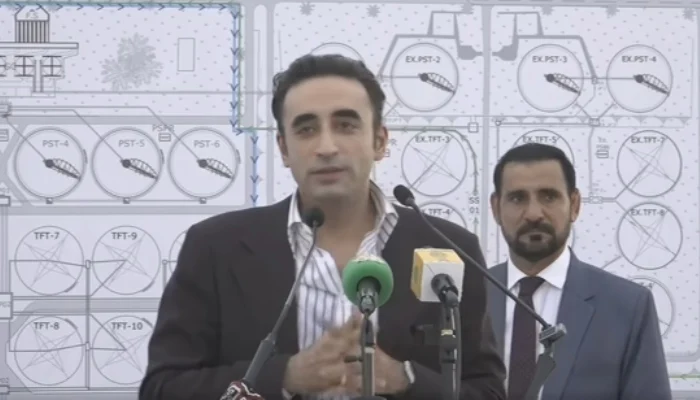
Pakistan Peoples Party (PPP) Chairman Bilawal Bhutto Zardari has called for a formal written agreement between the federal and provincial governments to strengthen cooperation against terrorism. Speaking at the inauguration of Treatment Plant-I in Karachi, Bilawal stressed that the worsening security situation requires coordinated action rather than political divisions.
The PPP chairman said terrorism should be treated as a national issue, with the Centre and provinces working together to develop a unified strategy. He also urged political parties to keep their political differences separate from the fight against terrorism, warning that growing insecurity could eventually affect more than one province.
Call for Centre-Province Cooperation
Bilawal Bhutto Zardari proposed a written pact between the federal and provincial governments to establish clearer responsibilities in counterterrorism efforts. He argued that cooperation between different levels of government is essential at a time when security challenges are increasing.
According to Bilawal, political disagreements should not prevent governments from working together on matters directly linked to public safety. He particularly highlighted the situation in Khyber Pakhtunkhwa (KP), where militant attacks have remained a major concern.
The PPP leader criticised the KP government for what he described as insufficient attention to terrorism. He said the provincial administration needs to cooperate with the federal government to address the security situation effectively.
Bilawal Warns Against Political Division
Bilawal Bhutto Zardari also warned that failure to cooperate could create a situation in which constitutional measures might be considered. He referred to possibilities including Governor’s Rule or an emergency in Khyber Pakhtunkhwa.
However, he emphasised that such measures should not be the first option. The PPP chairman said political engagement and cooperation should be pursued before moving toward extraordinary constitutional steps.
His comments come amid broader political tensions between the federal government and opposition parties, particularly Pakistan Tehreek-e-Insaf (PTI). Bilawal argued that political stability could help strengthen democratic institutions while allowing the government to focus more effectively on security challenges.
Focus on a Political Solution
Bilawal Bhutto Zardari also addressed PTI’s planned long march towards Islamabad. The protest, initially scheduled for September 27, was postponed to October 4. PTI has linked the protest to demands including the release of its founder Imran Khan and what the party describes as the restoration of constitutional supremacy.
Bilawal said political parties have the right to protest, but he urged them to recognise the importance of ongoing negotiations. He maintained that dialogue should be used to resolve political disputes rather than allowing tensions to further disrupt the country.
The PPP chairman said his party had supported efforts to facilitate talks between the government and PTI. He argued that a political solution could help reduce tensions and create a more stable environment for addressing other national challenges.
Concerns Over Islamabad Disruptions
Discussing the political situation, Bilawal Bhutto Zardari referred to disruptions in Islamabad linked to the PTI protest movement. He said the capital had remained effectively shut for an extended period and urged political workers to consider bringing the protest campaign to an end.
According to Bilawal, political parties should acknowledge their ability to raise their concerns while also considering the broader impact of prolonged political confrontation on the country.
He connected political stability with the government’s ability to respond to terrorism. In his view, continued political conflict could make it more difficult for institutions to coordinate effectively on national security matters.
A Broader Counterterrorism Strategy
The proposal by Bilawal Bhutto Zardari comes as Pakistan continues to face security challenges in different parts of the country. A formal agreement between the Centre and provinces could potentially provide a framework for cooperation, information sharing and coordinated responses.
Bilawal also alleged that India was behind terrorist activities originating from Afghanistan, linking the regional security environment with Pakistan’s internal terrorism concerns. Such claims remain part of the wider political and security debate between Pakistan and India.
For Bilawal Bhutto Zardari, the central message is that terrorism should not become another source of political division. He has called for governments and political parties to focus on cooperation, dialogue and institutional coordination.
As political tensions continue alongside security concerns, the debate over how Pakistan should coordinate its counterterrorism response is likely to remain important. The PPP chairman’s proposal for a written Centre-province agreement reflects his call for a more coordinated approach, while his emphasis on political dialogue highlights the connection he sees between political stability and national security.