
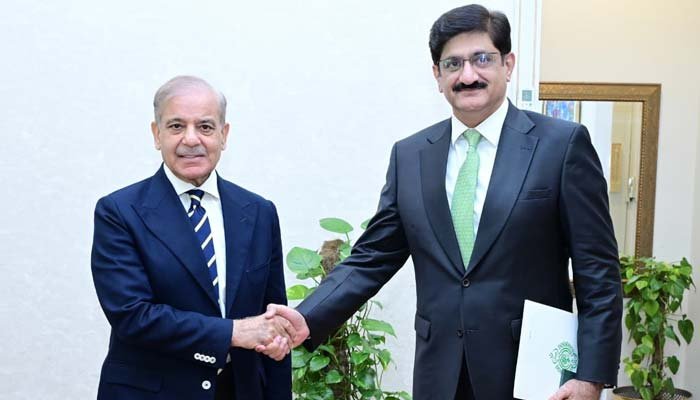
Prime Minister Shehbaz Sharif and Sindh Chief Minister Murad Ali Shah held a key meeting on Monday, with Shehbaz Sharif and Murad Ali Shah agreeing to maintain political harmony and consultation on matters of national importance. The meeting comes at a time when relations between the Pakistan Peoples Party (PPP) and Pakistan Muslim League-Nawaz (PML-N) have faced growing pressure over political and electoral issues.
Focus on Political Cooperation
According to a statement issued by the Prime Minister’s Office, the meeting covered a range of issues, including national politics, affairs related to Sindh, development projects and other matters of mutual interest.
The agreement between Shehbaz Sharif and Murad Ali Shah to continue consultation is particularly significant because the PPP remains an important political partner of the federal government. Maintaining cooperation between the two sides is considered important for the government’s ability to pursue legislation, development programmes and economic policies.
The meeting also provided an opportunity to discuss Sindh’s development priorities and ongoing projects. As chief minister, Murad Ali Shah has frequently emphasized the need for greater coordination between the provincial and federal governments to address infrastructure, economic and administrative challenges.
Senior Ministers Attend Meeting
Several senior federal officials participated in the meeting, reflecting the importance attached to discussions between the two leaders.
Finance Minister Muhammad Aurangzeb, Prime Minister’s Adviser on Political Affairs Rana Sanaullah, Information Technology Minister Shaza Fatima Khawaja, Law Minister Azam Nazeer Tarar, Economic Affairs Minister Ahad Khan Cheema and Petroleum Minister Ali Pervaiz Malik were among those present.
Their participation suggests that the discussions were not limited to political relations but also covered economic, legal, development and energy-related matters.
For Shehbaz Sharif and Murad Ali Shah, coordination on these areas could be particularly important as the federal and provincial governments work on projects affecting Sindh’s economy and public services.
PPP-PML-N Tensions
The meeting took place against the backdrop of increasing tensions between the PPP and PML-N. One of the most significant disagreements concerns the recent Azad Jammu and Kashmir (AJK) elections.
The PML-N emerged as the winner of the polls, but the PPP has raised allegations of irregularities and rigging. The party has demanded that its concerns be addressed before it resumes full political support for the PML-N-led federal government.
PPP Chairman Bilawal Bhutto-Zardari recently said the party would withhold its support until issues raised by the PPP were resolved.
Bilawal has strongly criticized the conduct of the AJK elections, claiming that the PPP had been disadvantaged through alleged rigging in several constituencies. He also said the party had raised concerns before the elections and called for adequate security arrangements.
Bilawal Raises Election Concerns
Speaking to journalists at Parliament House, Bilawal argued that the PPP had faced an unfair electoral process in parts of AJK.
He particularly criticized what he described as the division of the election into phases and questioned the manner in which the electoral process was conducted.
Bilawal also alleged that the PPP government in Poonch had been defeated through rigging. His comments reflected the growing frustration within the PPP over the election outcome and its broader relationship with the ruling PML-N.
The dispute over the AJK elections has therefore created an additional challenge for the coalition relationship. The latest meeting between Shehbaz Sharif and Murad Ali Shah could be viewed as an effort to keep channels of communication open despite these disagreements.
Importance of Political Dialogue
Political stability remains important for Pakistan as the government continues to deal with economic pressures, development requirements and security challenges.
Disagreements between coalition partners are normal in a parliamentary system, but prolonged disputes can affect policymaking and legislative cooperation. Regular consultation can help prevent political disagreements from developing into larger institutional conflicts.
The emphasis on political harmony during the meeting indicates that both sides recognize the importance of communication.
For the federal government, maintaining a working relationship with Sindh is essential because the province plays a major role in Pakistan’s economy, trade, industry and revenue generation. Karachi, in particular, remains a crucial economic centre.
Development Matters for Sindh
The discussions on development projects are also important for Sindh. Infrastructure, energy, transportation, water management and urban development remain major priorities for the province.
Better coordination between Islamabad and Karachi could help speed up federally supported projects while ensuring that provincial priorities are properly considered.
The involvement of federal ministers responsible for finance, economic affairs, petroleum and information technology also highlights the broader policy areas that can affect Sindh’s economic development.
The meeting between Shehbaz Sharif and Murad Ali Shah does not immediately resolve the disagreements between the PPP and PML-N, particularly those linked to the AJK elections. However, the commitment to consultation provides a channel through which the two sides can continue discussing their differences.
The coming weeks will show whether political dialogue can ease tensions and restore stronger cooperation between the coalition partners.
The message from the meeting is clear: despite political disagreements, Shehbaz Sharif and Murad Ali Shah want to keep communication open and focus on national and provincial interests. If that approach continues, it could help maintain political stability while allowing both governments to concentrate on development and governance priorities.


