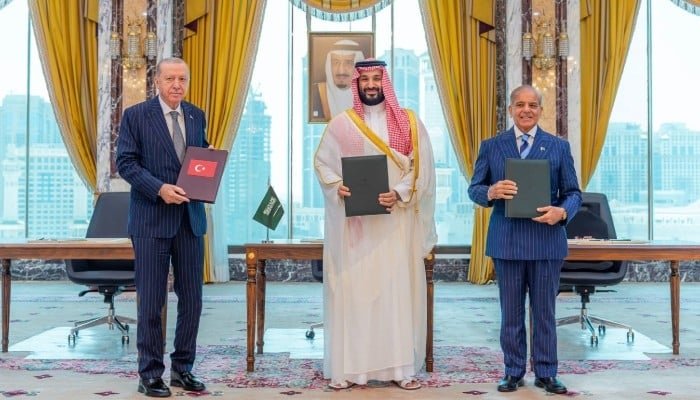
Pakistan, Turkiye and Saudi Arabia have agreed to deepen their military cooperation under the Makkah Joint Defence Agreement, establishing new mechanisms for strategic coordination, joint military exercises and defence-industry collaboration. The pact, signed on August 7, marks a significant step toward creating a more structured defence partnership among the three countries.
New Defence Framework
The agreement was signed during the Makkah Al-Mukarramah Summit for Joint Defence, attended by Prime Minister Shehbaz Sharif, Saudi Crown Prince and Prime Minister Mohammed bin Salman, and Turkish President Recep Tayyip Erdogan.
One of the most significant elements of the Makkah Joint Defence Agreement is its collective-security provision. Under the pact, an armed attack against any one of the three countries will be regarded as an attack against all three.
The arrangement is intended to strengthen cooperation and provide a more coordinated response to potential security challenges. However, Turkish officials have emphasized that the agreement is not designed to replace existing international alliances.
Senior Ministers to Coordinate
According to Türkiye’s Defence Ministry, the new partnership will establish strategic political and military mechanisms involving defence ministers, foreign ministers and chiefs of general staff or armed forces commanders.
This structure is expected to ensure that communication between Pakistan, Saudi Arabia and Türkiye takes place at the highest level.
The Makkah Joint Defence Agreement therefore goes beyond traditional defence purchases. The three countries are seeking to establish institutional mechanisms that can support long-term military planning, strategic consultations and coordinated responses to emerging regional threats.
Regular interaction among senior officials could also help the countries develop a common understanding of security developments across the Middle East, South Asia and surrounding regions.
Joint Military Exercises Planned
Another major component of the agreement is joint military training. Türkiye’s Defence Ministry said the three countries plan to organize exercises involving their land, naval and air forces.
Cooperation will also cover air defence and unmanned systems, reflecting the changing nature of modern warfare.
Joint exercises can provide several benefits, including improving interoperability, communication and operational coordination among participating forces. They can also allow military personnel to exchange experience and develop common procedures for responding to different scenarios.
For Pakistan, such exercises could provide opportunities to strengthen cooperation with two strategically important partners. Saudi Arabia could benefit from Türkiye’s growing defence capabilities, while Türkiye and Pakistan already have experience working together in several defence-related areas.
Defence Industry Cooperation
The partnership also places strong emphasis on the defence industry. Türkiye said cooperation would not be limited to purchasing weapons and military equipment.
Instead, the three countries aim to explore joint development and production, technology cooperation, maintenance and logistics support.
The Makkah Joint Defence Agreement specifically identifies unmanned and autonomous systems, electronic warfare and artificial intelligence as priority areas.
These technologies have become increasingly important in modern military operations. Unmanned aerial systems, electronic warfare capabilities and AI-supported technologies are rapidly changing how militaries conduct surveillance, intelligence gathering and battlefield operations.
Joint development could potentially allow the three countries to share expertise, reduce development costs and build stronger domestic defence industries.
Possibility of Expansion
Türkiye has indicated that the partnership could eventually expand beyond the original three members. President Erdogan said the vision was not limited to Pakistan, Saudi Arabia and Türkiye and expressed hope that other countries could join under suitable conditions.
Egypt has emerged as a potential future participant. Turkish Foreign Minister Hakan Fidan said Türkiye expected Egypt to join at a later stage, although he noted that some technical matters still needed to be resolved.
Egypt has not publicly commented on the possibility of joining the agreement.
If additional regional countries eventually become members, the partnership could develop into a broader platform for defence cooperation across the Middle East and surrounding regions.
Regional Security Implications
The Makkah Joint Defence Agreement comes at a time of heightened security concerns across the region. Türkiye is also participating in discussions in Jeddah focused on establishing an international coalition to protect shipping in the Red Sea.
The agreement could therefore become part of wider regional efforts to improve security cooperation and protect strategic trade routes.
At the same time, its success will depend on how effectively the three countries translate the commitments into practical cooperation. Joint exercises, technology projects and regular high-level consultations will be important in determining the pact’s long-term impact.
A New Chapter in Defence Cooperation
The Makkah Joint Defence Agreement represents a deeper level of institutional defence cooperation between Pakistan, Saudi Arabia and Türkiye. Its focus on collective security, military exercises, defence technology and joint production gives the partnership a broader scope than a conventional defence agreement.
For Pakistan, the arrangement offers another avenue for strengthening strategic ties with two important partners. For Saudi Arabia, closer cooperation could support its efforts to develop advanced defence capabilities, while Türkiye can expand its growing role in regional security and defence technology.
Whether the partnership remains limited to three countries or eventually expands to include states such as Egypt, its development will be closely watched. The coming years will show whether the agreement can translate its ambitious commitments into sustained military and technological cooperation.