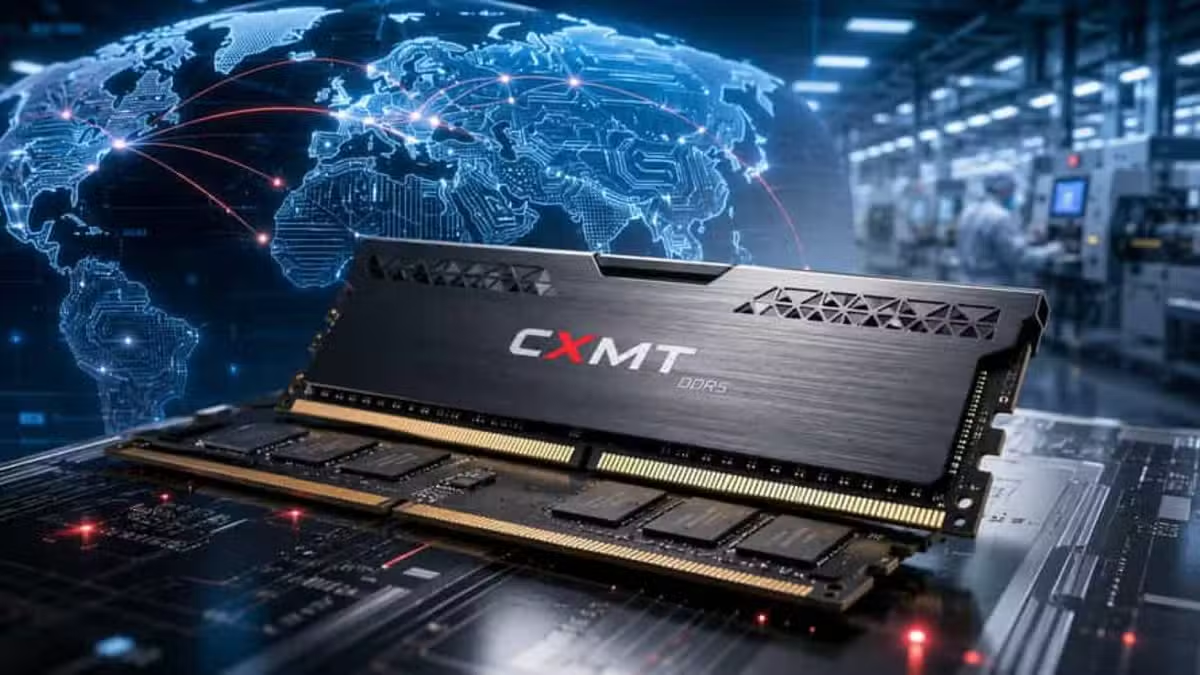
Chinese Memory Chips are steadily making their way into mainstream computer memory products, marking an important shift in the global semiconductor industry. As demand for memory continues to surge due to artificial intelligence, cloud computing, and data center expansion, Chinese manufacturers are increasingly positioning themselves as viable alternatives to established industry giants.
For years, the memory market has been dominated by companies such as Samsung, Micron, and SK Hynix. However, growing investments, government support, and advancements in domestic manufacturing technologies are helping Chinese companies challenge the traditional leaders. The emergence of Chinese Memory Chips in consumer and enterprise products could reshape the future of memory supply chains worldwide.
Rising Demand Creates New Opportunities
The rapid growth of artificial intelligence has dramatically increased the demand for memory products. Modern AI systems require enormous amounts of RAM and storage to process large datasets and perform complex calculations. As a result, memory manufacturers are under pressure to increase production capacity while maintaining stable supply levels.
This environment has created opportunities for new players to enter the market. Chinese manufacturers have taken advantage of this trend by expanding production and improving their technological capabilities. With global demand continuing to rise, many hardware companies are now exploring alternative suppliers to reduce dependency on a small number of dominant vendors.
The Role of CXMT and YMTC
Two companies are at the center of China’s memory ambitions. ChangXin Memory Technologies (CXMT) focuses on DRAM production, while Yangtze Memory Technologies Corporation (YMTC) specializes in NAND flash storage.
DRAM is used in system memory for desktops, laptops, and servers, while NAND flash powers solid-state drives and other storage devices. Together, these technologies form the foundation of modern computing infrastructure.
The growing adoption of Chinese Memory Chips is largely driven by the progress made by these companies. Their ability to manufacture competitive products has encouraged both domestic and international brands to consider integrating Chinese-made memory into commercial products.
Government Support Accelerates Growth
China’s push for technological independence has played a major role in the development of its semiconductor industry. Government support, financial incentives, and strategic investments have allowed domestic manufacturers to expand operations and improve production capabilities.
Unlike some global competitors that prioritize high-margin enterprise customers, Chinese manufacturers are often encouraged to maintain supply for local industries. This approach helps stabilize pricing and ensures that domestic businesses have access to essential components.
The support system surrounding Chinese Memory Chips has enabled companies to continue investing in research and development despite challenges posed by international competition and export restrictions.
DDR5 Memory Marks a New Milestone
One of the most notable developments is the introduction of DDR5 memory modules built with Chinese-made chips. Brands such as Gloway and KingBank have announced DDR5 products using domestically produced memory dies.
These modules offer larger capacities and improved performance compared to previous generations. Manufacturers can now create 24GB memory modules and high-capacity kits that meet the growing requirements of modern gaming systems, workstations, and AI applications.
The appearance of Chinese Memory Chips in DDR5 products demonstrates that domestic manufacturers are no longer limited to entry-level markets. Instead, they are beginning to compete in advanced technology segments where performance and reliability are critical.
Expanding Beyond China
Chinese-made memory is no longer confined to domestic markets. Several international hardware companies have started incorporating CXMT memory chips into their products.
Major technology brands have reportedly begun qualifying memory modules that use Chinese components. This represents a significant milestone because it signals growing confidence in the quality and reliability of these products.
As more manufacturers test and adopt Chinese Memory Chips, consumers may soon see a wider variety of memory options available in laptops, desktops, servers, and other computing devices.
Overcoming Manufacturing Challenges
Despite their progress, Chinese memory companies continue to face challenges. Restrictions on advanced semiconductor equipment have limited access to some of the most sophisticated manufacturing technologies.
To overcome these obstacles, manufacturers have focused on optimizing existing production methods. CXMT, for example, has developed competitive memory products using deep ultraviolet lithography rather than the more advanced extreme ultraviolet equipment used by some rivals.
Its current 16nm manufacturing process supports modern DDR5 and LPDDR5X memory products, proving that innovation can continue even under technological constraints.
What the Future Holds
The future of Chinese Memory Chips looks increasingly promising. As AI adoption expands and demand for memory continues to rise, the need for additional suppliers will become even more important.
If Chinese manufacturers maintain their current pace of development, they could become major players in the global memory market over the next few years. Increased competition may also benefit consumers through better availability, more innovation, and potentially lower prices.
While established companies will continue to dominate much of the industry, the growing presence of Chinese memory technology suggests that the semiconductor landscape is evolving. The coming years will reveal whether these manufacturers can transform their recent progress into long-term global influence.
In an industry where supply, performance, and innovation are critical, Chinese Memory Chips are no longer just an emerging alternative—they are becoming a significant force shaping the future of computing.