The Gilgit-Baltistan elections 2026 have become the center of intense political debate in Pakistan as major political parties accuse each other of unfair practices and restrictions ahead of polling day. With elections for 24 assembly seats scheduled for June 7, political activity in the mountainous region has reached its peak, drawing national attention toward the evolving political landscape of Gilgit-Baltistan.
The Gilgit-Baltistan elections 2026 are especially important because the region holds strategic, political, and economic significance for Pakistan. As election campaigns continue, tensions between the ruling coalition and Pakistan Tehreek-e-Insaf (PTI) have increased over allegations regarding political freedom and equal opportunities for campaigning.
Senior leaders from Pakistan’s major political parties arrived in Gilgit-Baltistan to support their candidates. Nawaz Sharif visited Gilgit during a short political tour, while Aseefa Bhutto Zardari reached Skardu to address a public rally. Their presence highlighted how seriously mainstream political parties are taking the upcoming elections.
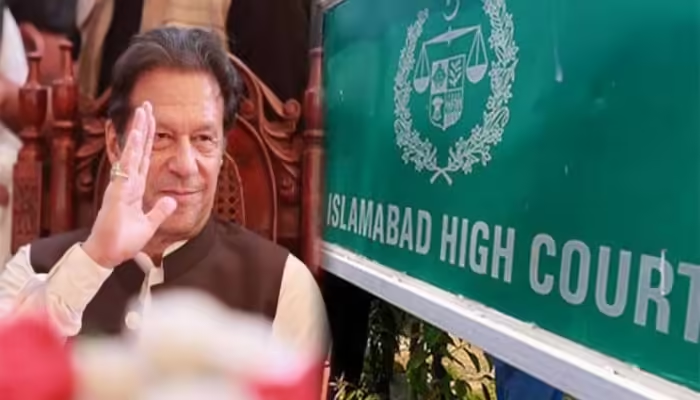
However, the PTI leadership has claimed that its members and supporters are facing difficulties in conducting political activities freely. According to party representatives, several restrictions have limited their ability to campaign effectively in the region. These allegations have further intensified the political atmosphere surrounding the Gilgit-Baltistan elections 2026.
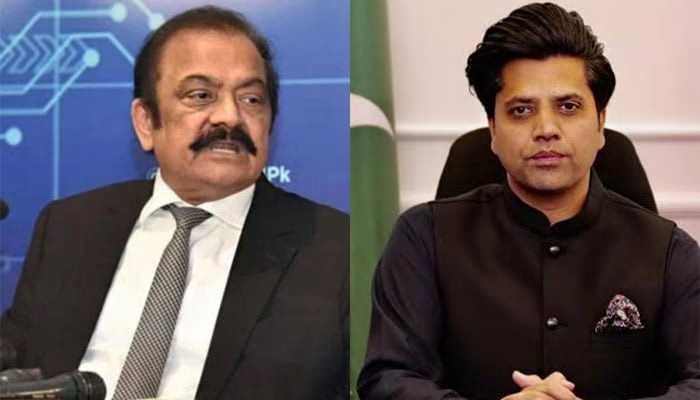
Prime Minister’s Adviser on Political Affairs Rana Sanaullah rejected the accusations and defended the government’s position. Speaking in a televised interview, he stated that all legal procedures were being followed properly. He explained that Nawaz Sharif had obtained the necessary no-objection certificate before traveling to the region and argued that PTI leaders could also campaign freely if they completed the same requirements.
Rana Sanaullah further claimed that no federal ministers were interfering in the election process and insisted that the upcoming polls would remain transparent and fair. According to him, PTI Chairman Gohar Ali Khan had already been holding rallies and meetings in the area without obstruction.
Despite these statements, PTI leaders continue to criticize what they describe as unequal treatment. PTI representative Shafi Jan argued that leaders from the Pakistan Muslim League-Nawaz (PML-N) and Pakistan Peoples Party (PPP) were freely campaigning while PTI supporters faced unnecessary hurdles. He questioned why the Election Commission had remained silent regarding these alleged issues.
The political conflict has added more importance to the Gilgit-Baltistan elections 2026, as many observers believe the outcome could influence future political alignments in Pakistan. Gilgit-Baltistan has increasingly become a politically active region where national parties compete aggressively for influence and support.
PTI leaders also raised concerns regarding independent candidates and political alliances. According to party representatives, candidates associated with PTI were allegedly forced to contest independently after the cancellation of certain alliances. These developments have fueled fears among PTI supporters that attempts are being made to weaken the party’s electoral performance.
Another major concern raised by the opposition involves transparency in vote counting and result management. PTI leaders warned against any attempt to manipulate election outcomes and vowed to resist what they described as engineered political operations. Such accusations have once again brought debates about electoral fairness into the national spotlight.
The Gilgit-Baltistan elections 2026 are not only politically important but also symbolically significant. Gilgit-Baltistan plays a key role in regional trade routes, tourism, water resources, and the China-Pakistan Economic Corridor (CPEC). Political stability in the region is considered essential for long-term economic development and strategic planning.
Public interest in the elections has increased because voters are expecting solutions to local challenges including infrastructure, healthcare, employment opportunities, tourism development, and education. Many residents hope the incoming government will focus more seriously on economic progress and social welfare.
Political analysts believe that competitive elections can strengthen democratic institutions if conducted fairly and transparently. They stress that all political parties should be given equal opportunities to campaign and present their policies before the public. Open political participation is considered essential for building trust in democratic systems.
The Election Commission and local administration are also under pressure to ensure peaceful polling and maintain credibility throughout the election process. Security arrangements, polling station management, and transparent vote counting are likely to remain major priorities in the coming days.
As the Gilgit-Baltistan elections 2026 approach, political rhetoric is expected to intensify further. Leaders from both the government and opposition continue to exchange sharp criticism while attempting to gain voter support in the strategically important region.
For ordinary citizens, however, the biggest concern remains whether the elections will lead to practical improvements in daily life. Many voters are less interested in political accusations and more focused on jobs, development, electricity, roads, and better public services.
The results of the upcoming elections could shape the political future of Gilgit-Baltistan and influence national politics as well. With strong competition among major parties, the region is once again at the center of Pakistan’s democratic process.