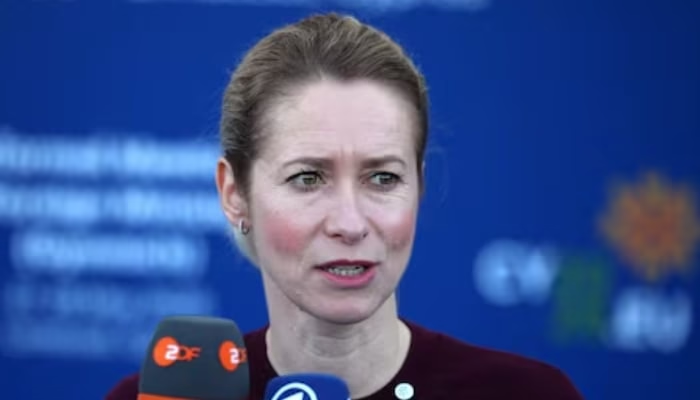
The ongoing Pakistan-Iran peace talks have attracted significant international attention after European Union foreign policy chief Kaja Kallas praised Pakistan’s role in helping reduce tensions between the United States and Iran. Speaking during a television interview, Kallas expressed hope that the first phase of a Pakistan-mediated agreement between Washington and Tehran would soon be officially signed.
The latest developments in the Pakistan-Iran peace talks come at a crucial moment for the Middle East, where rising tensions, military conflict, and disruptions in global trade routes have created serious economic and humanitarian concerns worldwide.
Kaja Kallas, the European Union’s High Representative for Foreign Affairs and Security Policy, stressed that the conflict in the Middle East is affecting countries far beyond the region. She noted that rising energy prices and supply chain disruptions are placing pressure on global economies and increasing the risk of future food shortages.
According to Kallas, reopening the Strait of Hormuz is one of the most urgent priorities linked to the ongoing negotiations. The strategic waterway is considered one of the world’s most important oil shipping routes, carrying a large portion of global energy supplies. Any disruption in the strait directly impacts oil prices, shipping costs, and international trade.
The Pakistan-Iran peace talks gained momentum after Islamabad stepped forward as a mediator following military tensions between the United States, Israel, and Iran earlier this year. The conflict escalated after coordinated strikes on Iranian targets and retaliatory attacks by Tehran on American military bases in the region.
Pakistan later played a key role in arranging a temporary ceasefire between the United States and Iran. Diplomatic meetings held in Islamabad also opened channels for direct discussions between the two sides, although a permanent agreement has not yet been finalized.
Kallas praised Pakistan’s diplomatic efforts, saying the country had helped prevent a wider regional war. She acknowledged that bringing opposing sides together for dialogue is an important achievement, especially during periods of intense geopolitical instability.
The Pakistan-Iran peace talks are also being closely watched because of their potential impact on international energy markets. Since the beginning of the conflict, oil prices have experienced major fluctuations due to fears about disruptions in Middle Eastern supply routes.
Economic experts warn that prolonged instability around the Strait of Hormuz could lead to higher fuel prices, increased inflation, and pressure on global markets. Countries dependent on imported oil are particularly vulnerable to continued tensions in the Gulf region.
Kallas also highlighted how shortages of fertilizers and agricultural supplies linked to regional instability could contribute to food insecurity in vulnerable countries. She warned that economic consequences from the conflict may continue to spread globally if peace efforts fail.
The Pakistan-Iran peace talks have therefore become more than a regional diplomatic initiative. They are now viewed as an important effort to protect global economic stability and prevent further escalation in the Middle East.
Pakistan’s role as a mediator has also strengthened its international diplomatic profile. Analysts say Islamabad’s balanced relations with both Tehran and Washington allowed it to maintain communication channels during a highly sensitive period.
Over the past few months, Pakistan has continued backchannel diplomacy aimed at reducing mistrust between the two sides. Although reports suggest disagreements still remain over key issues, international observers believe continued dialogue is a positive sign.
Kallas also addressed broader concerns regarding international law and regional conflicts. She emphasized that countries must respect sovereignty, territorial integrity, and the principles outlined in the United Nations Charter. According to her, violations of these principles weaken trust in international institutions and global cooperation.
The Pakistan-Iran peace talks are taking place at a time when the world is increasingly divided over geopolitical conflicts, military interventions, and humanitarian crises. Many experts believe successful diplomacy in the Middle East could create momentum for resolving other international disputes as well.
Meanwhile, the humanitarian situation in parts of the Middle East continues to remain difficult. Ongoing instability has affected civilian populations, disrupted trade, and created uncertainty across the region. International organizations continue to call for restraint, negotiations, and long-term political solutions.
Political analysts say that while achieving a comprehensive agreement between the United States and Iran may take time, even a limited understanding could help reduce military tensions and restore confidence in regional stability.
The Pakistan-Iran peace talks also demonstrate how middle-power diplomacy can play an effective role during international crises. Pakistan’s mediation efforts have shown that dialogue and diplomacy remain important tools for conflict prevention even in highly complex geopolitical situations.
As negotiations continue, governments, businesses, and global markets are closely monitoring developments. Any progress toward reopening the Strait of Hormuz and reducing military tensions could help stabilize energy prices and improve economic confidence worldwide.
International leaders remain hopeful that continued diplomatic engagement will eventually lead to broader agreements on security, nuclear issues, and regional cooperation. The coming weeks may prove critical in determining whether current efforts can deliver lasting peace and stability in the Middle East.