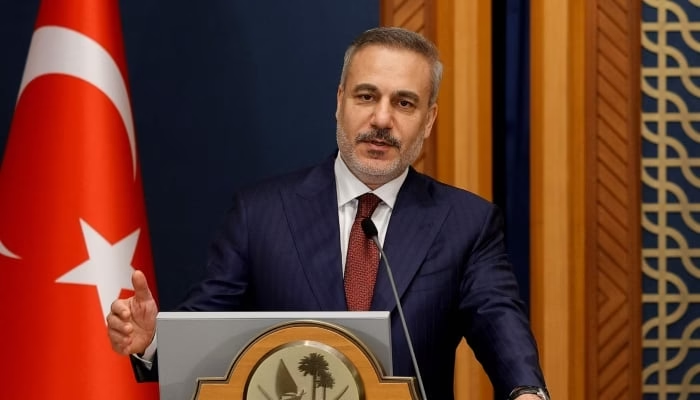
Turkish Foreign Minister Hakan Fidan stated on Monday that Israel “cannot live without an enemy” and is now attempting to portray Turkey as its next regional adversary. His remarks came during a televised interview with the state-run Anadolu news agency, where he sharply criticized Israel’s political direction and regional policies.
Fidan argued that after Iran, Israel consistently seeks out new adversaries to maintain its security narrative. He suggested that both Israel’s current leadership and some opposition figures are contributing to efforts aimed at framing Turkey as a hostile state. According to him, this reflects what he described as an emerging “state strategy” in Israel to identify and construct new external threats.
He further stated that the trend of targeting Turkey as a potential enemy represents a new and concerning phase in regional politics. His comments come at a time of heightened diplomatic strain between Ankara and Tel Aviv, particularly in the wake of the ongoing Gaza conflict and broader instability in the Middle East.
Relations between Turkey and Israel have significantly deteriorated since the outbreak of war in Gaza following the October 7, 2023 attacks in Israel. Since then, political tensions, public statements, and diplomatic disagreements have intensified, widening the gap between the two countries.
The situation escalated further after Turkish President Recep Tayyip Erdogan warned US President Donald Trump about potential “provocations and sabotage” that could undermine fragile ceasefire arrangements linked to broader regional conflicts involving Iran and Israel. These developments have added further complexity to already strained diplomatic relations in the region.
In parallel, a two-week ceasefire between Tehran and Washington was announced earlier in April, following weeks of conflict that involved US military action alongside Israel against Iran. The ceasefire was presented as a temporary step toward reducing tensions, although regional leaders have continued to express concern about instability and the risk of renewed escalation.
Following Erdogan’s warnings, Israeli Prime Minister Benjamin Netanyahu reiterated that Israel would continue its strategic operations against Iran and its regional allies. Israeli officials have maintained a firm security stance, emphasizing ongoing threats in the region and the need for defensive action.
In response, Turkish officials accused Netanyahu’s government of attempting to derail peace efforts and pursuing expansionist regional policies. They further argued that Israel’s leadership is actively working against diplomatic initiatives aimed at stabilizing the region.
The Turkish Foreign Ministry also escalated its criticism of Netanyahu personally, referencing his legal troubles and describing him as a controversial figure facing serious allegations in international courts. These statements reflect the increasingly hostile tone between the two governments.
Meanwhile, Fidan used the interview to broaden his criticism beyond the Middle East conflict, addressing NATO relations and global security concerns. He urged NATO member states to use their upcoming summit in Ankara as an opportunity to reassess and strengthen ties with the United States, especially amid uncertainty over Washington’s long-term commitment to the alliance.
He suggested that NATO allies should prepare for the possibility of reduced US involvement and develop contingency plans to ensure stability within the alliance structure. According to him, what was once dismissed as political rhetoric regarding US disengagement is now being taken more seriously by European allies.
Fidan emphasized the importance of structured planning within NATO to manage any potential shifts in US policy, warning that sudden changes could leave member states exposed if not properly coordinated. He called for a systematic approach to maintaining alliance cohesion in a changing geopolitical environment.
The broader context of his remarks reflects rising global tensions, including disputes over regional conflicts, shifting alliances, and growing uncertainty about future international security arrangements.