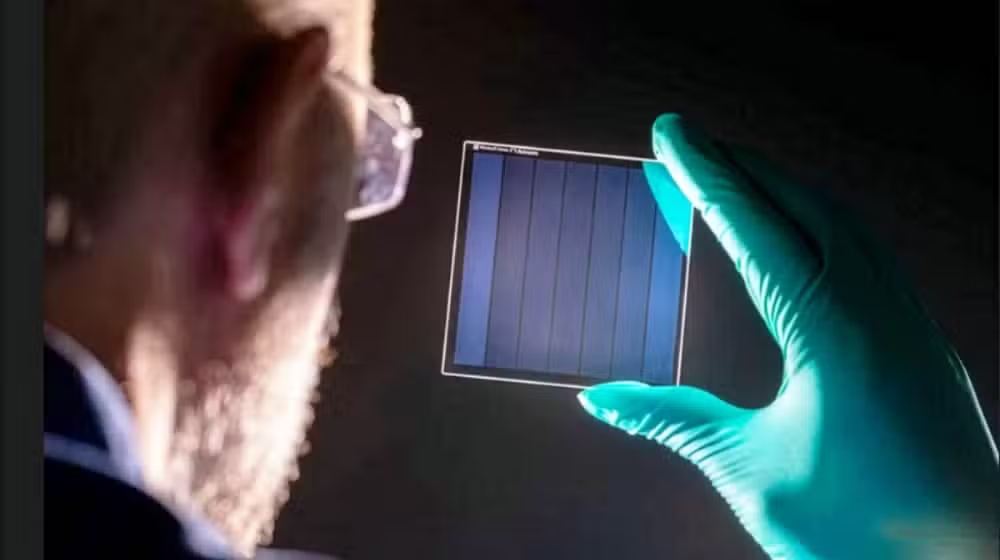
The emerging glass data storage technology is redefining how we think about long-term data preservation. Researchers at Microsoft have successfully demonstrated a system that stores digital information inside a thin plate of glass, offering a durable and energy-efficient alternative to traditional storage methods. This breakthrough in glass data storage technology could transform how organizations archive and protect critical data for the future.
One of the biggest challenges in today’s digital world is the limited lifespan of existing storage systems. Devices such as hard drives and magnetic tapes degrade over time, requiring constant maintenance and periodic data migration. The glass data storage technology addresses this issue by providing a medium that can preserve information for thousands of years without the need for continuous upkeep.
In the demonstration, researchers were able to store nearly two terabytes of data within a small piece of borosilicate glass. Even more impressive, the stored data was retrieved without any errors. This level of reliability highlights the potential of glass data storage technology to serve as a long-term archival solution for governments, businesses, and research institutions.
The process of writing data into glass is both advanced and precise. It involves the use of femtosecond laser pulses extremely short bursts of light that last for only a fraction of a second. These pulses create tiny structures inside the glass, altering how light passes through it. Each of these microscopic changes represents a unit of data, forming the foundation of glass data storage technology.
Unlike traditional storage methods, where data is stored on surfaces that can be easily damaged, this approach embeds information deep within the material. This makes the data resistant to scratches, environmental changes, and physical wear. As a result, glass data storage technology offers a level of protection that is difficult to achieve with conventional devices.
Reading the stored data is equally innovative. Researchers shine light through the glass and use specialized cameras to capture the resulting patterns. These patterns are then analyzed using advanced software, which reconstructs the original data. The system is designed to correct minor distortions, ensuring accurate retrieval. This reliability is a key advantage of glass data storage technology.
Durability is perhaps the most remarkable feature of this innovation. Tests suggest that data stored in glass can remain intact for over 10,000 years under normal conditions. The material is also capable of withstanding extreme environments, including high temperatures and exposure to water. This resilience makes glass data storage technology ideal for preserving historical records, scientific data, and cultural archives.
Another benefit is the concept of benign neglect.Unlike traditional systems that require electricity and regular monitoring, glass storage can simply be stored and left untouched. This reduces energy consumption and operational costs, making glass data storage technology an environmentally friendly option for long-term storage needs.
However, the technology is not without its challenges. One of the main limitations is speed. Currently, data is written at a slower rate compared to existing storage solutions. While researchers are exploring ways to improve performance, such as using multiple laser beams simultaneously, this remains a barrier to widespread adoption of glass data storage technology.
Scalability is another factor to consider. Although the system has proven capable of storing real-world content, including films and large datasets, it has not yet been commercialized. Bringing glass data storage technology to the market will require further development, cost reduction, and the creation of automated systems to handle large-scale storage operations.
Despite these challenges, the potential applications are vast. From preserving national archives to storing scientific research for future generations, the possibilities are significant. As data continues to grow at an unprecedented rate, solutions like glass data storage technology could play a crucial role in ensuring that valuable information is not lost over time.
Glass data storage technology represents a major step forward in the field of data preservation. With its unmatched durability, energy efficiency, and reliability, it offers a promising alternative to traditional storage methods. While there is still work to be done before it becomes widely available, the foundation has been laid for a future where data can be careful safely for thousands of years without degradation.