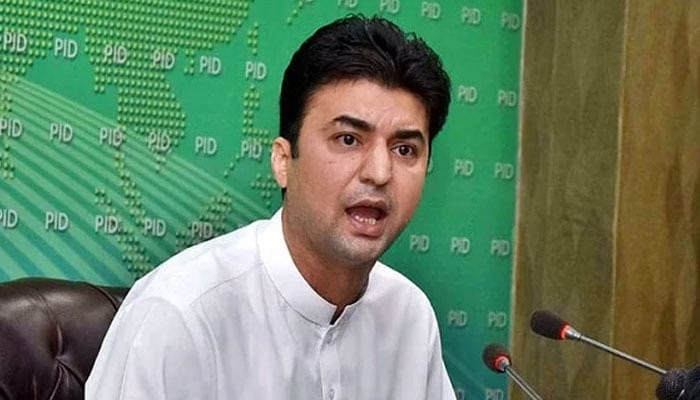
The recent Murad Saeed disqualification by the Election Commission of Pakistan (ECP) has added another significant development to the country’s evolving political landscape. The decision came after the former Pakistan Tehreek-e-Insaf (PTI) leader was convicted in a case linked to the May 9, 2023, violent protests. This move not only affects Saeed’s political career but also reflects the broader legal and political consequences of those events.
According to the official notification, the Murad Saeed disqualification was carried out under Article 63(1)(h) of the Constitution. This provision deals with the disqualification of lawmakers upon conviction for certain offenses. Saeed was sentenced to 10 years in prison by an anti-terrorism court in Rawalpindi, which directly led to his removal from the Senate. As a result, his general seat from Khyber Pakhtunkhwa has now been declared vacant.
Murad Saeed had been elected as a senator in July 2025. However, he was unable to take the oath due to his absence and ongoing legal issues. His situation became more complex when he went into hiding amid the legal proceedings. The Murad Saeed disqualification therefore formalizes a process that had already been surrounded by uncertainty regarding his role in the Senate.
Interestingly, Saeed had already submitted his resignation from the Senate seat earlier this year. In a letter addressed to the party leadership, he expressed strong dissatisfaction with the political system. He described the parliament as lacking legitimacy and criticized what he believed was a distortion of constitutional authority. Despite this resignation, the Murad Saeed disqualification holds legal importance as it is based on a court conviction rather than a voluntary exit.
The roots of this development lie in the May 9, 2023, incidents, which marked a turning point in Pakistan’s recent political history. The protests erupted following the arrest of former Prime Minister Imran Khan from the Islamabad High Court premises. What began as demonstrations quickly escalated into widespread unrest, with attacks reported on public property and sensitive installations. These events triggered a series of legal actions against many PTI leaders and workers.
The Murad Saeed disqualification is directly linked to his alleged involvement in those protests. Authorities pursued multiple cases against individuals accused of inciting or participating in the violence. Over time, courts have issued verdicts in several of these cases, leading to convictions and ongoing trials. Saeed’s sentencing is one of the most high-profile outcomes so far.
The political impact of the Murad Saeed disqualification is significant, especially for PTI. The party has already been facing challenges due to legal pressures on its leadership and members. Losing a Senate seat further weakens its position in the upper house. Additionally, the disqualification sends a broader message about accountability and the legal consequences of political actions.
From a legal perspective, the case highlights the role of anti-terrorism courts in handling incidents involving violence and national security concerns. The court’s decision to sentence Saeed to 10 years in prison indicates the seriousness with which such cases are being treated. The Murad Saeed disqualification therefore reflects not just a political decision, but a judicial outcome based on existing laws.
Public reaction to this development has been mixed. Some view the disqualification as a necessary step to uphold the rule of law, while others see it as part of a larger political struggle. Regardless of differing opinions, the Murad Saeed disqualification underscores the ongoing tensions within Pakistan’s political environment.
It is also important to note that many individuals linked to the May 9 events are still facing legal proceedings. While some have been released on bail, others remain in custody. The situation continues to evolve as courts review evidence and deliver judgments. In this context, the Murad Saeed disqualification may not be the last major decision related to those incidents.
The vacant Senate seat from Khyber Pakhtunkhwa will need to be filled according to constitutional procedures. This opens up a new political contest and may influence party dynamics in the region. The Murad Saeed disqualification could therefore have ripple effects beyond just one individual, shaping future political alignments.
The Murad Saeed disqualification represents a key moment in Pakistan’s current political and legal landscape. It highlights the consequences of the May 9 events and reflects the intersection of law and politics in the country. As developments continue to unfold, this case will likely remain an important reference point in discussions about accountability, governance, and political stability.