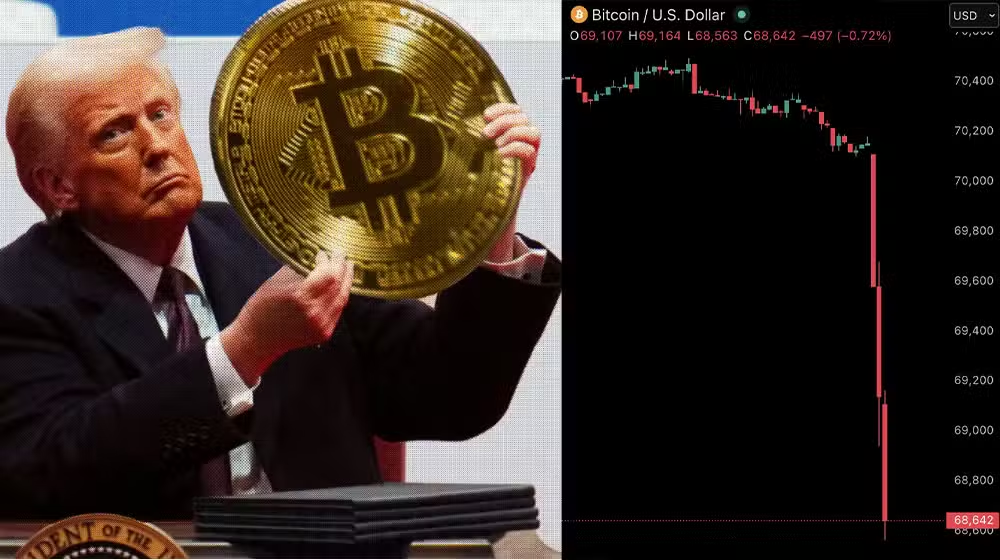
The recent Bitcoin price drop has once again highlighted how sensitive cryptocurrency markets are to global political developments. In the early hours of the day, Bitcoin fell below $68,000 following strong remarks from Donald Trump regarding potential military action against Iran. This sudden shift in tone created uncertainty across financial markets, leading to rapid sell-offs in crypto assets.
The Bitcoin price drop was not just a minor fluctuation—it triggered a wave of liquidations in the crypto market. Within a single hour, over $240 million worth of leveraged positions were wiped out. This kind of sharp movement is common in highly volatile markets like cryptocurrency, where traders often use borrowed funds to amplify gains, but also risk significant losses during sudden downturns.
One of the key reasons behind this reaction lies in Iran’s role in the global crypto ecosystem. Iran is considered one of the major hubs for Bitcoin mining due to its relatively low energy costs. Mining operations require substantial electricity, and any disruption to Iran’s power infrastructure could significantly impact global mining output. The Bitcoin price drop reflects concerns that potential strikes on energy facilities might reduce mining activity, affecting supply dynamics and market confidence.
Geopolitical tensions have always played a role in shaping financial markets, but cryptocurrencies are particularly reactive due to their decentralized and speculative nature. When investors sense instability, they often move quickly to reduce risk. The recent Bitcoin price drop is a clear example of how political statements alone can influence billions of dollars in market value within minutes.
Interestingly, the market reaction also highlights the psychological aspect of trading. Many investors tend to react emotionally to breaking news, leading to panic selling. However, some experienced traders argue that such reactions are often temporary. They believe that the Bitcoin price drop may stabilize once the immediate uncertainty surrounding geopolitical developments begins to fade.
Another factor contributing to the volatility is the constant flow of news updates. In today’s digital age, information spreads rapidly, and markets respond almost instantly. Reports about shifting strategies, possible military actions, and diplomatic changes create an environment of uncertainty. This continuous stream of updates amplifies the impact of events, making the Bitcoin price drop more pronounced than it might have been in a slower news cycle.
Despite the recent decline, it is important to view the situation in a broader context. Bitcoin has historically experienced sharp rises and falls, often driven by external factors. While geopolitical tensions can cause short-term disruptions, long-term trends are usually influenced by adoption rates, regulatory developments, and technological advancements. The current Bitcoin price drop may therefore be part of a larger pattern rather than a permanent shift.
Some market participants have also pointed out that comparing Bitcoin to traditional assets can be misleading. Unlike stocks or commodities, cryptocurrencies operate in a unique space where sentiment plays a major role. This makes them more vulnerable to sudden swings triggered by global events. The Bitcoin price drop serves as a reminder that crypto investments require a strong understanding of both market fundamentals and external influences.
At the same time, not all reactions to the drop have been negative. Some investors see such declines as buying opportunities, believing that prices will recover once stability returns. This perspective is common among long-term holders who focus less on short-term fluctuations and more on the overall growth potential of digital assets.
The recent Bitcoin price drop underscores the strong connection between global politics and cryptocurrency markets. Triggered by geopolitical tensions and amplified by rapid information flow, the decline reflects both market sensitivity and investor behavior. While uncertainty may continue in the short term, the long-term outlook for Bitcoin will depend on broader factors beyond immediate political events. For now, the situation serves as an important lesson in how quickly markets can react—and how crucial it is for investors to remain informed and composed during periods of volatility.