The appointment of Mojtaba Khamenei as Iran’s new Supreme Leader marks a significant moment in the country’s political and religious leadership. Following the death of his father, Ali Khamenei, Mojtaba Khamenei has taken on the responsibility of guiding the Islamic Republic during a challenging period marked by regional tensions and political uncertainty.
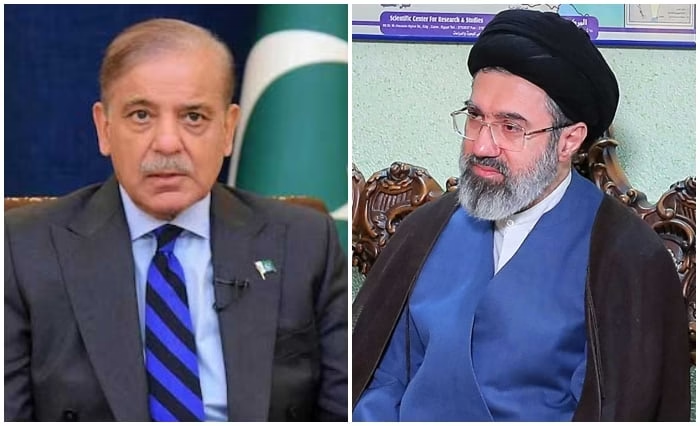
Leaders from across the region have responded to the development, including Shehbaz Sharif, who extended his congratulations and condolences to the Iranian leadership and people. In a formal message, the Pakistani prime minister expressed hope that Mojtaba Khamenei’s leadership would bring peace, stability, and prosperity to Iran in the years ahead.
Pakistan’s Message of Solidarity
In his official letter, Shehbaz Sharif conveyed condolences on the passing of Ali Khamenei and other members of his family. He stated that the people of Pakistan were deeply saddened by the loss and stood in solidarity with the Iranian nation during this difficult time.
The prime minister also emphasized the strong historical and cultural ties between Pakistan and Iran. According to the statement, relations between the two countries are built on shared faith, cultural heritage, and longstanding diplomatic cooperation.
He reaffirmed Pakistan’s commitment to strengthening bilateral relations with Iran and working together on matters of mutual interest.
Who Is Mojtaba Khamenei?
Mojtaba Khamenei is the son of the late Supreme Leader Ali Khamenei and has long been considered an influential figure within Iran’s political and religious establishment.
At the age of 56, Mojtaba Khamenei is regarded as a mid-ranking cleric with deep connections to Iran’s ruling institutions. Over the years, he has played an active role behind the scenes in the country’s political structure.
His appointment as Iran’s top leader was confirmed by the Assembly of Experts, the influential body responsible for selecting and overseeing the Supreme Leader.
The decision was announced shortly after midnight in Iran, marking a rapid leadership transition following the death of his father.
Leadership Transition in a Difficult Time
The rise of Mojtaba Khamenei to Iran’s highest leadership position comes at a time of significant geopolitical tension. The country has faced increasing pressure and conflict in recent weeks, which has heightened concerns about regional stability.
According to reports, Ali Khamenei was killed during an airstrike linked to a military confrontation involving the United States and Israel. His death triggered a period of national mourning and raised questions about Iran’s leadership succession.
The selection of Mojtaba Khamenei was seen as a move to ensure continuity within Iran’s political and religious system.
Selection by the Assembly of Experts
The responsibility of appointing the Supreme Leader lies with the Assembly of Experts, a council of senior clerics tasked with overseeing the leadership of the Islamic Republic.
Members of the council reviewed several potential candidates before announcing Mojtaba Khamenei as the new leader.
According to one member of the council, Mohsen Heidari Alekasir, the final decision was influenced by the belief that Iran’s top leader should be someone who firmly resists foreign pressure.
Other individuals were reportedly considered for the position, including Alireza Arafi, Mohsen Araki, and Hassan Khomeini. Each of these figures holds influence within Iran’s religious and political circles.
However, the council ultimately chose Mojtaba Khamenei to lead the country.
Regional and Global Reactions
The appointment of Mojtaba Khamenei has drawn attention from political leaders and analysts around the world. As Iran plays a key role in Middle Eastern geopolitics, any change in leadership can influence regional dynamics.
International observers are closely watching how the new leader will approach diplomatic relations, economic challenges, and regional security issues.
Pakistan’s leadership has emphasized the importance of maintaining strong ties with Iran. Both countries share a long border and cooperate in areas such as trade, security, and cultural exchange.
By expressing support for Mojtaba Khamenei, Pakistan has reaffirmed its intention to maintain positive diplomatic relations with its neighbor.
Challenges Ahead for the New Leader
Taking office during a time of political tension means Mojtaba Khamenei will face several immediate challenges. These include managing Iran’s domestic stability, responding to international pressure, and maintaining unity within the country’s leadership structure.
The expectations placed on Iran’s Supreme Leader are significant, as the position carries both religious authority and political influence.
Observers will be watching closely to see how Mojtaba Khamenei shapes Iran’s policies and leadership style in the coming years.
The appointment of Mojtaba Khamenei as Iran’s new Supreme Leader represents a major transition in the country’s leadership. Following the passing of his father, he now carries the responsibility of guiding Iran through a complex political and regional landscape.
With messages of support from neighboring countries such as Pakistan, the new leader begins his tenure with expectations of stability, diplomacy, and progress. As Mojtaba Khamenei steps into this powerful role, the direction he chooses will likely influence Iran’s future and its relationships with the wider world.