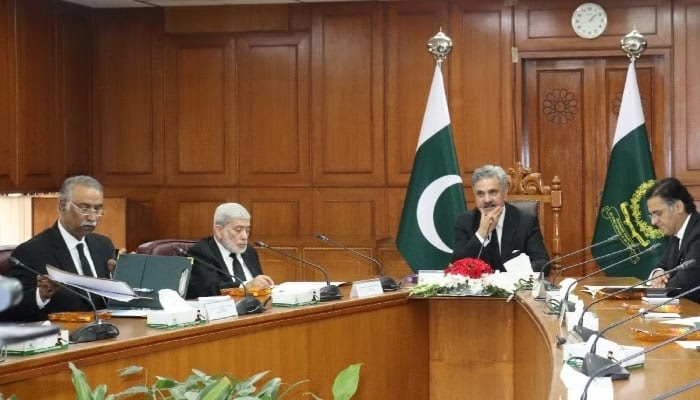
Pakistan’s judiciary has introduced several judicial energy conservation measures to reduce fuel consumption and manage rising energy costs caused by the ongoing Middle East conflict. The decision was approved during a meeting of the National Judicial (Policy Making) Committee, chaired by Yahya Afridi. These steps are part of a broader national effort to address the economic impact of increasing fuel prices and potential disruptions in petroleum supply.
The newly announced judicial energy conservation measures aim to ensure responsible use of resources while maintaining uninterrupted access to justice across the country. By introducing operational changes and encouraging energy efficiency, the judiciary is aligning itself with the government’s nationwide austerity strategy.
Why the Measures Were Introduced
The adoption of judicial energy conservation measures comes at a time when global fuel prices are rising sharply due to geopolitical tensions in the Middle East. The conflict has disrupted energy supply chains and increased the cost of petroleum products worldwide.
Pakistan, which relies heavily on imported fuel, is particularly vulnerable to such disruptions. In response, the government and several national institutions have begun implementing policies designed to conserve fuel and reduce operational costs.
The judiciary’s participation in this effort reflects its commitment to supporting national stability during a period of economic uncertainty.
Four-Day Working Week for Courts
One of the most significant judicial energy conservation measures is the introduction of a four-day working week for higher courts. Under the new arrangement, the Federal Shariat Court and all high courts will operate from Monday to Thursday.
Although regular court operations will be concentrated during these four days, urgent judicial and administrative matters will continue to be handled when necessary on Fridays and Saturdays. Courts have been given flexibility to adopt internal arrangements to manage their workloads effectively.
District courts will also operate at full capacity from Monday to Thursday. However, staff presence on Fridays and Saturdays will be minimized depending on operational needs and case workload.
This adjustment is expected to significantly reduce commuting and energy consumption associated with daily court operations.
Reduction in Fuel Allowances
Another important part of the judicial energy conservation measures involves reducing fuel allocations for members of the judiciary.
The committee approved a 50% reduction in the Petroleum, Oil and Lubricants (POL) allowance allocated to judges of the Federal Shariat Court and high courts. Judicial officers will face a 25% reduction in their fuel allowance.
These cuts are intended to reduce fuel consumption within the judiciary while setting an example for other institutions to follow.
The move reflects a broader commitment by public institutions to share responsibility in addressing the country’s economic challenges.
Encouraging Virtual Court Hearings
To further support the judicial energy conservation measures, courts are encouraging the use of video-link facilities for legal proceedings whenever possible.
Lawyers and litigants will be able to participate in hearings remotely through digital platforms, reducing the need for travel to court buildings. Video conferencing may be conducted through facilities available at high courts and district courts.
Remote participation not only saves fuel but also improves efficiency by reducing travel time and congestion in court premises.
The increased use of technology in court proceedings also reflects a growing trend toward digital transformation in the legal system.
Rotational Attendance for Court Staff
Another key initiative within the judicial energy conservation measures is the introduction of rotational attendance for court staff.
Under this system, employees will work on alternating schedules to ensure that only essential personnel are present in court buildings at any given time. This approach reduces commuting requirements while allowing courts to maintain necessary operations.
By limiting daily staff presence, the judiciary aims to lower energy consumption associated with transportation, office facilities, and utilities.
Rotational staffing is also expected to help maintain productivity while supporting the broader goal of resource conservation.
Security and Operational Considerations
Despite the cost-cutting measures, the judiciary has emphasized that security and essential services will remain unaffected.
For instance, while no additional protocol or security vehicles will be deployed for movement within designated high-security zones, existing route security arrangements will remain in place.
Judges and judicial officers serving in sensitive regions such as Khyber Pakhtunkhwa and Balochistan will continue to maintain security measures according to local circumstances.
These adjustments ensure that safety is not compromised while implementing the energy-saving strategy.
Coordination With Government Policies
The introduction of judicial energy conservation measures aligns closely with the government’s broader austerity initiatives. The federal government has also announced an additional weekly holiday, which will be observed on Fridays.
This policy was confirmed following a review meeting led by Shehbaz Sharif, who recently unveiled a nationwide austerity plan aimed at conserving fuel and reducing public sector expenditures.
The judiciary’s decision to implement its own conservation measures demonstrates institutional cooperation in addressing the country’s economic challenges.
The implementation of judicial energy conservation measures marks an important step toward responsible resource management in Pakistan’s public institutions. By introducing a four-day workweek, reducing fuel allowances, encouraging virtual hearings, and adopting rotational staffing, the judiciary aims to contribute to national efforts to conserve energy.
These initiatives highlight the role that government institutions can play in addressing economic pressures caused by global energy disruptions. While the measures may require adjustments in daily operations, they reflect a broader commitment to sustainability, efficiency, and national resilience during a challenging period for the country.