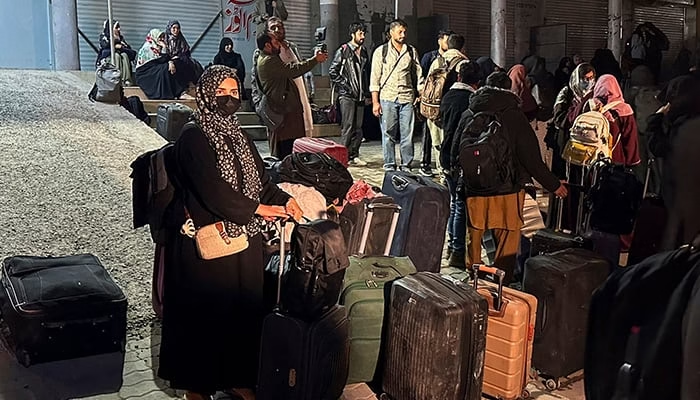
Pakistanis returning from Iran have described terrifying scenes of explosions, missile strikes and widespread destruction across Tehran as the ongoing conflict involving the United States and Israel against Iran continues to escalate.
Many Pakistani students, businesspeople and pilgrims who recently crossed back into Pakistan said the ground shook from repeated explosions while buildings across the Iranian capital were engulfed in fire and smoke.
The regional conflict has widened significantly. Reports indicate that a US submarine sank an Iranian warship off the coast of Sri Lanka on Wednesday, while air defence systems from North Atlantic Treaty Organization reportedly intercepted an Iranian missile fired toward Türkiye.
With the security situation deteriorating rapidly, governments across the region have been scrambling to evacuate their citizens. Much of the region’s airspace has been closed due to fears that missiles or military operations could endanger commercial flights.
Students Recall Terrifying Moments
Several Pakistani students who recently returned described the frightening moments they experienced while the attacks were taking place.
Hareem Zahra, a 23-year-old student at Tehran University of Engineering, said she was inside a classroom when a powerful blast shook the building.
“I was in the classroom when a powerful explosion rocked our university building,” she told Reuters after crossing the land border back into Pakistan.
“We saw thick smoke coming from many buildings that were on fire,” she added, saying the city was still under attack until the moment she left Tehran.
Tehran Appears Deserted
According to Mudassir Tipu, Pakistan’s ambassador in Tehran, nearly 1,000 Pakistanis have already left Iran since the conflict began. Around 35,000 Pakistani citizens, including students, businesspeople and religious pilgrims, are believed to be living in Iran.
Tipu said the situation has become increasingly difficult, particularly due to communication problems.
“There are now serious challenges. As you know there is no internet in most parts of Iran,” he said, highlighting the difficulties authorities face while trying to coordinate evacuations.
Many returning Pakistanis reported that Tehran looked almost empty as residents rushed to leave the city amid the ongoing attacks.
Nadir Abbas, a 25-year-old student studying Persian literature at a university in the Iranian capital, said the city appeared deserted since the fighting began.
Destruction and Continuous Attacks
Another student, Sakhi Aun Mohammad from Tehran University of Medical Sciences, described how the first strike he witnessed occurred very close to the hospital where he was studying.
“The first attack happened right next to my hospital,” he said.
After he safely reached Pakistan, an Iranian friend contacted him to check on his safety and shared shocking news.
“He told me: ‘Thank God you have gone to Pakistan and all of you are safe, but your hostel has been attacked,’” Mohammad recalled.
Other Pakistanis who returned also described widespread destruction across different areas of the city.
Diplomat Describes ‘Ghost Town’
A Pakistani diplomat who remains in Tehran said the attacks have been occurring regularly, sometimes every four or five hours.
According to the diplomat, one missile struck a building located next to his office.
“At times you feel as if something exploded right at your feet,” he said while describing the intensity of the blasts.
He added that during his last trip outside at night, he witnessed collapsed buildings and fires burning across the city.
“Buildings had collapsed and some others were on fire. There is destruction everywhere,” he said.
The diplomat added that large parts of the city now feel abandoned.
“It is almost like a ghost town,” he said.
As the conflict continues to intensify, many Pakistanis are still trying to leave Iran while authorities work to safely evacuate their citizens from the region.