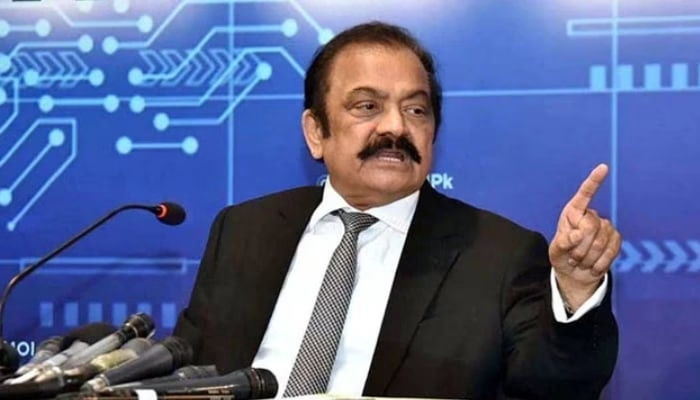
As tensions intensify in the Middle East, Pakistan mediation between Iran and Saudi Arabia has emerged as a key diplomatic effort aimed at preventing further regional escalation. Adviser to the Prime Minister on Political Affairs Rana Sanaullah stated that Islamabad is actively engaging Tehran to ensure that Gulf countries, particularly Saudi Arabia, are not drawn into the widening conflict following joint US-Israel strikes on Iran.
Speaking after an in-camera briefing chaired by Prime Minister Shehbaz Sharif, Sanaullah revealed that Pakistan’s military and political leadership are in constant contact with Iranian authorities. The objective of Pakistan mediation between Iran and Saudi Arabia is clear: de-escalation, protection of regional stability, and prevention of a broader war that could engulf Gulf states.
Diplomatic Engagement at the Highest Level
The high-level meeting brought together parliamentary leaders to discuss developments in the Middle East, the Pakistan-Afghanistan situation, and Islamabad’s diplomatic initiatives. According to Sanaullah, participants acknowledged Iran’s right to respond to attacks but emphasized that retaliation should not target Gulf nations.
Deputy Prime Minister and Foreign Minister Ishaq Dar reportedly briefed attendees on his recent diplomatic contacts, particularly with Gulf states. He conveyed that Iran had indicated it would refrain from attacking Saudi Arabia if Riyadh assured that its territory would not be used for hostile actions against Tehran.
This development highlights the delicate balance Islamabad is attempting to maintain. Pakistan mediation between Iran and Saudi Arabia focuses on building guarantees and mutual assurances to prevent miscalculations that could expand the conflict.
Preventing a Wider Regional War
The Middle East conflict escalated sharply after coordinated strikes by the United States and Israel targeted sites across Iran. Since the beginning of the assault on February 28, more than 1,000 people have reportedly been killed, according to Iranian sources.
In such a volatile environment, even a single retaliatory strike against a Gulf country could trigger a chain reaction. Pakistan’s leadership appears deeply aware of this risk. Sanaullah described the war as one imposed on Iran but stressed that Pakistan’s diplomatic efforts are aimed at reaching an agreement to bring hostilities to an end.
Pakistan mediation between Iran and Saudi Arabia is therefore not merely symbolic—it is a strategic attempt to prevent the conflict from spiraling into a broader regional confrontation.
A History of Facilitating Dialogue
Pakistan has previously played a behind-the-scenes role in easing tensions between Tehran and Riyadh. Islamabad’s unique position—maintaining cordial relations with both countries—allows it to serve as a bridge during times of crisis.
Sanaullah noted that Pakistan’s military and political leadership had played a constructive role in earlier negotiations involving Iran. That experience is now being leveraged again as Islamabad works to facilitate communication channels and resolve misunderstandings.
In complex geopolitical crises, trusted intermediaries often make a critical difference. Pakistan mediation between Iran and Saudi Arabia reflects Islamabad’s ambition to position itself as a responsible regional actor committed to peace.
Military and Political Coordination
One notable aspect of the current effort is the coordination between Pakistan’s civilian and military leadership. According to Sanaullah, the armed forces are maintaining constant contact with Iranian counterparts while political leaders engage diplomatically with Gulf capitals.
This unified approach strengthens Pakistan’s credibility. When both military and political institutions align behind a diplomatic initiative, it signals seriousness and commitment. In this case, the shared goal is clear: to ensure that Gulf countries are not targeted and that the conflict remains contained.
The Stakes for the Region
The Gulf region holds immense strategic importance due to its energy resources, trade routes, and expatriate populations. Any direct attack on Saudi Arabia could destabilize global oil markets and disrupt economic stability far beyond the Middle East.
For Pakistan, stability in the Gulf is particularly crucial. Millions of Pakistani expatriates live and work in Saudi Arabia and other Gulf states. Escalation could have humanitarian and economic consequences that directly impact Pakistan.
This reality adds urgency to Pakistan mediation between Iran and Saudi Arabia. Islamabad’s diplomatic push is not only about regional peace but also about protecting its own national interests.
A Fragile but Necessary Effort
While Sanaullah described Pakistan’s exchanges with Iran and other countries as “quite positive,” the situation remains fragile. Conflicts of this scale rarely de-escalate quickly. Misinterpretations, strategic calculations, and domestic pressures in involved countries can complicate negotiations.
Nevertheless, Pakistan’s continued engagement signals that dialogue remains possible. By encouraging guarantees, clarifying intentions, and promoting communication, Islamabad aims to reduce the risk of further escalation.
Pakistan mediation between Iran and Saudi Arabia represents a critical diplomatic initiative at a time of extreme regional tension. With hostilities escalating and casualties mounting, Islamabad’s efforts focus on preventing Gulf nations from becoming direct targets and on encouraging restraint.
In an increasingly polarized Middle East, the need for mediators has never been greater. Pakistan’s outreach to Tehran and Riyadh underscores its commitment to regional stability and peaceful resolution. Whether these efforts succeed will depend on the willingness of all parties to prioritize dialogue over confrontation—but for now, Pakistan appears determined to keep communication channels open and prevent a wider war.