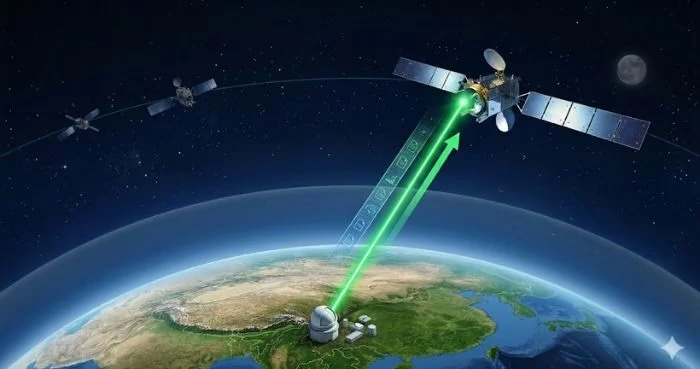
Chinese researchers have successfully tested a high-speed laser communication link between a geosynchronous satellite and a ground station, achieving two-way data transmission at 1 gigabit per second over more than 40,000 kilometers, according to reports.
The breakthrough marks a major step toward building a future integrated Earth-space communication network.
Who conducted the experiment?
The test was carried out by the Chinese Academy of Sciences’ Institute of Optics and Electronics, in collaboration with:
- Beijing University of Posts and Telecommunications
- China Academy of Space Technology
- Other affiliated research institutions
The team established a stable laser link between an observatory in southwestern Yunnan Province and a satellite in geosynchronous orbit.
Record-setting performance
Key achievements from the test include:
- Distance: Up to 40,740 kilometers
- Speed: 1 gigabit per second (two-way)
- Link setup time: Just four seconds
- Continuous operation: More than three hours
Previous high-orbit experiments typically maintained stable connections for only minutes. This test extended that window to hours, demonstrating sustained, real-time, high-speed communication
Why it matters
Satellite-ground laser communication research focuses on two main goals:
- Boosting downlink speeds to manage large data flows
- Ensuring stable, long-term, real-time two-way communication in high-orbit environments
This successful test shows that satellites can not only transmit vast amounts of data rapidly but also receive complex commands in real time.
That capability could transform high-orbit satellites from simple data relays into intelligent processing hubs capable of advanced interactive functions.
Toward deep-space networks
Researchers say the experiment confirms the deep-space communication potential of ground-based laser stations.
The demonstrated reliability provides a practical engineering model for:
- Future Moon communication systems
- Mars missions
- Long-distance space probes
With laser links offering faster speeds and improved security compared to traditional radio-frequency systems, this milestone could help lay the foundation for high-speed interplanetary communication networks in the years ahead.