The upcoming Pakistan security briefing called by Prime Minister Shehbaz Sharif reflects the government’s effort to build political consensus as regional tensions intensify. With instability rising both along the western border and in the Middle East, the prime minister has invited parliamentary leaders and heads of political parties to discuss the evolving situation and Pakistan’s response.
According to the Prime Minister’s adviser Rana Sanaullah, the meeting is scheduled for 11:30am and aims to provide a comprehensive overview of domestic and regional security challenges. Speaking to the media in Islamabad, Sanaullah emphasized that the invitation was extended on the direct instructions of the prime minister and urged opposition leaders to rise above partisan considerations.
A Call for Political Unity
The Pakistan security briefing comes at a critical time. The government is facing multiple external challenges, including heightened tensions in the Middle East and cross-border security concerns with Afghanistan. In such circumstances, building national unity becomes essential.
Sanaullah stated that opposition leaders have been asked to consult with their colleagues before participating and to avoid attaching demands to the meeting. The goal, he said, is to focus purely on national interest rather than political differences.
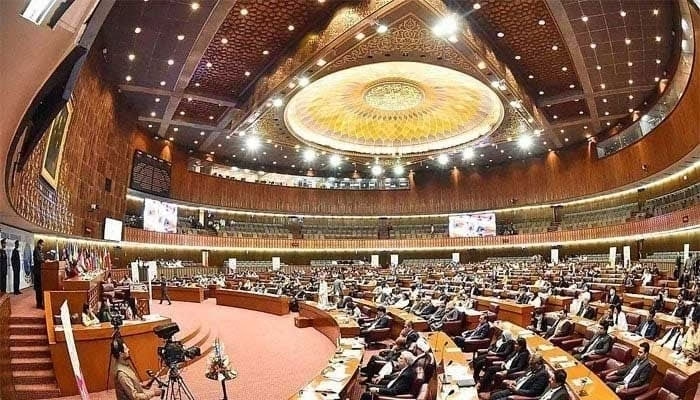
However, National Assembly Opposition Leader Mahmood Khan Achakzai suggested that the session should not be limited to selected leaders. He proposed expanding the Pakistan security briefing to the entire parliament, arguing that all representatives must be fully informed given the seriousness of regional developments.
This difference in approach highlights the importance of transparency and collective decision-making during sensitive times.
Rising Tensions in the Middle East
The scheduling of the Pakistan security briefing coincides with escalating tensions in the Middle East. Recent joint strikes by the United States and Israel on Iran have intensified the situation, raising fears of broader conflict in the region.
Reports indicate that the assault on Tehran, launched on February 28, aimed to target Iran’s naval and missile capabilities. Such developments have global implications, including potential disruptions in energy markets and increased geopolitical uncertainty.
For Pakistan, instability in the Middle East carries significant economic and diplomatic consequences. Millions of Pakistanis work in Gulf countries, and any prolonged conflict could affect remittances, trade routes, and energy supplies.
Cross-Border Security Challenges
In addition to Middle East tensions, Pakistan is dealing with cross-border security threats along the Afghanistan border. The Pakistan Armed Forces have been conducting ground and aerial operations under Operation Ghazab lil-Haq in response to what officials describe as provocative actions by Afghan Taliban elements.
The Pakistan security briefing is expected to include updates on these operations. According to official statements, the operation began on February 27 after unprovoked firing along the Pakistan-Afghanistan border. Since then, hundreds of militants have reportedly been neutralized, and multiple checkposts have been destroyed or captured.
These developments underline the seriousness of the security situation and the need for coordinated political and military strategies.
In-Camera Session for Leaders
Law Minister Azam Nazeer Tarar confirmed that the prime minister will deliver an in-camera briefing to political leaders. Sensitive national security matters often require confidentiality, particularly when operational details and intelligence assessments are involved.
The Pakistan security briefing will likely cover strategic assessments, diplomatic engagements, and potential future scenarios. By keeping the session closed to the public, the government aims to provide candid updates without compromising operational security.
The Importance of Consensus
National security issues often demand bipartisan support. While political disagreements are part of democratic systems, moments of crisis require collaboration. The Pakistan security briefing represents an attempt to ensure that major political stakeholders are aligned on key decisions affecting the country’s stability.
Opposition leaders have indicated they will respond after internal consultations. Their participation could send a strong message of unity, both domestically and internationally.
Political consensus is particularly crucial when dealing with regional conflicts that could have far-reaching consequences. A unified stance strengthens Pakistan’s diplomatic position and reassures citizens that national security remains the top priority.
As regional tensions continue to evolve, the Pakistan security briefing may serve as a foundation for coordinated policy responses. Whether addressing Middle East instability or cross-border security threats, Pakistan faces a complex security environment.
The coming days will reveal how political leaders respond to the prime minister’s invitation and whether broader parliamentary engagement will be considered. What remains clear is that open communication among national leaders is essential during times of uncertainty.
The Pakistan security briefing signals the government’s recognition of the gravity of current regional challenges. By engaging political leadership across party lines, the prime minister aims to foster unity and ensure that Pakistan navigates this sensitive period with clarity and collective resolve.