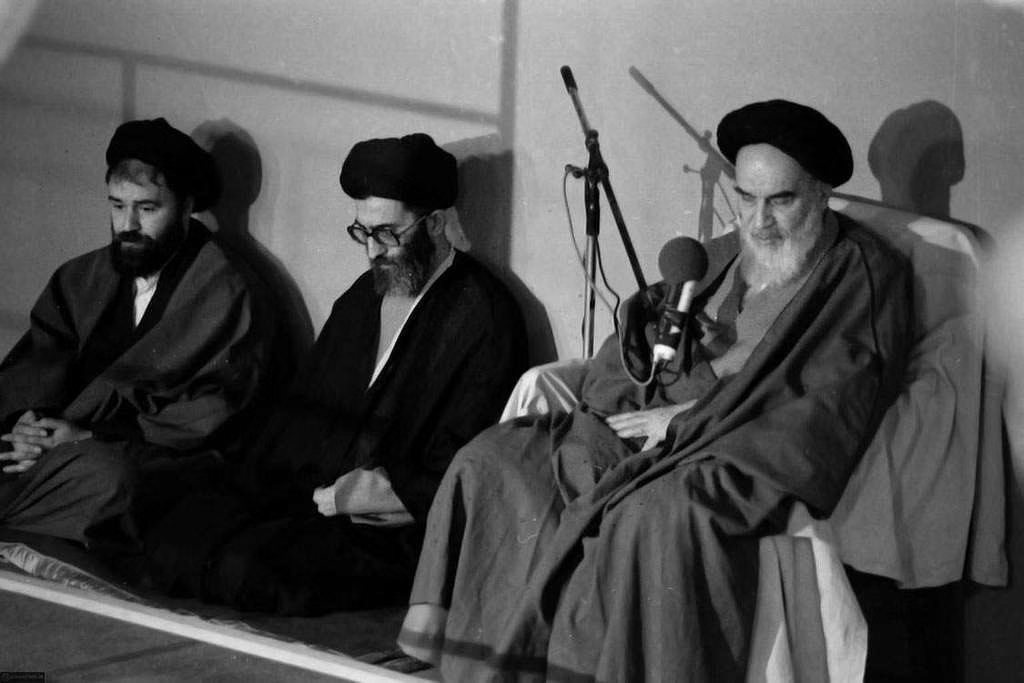
It has been nearly five decades since Ayatollah Ruhollah Khomeini recorded speeches calling for an Islamic revolution from a quiet country house in the affluent French village of Neauphle-le-Château, west of Paris.
Yet residents say they have never entirely moved past the presence of their most famous guest, especially as the US-Israeli war against Iran once again brings attention to the legacy of Iran’s founding revolutionary leader.
Khomeini, regarded as the spiritual architect of Iran’s modern theocratic system, spent just 120 days in the village, located about 40 kilometres from Paris. From there, he coordinated opposition to Shah Mohammad Reza Pahlavi before returning to Tehran on February 1, 1979, in a dramatic homecoming that paved the way for the Iranian Revolution.
Media Storm in a Quiet Town
Andre, an 86-year-old resident who has lived in Neauphle-le-Château since 1974, recalled how the peaceful community in the Yvelines department was suddenly thrust into the global spotlight.
“One evening on television, they announced that an ayatollah had set up home in a comfortable district in the Yvelines,” he said. “By Saturday morning, there was an invasion of journalists. They were parked everywhere.”
The village, situated about 20 kilometres from Versailles, quickly became a gathering point for international media and Iranian supporters, including students travelling from Germany.
“It was incredible,” Andre said. “He organised the whole Iranian revolution from Neauphle-le-Château.”
A Strategic Base in Exile
At the time, Khomeini had been expelled from his exile base in Najaf, Iraq, by Saddam Hussein. France became his next destination, as it was one of the few countries Iranians could enter without a visa.
Initially offered accommodation near Paris by future Iranian president Abolhassan Banisadr, Khomeini ultimately settled in the villa west of the capital. From October 6, 1978, until February 1, 1979, he recorded speeches condemning the shah. These recordings were distributed on cassette tapes and smuggled into Iran, helping mobilise revolutionary forces.
Mixed Feelings Among Residents
Residents remember heightened security, police checks and blocked roads during his stay. While many were not directly disturbed, those living closest to the villa faced inconveniences.
Some locals consider the episode a significant historical moment; others describe it as a brief but unforgettable chapter in the village’s story.
“When we say we come from Neauphle-le-Château, everyone immediately remembers the ayatollah,” said one resident who moved to the area years after the events.
The Villa’s Fate
The house that served as Khomeini’s headquarters was destroyed in an explosion in February 1980. Other buildings now stand on the site, and a commemorative sign that once marked the location was vandalised in 2023.
Annual gatherings are still held to mark Khomeini’s return to Iran. In Tehran, a street bearing the name Neauphle-le-Château reflects the enduring historical link between the quiet French village and one of the most consequential revolutions of the 20th century.