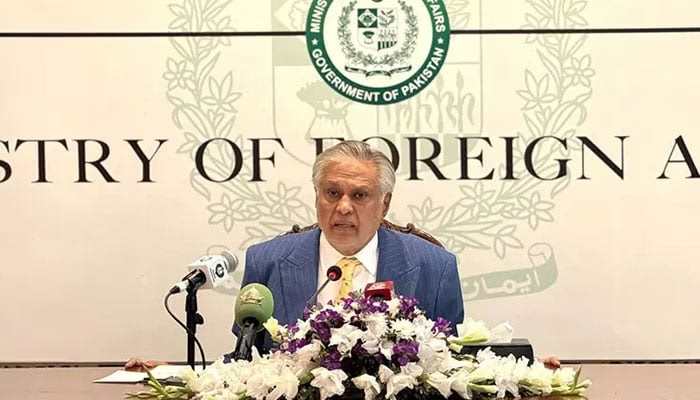
Ishaq Dar has reiterated Pakistan’s commitment to peaceful dialogue as tensions escalate in the region. In his recent statement, Ishaq Dar on Middle East conflict emphasized that negotiations and diplomacy must take precedence over military escalation. Speaking to members of the diplomatic corps in Islamabad, the Deputy Prime Minister underlined that Pakistan is making consistent efforts to reduce tensions and encourage all parties to return to the negotiating table.
The ongoing crisis has widened, with hostilities intensifying between Israel and Iran. Reports indicate that Israel has carried out attacks inside Iran, while Tehran has responded with missile and drone strikes targeting US-linked interests and bases across Gulf states. In this volatile atmosphere, Ishaq Dar on Middle East conflict highlighted that Pakistan views diplomacy as the only viable path toward lasting peace.
Pakistan’s Diplomatic Efforts
Addressing diplomats, Dar acknowledged that the region is going through challenging times. He stressed that Pakistan’s foreign policy efforts are currently centered on de-escalation. According to him, “All our efforts are focused on reducing tensions and bringing the parties back to negotiations.”
The position outlined in Ishaq Dar on Middle East conflict reflects Pakistan’s longstanding approach of advocating peaceful dispute resolution. Rather than aligning with confrontation, Islamabad is pushing for dialogue between the concerned states.
Dar also mentioned that Pakistan is closely monitoring developments in Iran. Given Pakistan’s geographic proximity and economic ties with the region, stability in the Middle East holds significant importance for its national interests.
Impact on Pakistan and the Region
The regional conflict has already had human consequences. Dar referred to an incident in the United Arab Emirates where one Pakistani citizen lost his life during an attack. This tragic development underscores how escalating tensions can affect not only the directly involved countries but also foreign nationals living and working in the region.
Through Ishaq Dar on Middle East conflict, Pakistan conveyed its desire to maintain friendly relations with all neighboring countries. The emphasis remains on constructive engagement rather than confrontation.
Pakistan’s leadership believes that prolonged instability in the Middle East could disrupt trade routes, energy supplies, and economic partnerships, all of which are crucial for regional prosperity.
Position on Palestine and Gaza
Dar also touched upon the situation in Gaza, reiterating Pakistan’s consistent support for peaceful solutions. He recalled that a group of Arab and Islamic countries had meaningful engagement with former US President Donald Trump in efforts aimed at restoring peace and ensuring humanitarian aid to Gaza.
The narrative of Ishaq Dar on Middle East conflict therefore extends beyond immediate hostilities and includes broader regional concerns, particularly the humanitarian dimension in Palestine. Pakistan continues to advocate for diplomatic channels to address these longstanding disputes.
Engagement with Afghanistan
In addition to Middle East tensions, Dar spoke about his diplomatic outreach to Afghanistan. He mentioned visiting Kabul and holding extensive discussions with the Taliban leadership regarding trade and economic cooperation.
However, Dar reiterated Pakistan’s firm stance that Afghan soil must not be used for terrorism against Pakistan. He stated that there is solid evidence suggesting that certain elements have exploited Afghan territory for hostile activities.
Although this issue is separate from the Middle East crisis, it demonstrates the broader diplomatic challenges Pakistan is currently navigating. The approach outlined in Ishaq Dar on Middle East conflict aligns with Islamabad’s regional policy of combining dialogue with clear security concerns.
Diplomacy as the Only Way Forward
A key takeaway from Dar’s remarks is his repeated assertion that negotiations are the only sustainable solution. Military responses, while immediate, often deepen conflicts and prolong instability. Pakistan’s leadership believes that diplomatic engagement can create space for trust-building and long-term stability.
The emphasis in Ishaq Dar on Middle East conflict was not merely rhetorical. It reflects a strategic calculation that regional peace directly impacts Pakistan’s security and economic outlook. Escalation between major regional players could have ripple effects far beyond the Middle East.
By advocating diplomacy, Pakistan positions itself as a supporter of peaceful conflict resolution on the international stage. This stance aligns with its broader foreign policy principles.
The escalating hostilities in the Middle East present serious challenges for global and regional stability. Through his remarks, Ishaq Dar has clearly articulated Pakistan’s preference for dialogue over confrontation. The message conveyed in Ishaq Dar on Middle East conflict is straightforward: sustainable peace can only be achieved through negotiations and diplomatic engagement.
As tensions continue, Pakistan’s call for restraint and dialogue underscores the importance of diplomacy in preventing further escalation. Whether global actors heed this call remains to be seen, but Islamabad’s position is firmly rooted in the belief that communication—not conflict—is the path toward lasting peace.