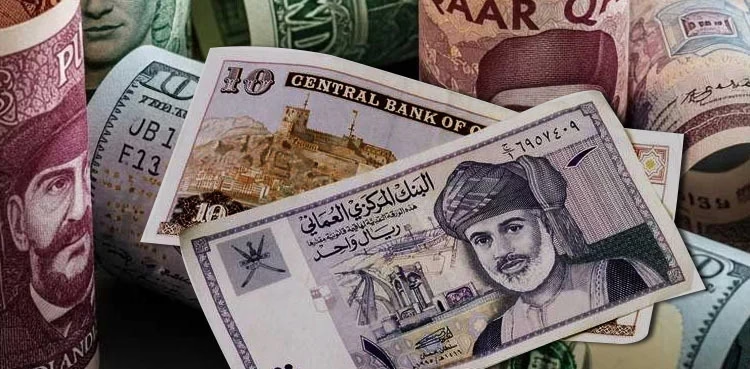
As of February 28, 2026, one Omani Riyal (OMR) is trading at 726.60 Pakistani Rupee (PKR), slightly down from last week’s 726.96 PKR.
The OMR–PKR pair remains confined to a tight 726–727 range, reflecting low volatility and no strong directional momentum.
Why the rate is so stable
🇴🇲 Omani Riyal fundamentals
- Pegged to the US dollar at 2.6008 since 1986
- Backed by Oman’s oil and gas revenues
- Historically one of the most stable Gulf currencies
With Brent crude hovering around $71–73 per barrel, there’s no major catalyst driving sharp OMR movement.
🇵🇰 Pakistani Rupee support
The State Bank of Pakistan oversees the PKR, which is currently supported by:
- Strong remittance inflows (January 2026: $3.5 billion, up year-on-year)
- Moderating inflation (around 5.6%)
- Improved external stability
Technically, the pair remains below the 50-day moving average near 732 PKR, maintaining a mild softening bias unless oil prices or dollar strength accelerate.
What it means for overseas Pakistanis
For the large Pakistani workforce in Oman, the extended stability brings predictability:
- 500 OMR ≈ 363,300 PKR
- Budgeting for school fees, healthcare, rent, and essentials becomes easier
- Minimal week-to-week fluctuations reduce financial stress
While the rate is slightly softer compared to earlier highs, the lack of sharp swings helps families plan confidently.
Trade and travel impact
Bilateral trade between Pakistan and Oman (estimated around $1–1.2 billion annually) continues smoothly at current levels:
- Pakistan exports textiles, rice, leather goods
- Oman supplies petroleum products and chemicals
The stable exchange range keeps energy imports reasonably priced and preserves competitiveness for exporters.
For travelers:
- 1,000 PKR ≈ 1.376 OMR, with negligible change week to week
Outlook
Near-term direction may depend on:
- Whether Brent crude pushes above $74–75 per barrel
- February remittance data performance
- Broader US dollar movement
Unless oil markets or dollar sentiment shift decisively, the OMR–PKR pair is expected to remain in its current contained band.