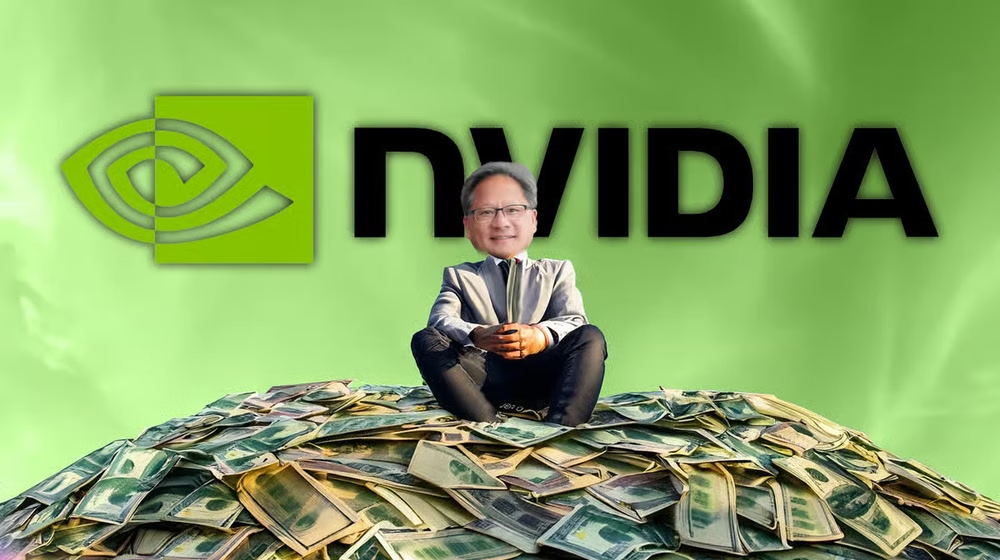
The latest earnings report confirms that Nvidia record profits are being powered by an unprecedented surge in artificial intelligence demand. The semiconductor giant announced $68 billion in quarterly revenue, marking a remarkable 73% increase compared to the same period last year. The results underline how deeply the global tech industry now depends on AI infrastructure and high-performance computing.
For the full fiscal year, Nvidia generated an impressive $215 billion in revenue. These numbers not only exceeded many market expectations but also reinforced the company’s position at the center of the AI revolution.
Data Center Drives Growth
A key driver behind Nvidia record profits is its data center business. Out of the $68 billion quarterly revenue, $62 billion came from this segment alone. This demonstrates how critical data centers have become in supporting AI models, cloud computing, and enterprise workloads.
For the first time, Nvidia provided a detailed breakdown of its data center revenue. The company reported $51 billion in compute revenue, largely driven by graphics processing units (GPUs), and $11 billion from networking technologies such as NVLink.
GPUs have become the backbone of modern AI systems, enabling machine learning models to train faster and process massive amounts of data. As AI adoption accelerates globally, demand for Nvidia’s hardware continues to surge.
AI Demand Reaches Exponential Levels
Chief Executive Officer Jensen Huang emphasized during an analyst call that the demand for AI tokens has grown exponentially. He noted that even older GPUs deployed in cloud environments remain fully utilized, with pricing on these resources increasing.
Huang described the industry as reaching an inflection point where compute power directly translates into revenue. According to him, in the new AI economy, “compute is revenue.” This idea highlights a shift in how technology companies view infrastructure spending—not merely as an expense, but as a revenue-generating engine.
The scale of Nvidia record profits reflects this transformation. Cloud providers and enterprises are investing heavily in AI compute to build advanced applications, from generative AI to large-scale data analytics.
No Revenue from China
Despite positive global performance, Nvidia reported no revenue from chip exports to China during the quarter. This is significant, given China’s historically important role in the semiconductor market.
Chief Financial Officer Colette Kress explained that while small quantities of H200 products were approved for China-based customers by U.S. authorities, these shipments have not yet generated revenue. She also acknowledged uncertainty about whether additional exports would be permitted in the future.
In addition, Kress pointed to rising competition within China. Domestic tech firms are ramping up development efforts, and recent IPO activity suggests growing ambitions in AI hardware. Over time, this competition could challenge Nvidia’s dominance in certain markets.
Even so, Nvidia record profits demonstrate that demand from other global regions more than compensated for the lack of Chinese revenue this quarter.
Expanding AI Partnerships
Beyond hardware sales, Nvidia is strengthening its role within the broader AI ecosystem. During the investor call, Huang addressed reports of a potential $30 billion investment discussion with OpenAI.
He indicated that negotiations toward a partnership agreement are ongoing and expressed optimism about reaching a deal. However, regulatory filings with the U.S. Securities and Exchange Commission clarified that there is no guarantee an investment will materialize.
Huang also highlighted partnerships with Anthropic, Meta, and xAI. These collaborations illustrate Nvidia’s strategy of aligning itself with major AI innovators, ensuring its chips remain central to next-generation platforms.
Addressing Sustainability Concerns
Some analysts have questioned whether the tech sector’s heavy capital expenditures on AI infrastructure are sustainable. Huang responded by arguing that compute investments are expected to generate substantial revenue returns.
In his view, AI tokens—units of data processed by AI systems—are becoming both productive for customers and profitable for cloud providers. Without compute power, there would be no tokens, and without tokens, no revenue growth.
This perspective suggests that Nvidia record profits may not be a short-term spike but part of a longer structural shift toward AI-driven business models.
The Bigger Picture
Nvidia’s financial performance signals a broader transformation in the global economy. Artificial intelligence is no longer an experimental field—it is a primary driver of corporate investment and innovation.
The combination of record-breaking revenue, expanding partnerships, and sustained demand positions Nvidia as one of the most influential companies in the AI era. While geopolitical challenges and competition remain factors to watch, the company’s current trajectory appears strong.
Nvidia record profits highlight how central AI infrastructure has become to modern technology. As organizations across industries continue integrating AI into their operations, the demand for high-performance compute is likely to remain robust. For now, Nvidia stands firmly at the forefront of this technological revolution.