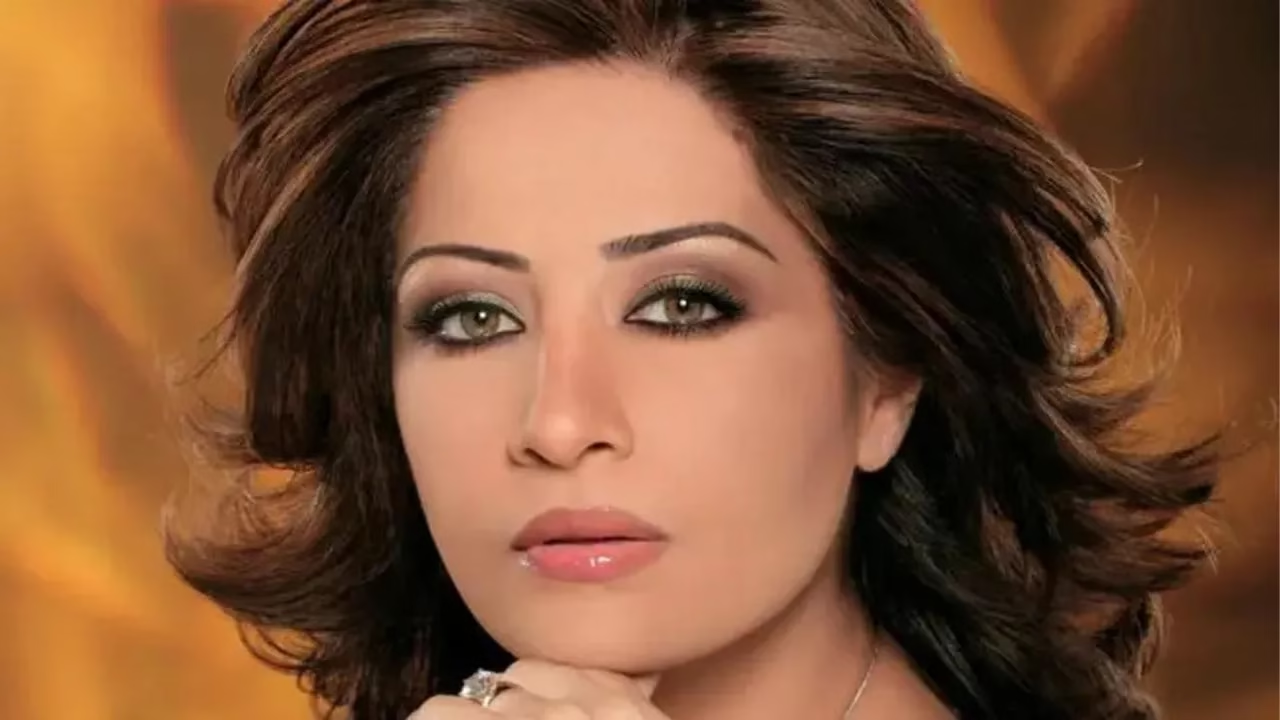
The recent statement by Atiqa Odho on gender equality has sparked an important conversation about how society views men and women. Speaking on a private television channel, Atiqa Odho shared her perspective that individuals should be judged based on their character rather than their gender. Her remarks have resonated with many who believe that fairness and balance are essential when discussing sensitive social issues.
In her candid discussion, Atiqa Odho on gender equality stressed that while women’s struggles are real and undeniable, it is unfair to label all men negatively. She acknowledged that women face oppression and injustice in many parts of the world, including Pakistan. However, she argued that holding every man responsible for societal wrongs creates another form of unfair judgment.
Judging Individuals, Not Genders
One of the key points in Atiqa Odho on gender equality was her emphasis on character. She explained that negative attitudes are not limited to one gender. Just as some men may behave unjustly, women can also display harsh or unfair behavior. According to her, reducing complex social problems to a simple men versus women debate does not solve anything.
She gave a personal example, mentioning her father and brother as men she considers excellent human beings. For her, this highlights how incorrect it is to generalize about an entire gender. By sharing her personal experiences, she aimed to show that good and bad behavior depends on individual values, upbringing, and choices — not gender alone.
Recognizing Women’s Real Struggles
While speaking about gender issues, Atiqa Odho made it clear that she fully recognizes the challenges women face. From workplace inequality to domestic violence, these are serious concerns that demand attention and action. She did not dismiss women’s struggles; instead, she called for a balanced approach.
Her comments suggest that acknowledging women’s rights does not require attacking men as a group. The conversation around gender equality should focus on solutions, empathy, and accountability, rather than blame directed at all men collectively.
The Global Nature of Oppression
Another important aspect of Atiqa Odho on gender equality was her observation that oppression is not limited to Pakistan. Around the world, societies grapple with inequality, discrimination, and injustice. However, she cautioned against turning frustration into blanket accusations.
By pointing out that injustice is a global issue, she emphasized that social problems are systemic. They are shaped by culture, tradition, power dynamics, and historical factors. Blaming every man for these issues oversimplifies a deeply complex reality.
The Emotional Impact of Generalization
Atiqa Odho also shared a personal reaction: she feels hurt when people say that all men are bad. According to her, such statements insult the many men who respect, protect, and support women in their lives. Fathers, brothers, husbands, and friends who stand by women should not be overshadowed by the wrongdoing of others.
This perspective adds another dimension to the debate. Generalizations not only distort reality but can also alienate individuals who are allies in the fight for equality. True progress, she implied, comes from unity rather than division.
Men as Silent Victims
In a revealing part of her discussion, Atiqa Odho mentioned that she knows many men who have suffered abuse or emotional trauma due to domestic problems or failed marriages. However, these men often remain silent about their pain.
Society frequently expects men to appear strong and emotionally unaffected. As a result, male victims may hesitate to speak about their experiences. By bringing this issue into the conversation, Atiqa Odho on gender equality broadened the discussion beyond traditional narratives.
Her point was not to minimize women’s suffering but to remind audiences that injustice can affect anyone. Compassion and understanding should extend to all individuals facing hardship.
A Call for Balanced Dialogue
The essence of Atiqa Odho’s message is balance. Gender equality should mean fairness, accountability, and respect for everyone. It should encourage addressing harmful behaviors without creating new stereotypes.
Constructive dialogue requires acknowledging real issues while avoiding sweeping generalizations. When discussions turn into blame games, they often lose their power to create meaningful change.
Moving Toward Mutual Respect
The conversation sparked by Atiqa Odho on gender equality reflects a broader shift in how society talks about gender roles. As awareness grows about women’s rights and empowerment, it is equally important to maintain fairness in judgment.
Equality does not mean replacing one extreme with another. Instead, it calls for recognizing humanity in every individual. By judging people on their actions rather than their gender, society can move toward healthier relationships and stronger communities.
Atiqa Odho’s remarks remind us that progress depends on empathy, open dialogue, and mutual respect. True equality lies not in collective blame, but in shared responsibility for building a just and balanced society.