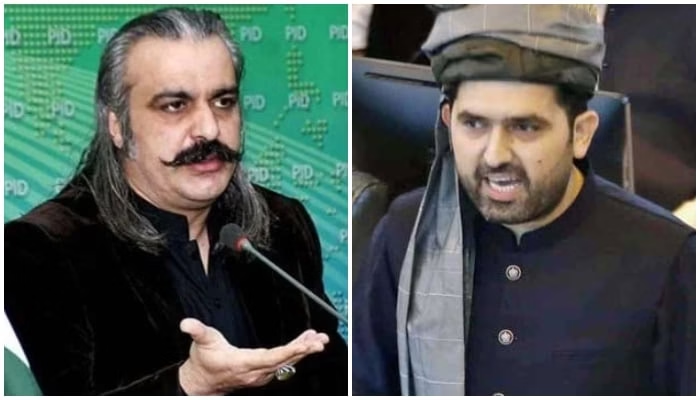
The recent Ali Amin Gandapur security controversy has sparked political debate in Khyber Pakhtunkhwa after the former chief minister claimed that his government-provided security had been withdrawn. Gandapur stated that even if his security is restored, he would refuse to accept it, further intensifying the discussion around the issue.
Ali Amin Gandapur, who stepped down as chief minister of Khyber Pakhtunkhwa in October last year, revealed that his security personnel were contacted late at night by officials and instructed to return. According to him, the deputy chief security officer of the provincial administration called his team around 11pm, directing them to report back.
Claims of Security Withdrawal
Gandapur explained that he had been provided with a provincial government jammer, a double-cabin vehicle, and 14 security personnel as part of his official protection. However, he claimed that the security staff approached him after receiving instructions to withdraw, prompting him to tell them to just close up.
The Ali Amin Gandapur security controversy deepened when he publicly declared that he does not require security and would not accept it even if the provincial government attempts to restore it. He directly addressed the current chief minister, stating there was no need to return his protection detail.
Such a strong statement from a former chief executive has raised eyebrows, especially in a province where political tensions and security concerns have often been high.
Government’s Response
In response to Gandapur’s claims, a spokesperson for the KP Chief Minister House denied that any decision had been made to withdraw his security. The spokesperson clarified that no instructions had been issued to the relevant authorities regarding this matter.
This denial has created conflicting narratives surrounding the Ali Amin Gandapur security controversy. While Gandapur insists his security was ordered back, the provincial administration maintains that no such directive was given.
The situation highlights the sensitive nature of security arrangements for former public office holders. In Pakistan, former chief ministers are often provided security based on risk assessments and government policies.
Political Background
To fully understand the Ali Amin Gandapur security controversy, it is important to revisit the political developments that led to his resignation.
Gandapur, a prominent leader of Pakistan Tehreek-e-Insaf (PTI), resigned as chief minister on October 8 last year. His resignation came shortly after party leadership announced Sohail Afridi as his successor for the top provincial post.
At the time of his resignation, Gandapur stated that he was stepping down in compliance with the orders of PTI’s founding chairman, Imran Khan. He described it as an honor to follow his leader’s directive.
Following the announcement, Afridi was elected as the new chief executive of the province on October 13 and took oath on October 15. Reports at the time suggested that internal party dynamics and political strategies played a role in the leadership transition.
Speculations Around Resignation
After Gandapur’s resignation, Member of the National Assembly Sher Afzal Marwat claimed that one of the reasons behind the move was Gandapur’s inability to secure the release of Imran Khan from jail. Although this claim was widely discussed, there was no official confirmation linking the resignation directly to that issue.
The Ali Amin Gandapur security controversy now adds another layer to the evolving political narrative within PTI and Khyber Pakhtunkhwa’s provincial politics.
Security and Political Messaging
Security matters in Pakistan often carry political symbolism. By publicly refusing government-provided protection, Gandapur appears to be sending a strong message. Whether this stance is rooted in principle, political strategy, or personal conviction remains open to interpretation.
Supporters may view his decision as a show of confidence and independence, while critics could question the implications of such statements, especially if security assessments recommend continued protection.
The Ali Amin Gandapur security controversy also underscores the importance of clear communication between political leaders and administrative authorities. Conflicting statements can create confusion and speculation, particularly in a politically charged environment.
Broader Implications
Beyond the immediate issue of security withdrawal, this development reflects ongoing political adjustments within Khyber Pakhtunkhwa. Leadership transitions, internal party shifts, and public messaging all contribute to the evolving landscape.
For the public, clarity and transparency are essential. Whether the matter resolves quietly or develops into a larger political debate will depend on future statements and actions from both Gandapur and the provincial government.
The Ali Amin Gandapur security controversy has once again brought Khyber Pakhtunkhwa’s political scene into the spotlight. With claims of security withdrawal, official denials, and a firm refusal from the former chief minister, the situation remains noteworthy.
While the matter may ultimately be administrative, its political undertones make it significant. As events unfold, observers will be watching closely to see how both sides address the issue and whether it leads to further political developments in the province.