China on Tuesday imposed export restrictions on 40 Japanese companies and entities, citing national security concerns, in the latest escalation of a diplomatic and economic row between the two countries.
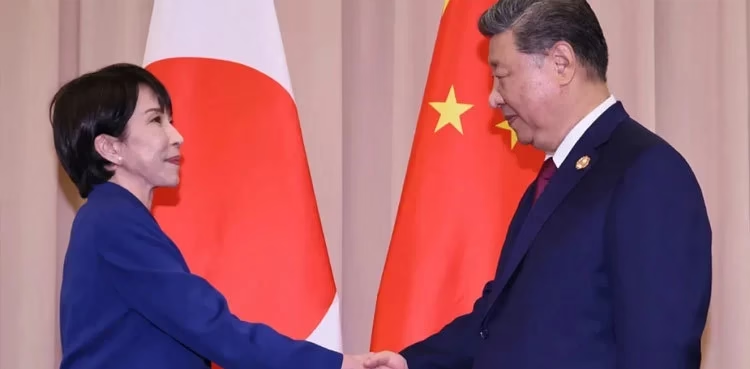
The dispute intensified after Japanese Prime Minister Sanae Takaichi said in November that Tokyo could intervene militarily in the event of an attack on Taiwan. Since then, tensions have risen sharply, with Chinese tourism to Japan reportedly plummeting.
In its latest move, China’s commerce ministry restricted exports to 20 Japanese entities, including five subsidiaries of Mitsubishi Heavy Industries and the Japan Aerospace Exploration Agency. The entities are accused of contributing to Japan’s military capabilities.
Under the new rules, Chinese exporters are barred from supplying dual-use items — goods with both civilian and military applications — to the listed entities. Overseas firms are also prohibited from providing them with dual-use products originating in China.
An additional 20 Japanese companies, including automaker Subaru, were placed on a “watch list,” subjecting them to stricter export reviews for items that could have military applications.
Beijing said the measures aim to curb what it described as Japan’s “remilitarisation” and nuclear ambitions, calling the steps legitimate and lawful. A Japanese trade official responded that Tokyo would assess the impact of the curbs and take appropriate measures.
Shares Slide, Defence Firms Targeted
The announcement triggered declines in Japanese markets. Shares of Kawasaki Heavy Industries fell nearly five percent, while Mitsubishi Heavy Industries dropped close to four percent and IHI slid almost seven percent.
The restrictions particularly affect shipbuilding and aerospace firms, including major shipbuilder Japan Marine United and subsidiaries of Kawasaki Heavy Industries. Many of the targeted companies are involved in defence production, manufacturing ships, fighter jets and missile systems for Japan’s military.
China’s commerce ministry stressed that the measures target only a limited number of entities and would not disrupt normal economic exchanges. Companies placed on the watch list — including Mitsubishi Materials — may apply for removal if they comply with Beijing’s verification requirements.
Broader Economic Fallout
The tensions have had wider economic consequences. Chinese tourism to Japan has declined significantly since Beijing warned citizens against travel. Reports also indicate that China has again suspended Japanese seafood imports, following earlier bans related to wastewater releases from the Fukushima nuclear plant.
In January, Beijing announced a broader ban on exporting dual-use goods to Japan. Additionally, China has reportedly tightened exports of rare earth elements and high-powered magnets — critical components for advanced technologies and defence systems.
Meanwhile, Japan has been expanding its defence posture. Takaichi’s government recently approved a record nine-trillion-yen ($58 billion) defence budget to enhance military capabilities, citing increased Chinese activity in the East and South China Seas.
As both nations harden their positions, the trade restrictions mark a significant escalation in a dispute that is increasingly spilling over into economic and strategic sectors.