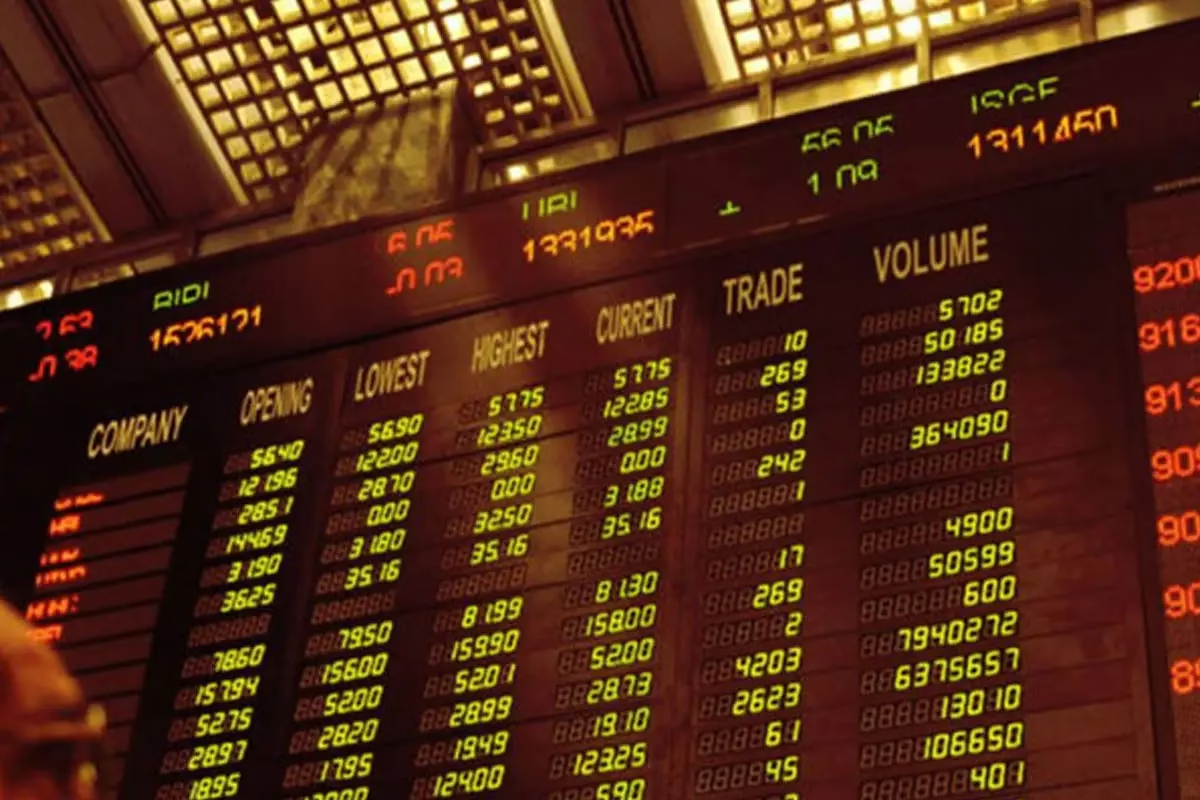
The latest Pakistan stock market crash sent shockwaves through investors on Monday as the benchmark index erased last week’s gains and slipped deeper into negative territory. The sharp decline reflected rising uncertainty and growing caution among traders who are closely monitoring both domestic and global economic developments.
The benchmark KSE-100 Index plunged by 5,478 points, or 3.16%, closing at 167,691 points. During intraday trading, the index briefly touched a low of 166,886 points, marking a drop of 6,283 points (3.63%). The scale of the fall indicates significant selling pressure across major sectors.
Heavyweights Drag the Market Down
Large-cap companies played a major role in the Pakistan stock market crash. Among the biggest contributors to the decline were Fauji Fertilizer Company (FFC), Lucky Cement (LUCK), Engro Holdings (ENGROH), National Bank of Pakistan (NBP), and Habib Bank Limited (HBL). Collectively, these stocks wiped out 1,797 points from the index.
Because these firms carry significant weight in the KSE-100, even moderate price declines can have a noticeable impact on the overall market. The heavy selling in banking, cement, and fertilizer sectors suggests that institutional investors may be reducing exposure amid uncertainty.
Out of 567 companies traded during the session, only 42 recorded gains, while 389 declined and 136 remained unchanged. This broad-based weakness highlights the depth of the downturn rather than a sector-specific correction.
Trading Activity Remains Strong
Despite the negative sentiment, trading volumes remained active. A total of 204.7 million shares were exchanged, with a turnover value of Rs. 20.6 billion. High trading volumes during a downturn often indicate panic selling or portfolio rebalancing by large investors.
Among the most traded stocks by volume was K-Electric (KEL), with 36.06 million shares changing hands. The stock fell by Rs. 0.37. WorldCall Telecom (WTL) followed with 33.67 million shares traded, slipping by Rs. 0.06.
Bank of Punjab (BOP) saw 26.67 million shares traded and declined by Rs. 2.85, reflecting pressure on the banking sector. Meanwhile, Fauji Net Limited (FNEL) was one of the few gainers, rising slightly by Rs. 0.08 with 24.64 million shares traded.
Other active stocks included Pakistan Telecommunication Company Limited (PTC), which dropped Rs. 2.12, and Pakistan International Bulk Terminal (PIBTL), which fell Rs. 1.19.
What Triggered the Decline?
The Pakistan stock market crash appears to be driven by a combination of domestic economic concerns and global market volatility. Investors are carefully watching inflation trends, interest rate expectations, and exchange rate stability.
Globally, uncertainties around economic growth, geopolitical tensions, and commodity price fluctuations have also affected emerging markets. Pakistan, being an emerging economy, is particularly sensitive to foreign investor sentiment and external financial conditions.
When uncertainty rises, investors often shift toward safer assets, leading to equity sell-offs. Monday’s sharp drop suggests that many market participants preferred to reduce risk exposure rather than wait for clarity.
Investor Sentiment and Outlook
The recent Pakistan stock market crash underscores how quickly sentiment can shift in financial markets. Just last week, the market had posted gains, raising hopes of a sustained recovery. However, the sudden reversal shows that confidence remains fragile.
Short-term volatility is likely to persist as traders react to economic data releases and policy signals. Analysts believe that upcoming monetary policy decisions and fiscal measures could play a key role in shaping the next market direction.
Long-term investors, however, often view such corrections as opportunities to accumulate fundamentally strong stocks at lower valuations. Much will depend on whether economic indicators stabilize in the coming weeks.
The sharp fall in the KSE-100 has put the spotlight back on market volatility. The Pakistan stock market crash wiped out recent gains and highlighted the influence of large-cap stocks on overall performance. While trading volumes suggest active participation, the dominance of declining shares reflects cautious sentiment.
As investors navigate uncertain economic conditions, market movements are likely to remain sensitive to both domestic developments and global trends. The coming days will be crucial in determining whether the market stabilizes or faces further downward pressure.