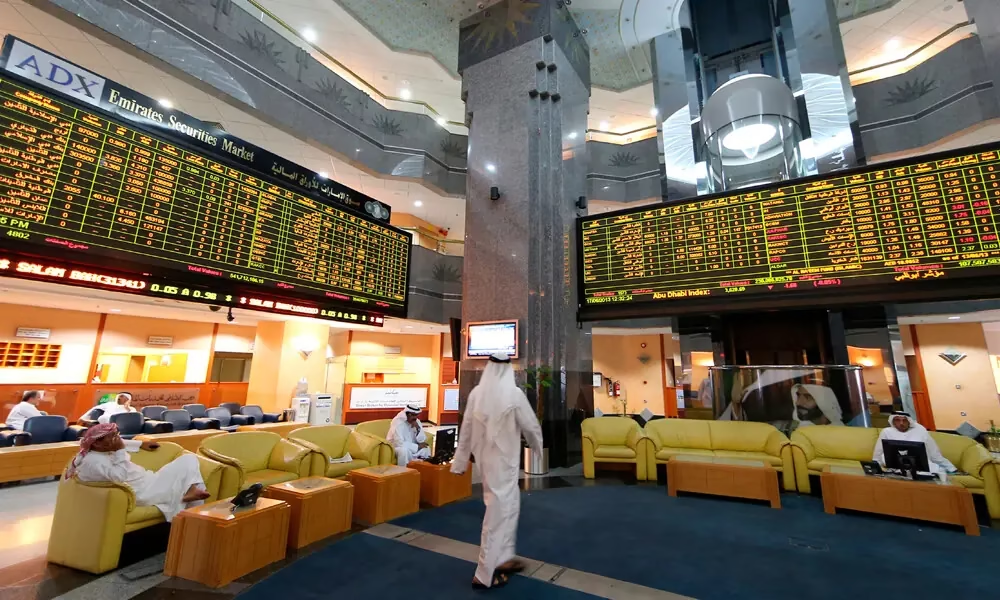
The UAE stock market decline on Friday reflected growing investor anxiety as geopolitical tensions between the United States and Iran intensified. Markets across the United Arab Emirates reacted cautiously after strong remarks from former U.S. President Donald Trump regarding Iran’s nuclear programme. His warning that really bad things could happen if Tehran failed to reach an agreement within 10 to 15 days added uncertainty to an already sensitive regional environment.
The impact of these political developments was immediately visible in Abu Dhabi and Dubai’s financial markets. Investors chose to reduce exposure, leading to a modest but noticeable dip in key indices.
Abu Dhabi Market Under Pressure
In Abu Dhabi, the benchmark index slipped by 0.3%, closing at 10,581 points. The downturn was mainly driven by losses in the real estate sector. Aldar Properties, one of the emirate’s largest property developers, saw its shares drop 2.6%. The decline came even after the company announced it had issued $1 billion in subordinated hybrid notes to Apollo Global Management through a private placement.
Although raising capital is often viewed as a positive long-term move, markets sometimes react cautiously to large debt issuances. Investors may worry about increased leverage, especially during periods of geopolitical tension.
Another stock that faced pressure was Agility Global, which recorded a 1.4% decline. The broader sentiment remained cautious, with traders closely monitoring international developments.
Despite the overall UAE stock market decline, there were some bright spots. Agro-food investment firm Invictus Investment rose 1.6% after reporting a strong 34% increase in full-year profit, reaching 225.9 million dirhams. This performance demonstrated that solid corporate earnings can still attract investor confidence even in uncertain times.
Dubai Market Follows the Trend
Dubai’s main index also ended the day 0.3% lower, closing at 6,590 points. Banking stocks were among the primary contributors to the drop. Dubai Islamic Bank fell 2.2%, while leading lender Emirates NBD slipped 0.7%.
Banks often react quickly to geopolitical news because such developments can influence economic growth, investment flows, and liquidity conditions. When uncertainty rises, investors typically shift towards safer assets, reducing exposure to equities.
The synchronized decline in both Abu Dhabi and Dubai highlights how regional markets are interconnected and sensitive to global political shifts.
Oil Prices Add to Caution
Oil prices, a major driver of Gulf economies, also played a role in shaping market sentiment. Brent crude eased by 0.4% to $71.38 per barrel after two consecutive sessions of gains. Although the drop was small, it added to the cautious mood.
For Gulf countries, oil revenues significantly influence government spending, infrastructure projects, and overall economic growth. Even slight fluctuations in oil prices can affect investor expectations. When combined with geopolitical uncertainty, this creates a complex environment for financial markets.
Geopolitics and Market Psychology
The current UAE stock market decline underscores how sensitive financial markets are to geopolitical risk. Statements regarding Iran’s nuclear programme have historically impacted global oil prices and regional stability. Investors closely watch such developments because they can influence trade routes, energy exports, and diplomatic relations.
While the immediate decline was modest, it reflects a wait-and-see approach among investors. Markets dislike uncertainty more than bad news. A clear diplomatic resolution could quickly restore confidence, whereas escalating tensions might deepen volatility.
It is important to note that the fundamentals of the UAE economy remain relatively strong. The country has diversified its economy beyond oil, investing heavily in tourism, technology, renewable energy, and financial services. Strong corporate earnings, such as those reported by Invictus, indicate resilience at the company level.
What Investors Should Watch
Going forward, market participants will closely monitor diplomatic discussions between the U.S. and Iran. Any indication of progress toward a deal could ease pressure and reverse the recent UAE stock market decline. On the other hand, further escalation may push investors toward defensive strategies.
Oil price movements will also remain critical. Stability above current levels would likely support market sentiment, while sharp declines could increase selling pressure.
The recent UAE stock market decline highlights the powerful connection between geopolitics and financial markets. Although the drop was relatively mild, it serves as a reminder that regional markets remain sensitive to international developments. As investors await clarity, volatility may persist, but strong economic fundamentals could help cushion the impact in the weeks ahead.