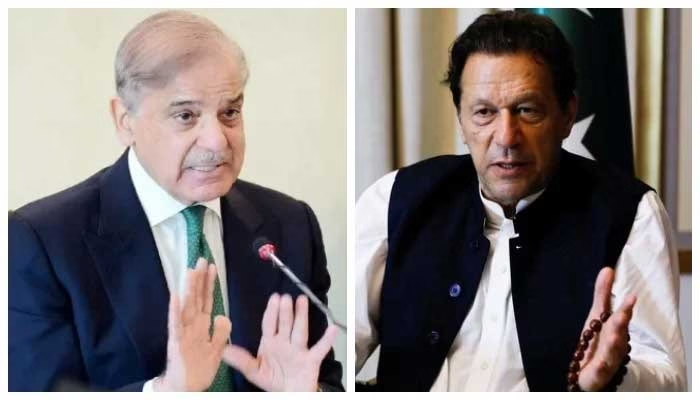
The recent development in the Supreme Court halts defamation case involving Prime Minister Shehbaz Sharif and PTI founder Imran Khan has drawn significant political and legal attention across Pakistan. On Friday, the apex court barred a trial court from proceeding further with the defamation lawsuit filed by the prime minister, temporarily pausing a high-profile legal battle that has been ongoing for several years.
The defamation suit stems from allegations made by Imran Khan during a television programme on April 26, 2017. In that broadcast, he claimed that Shehbaz Sharif had offered him Rs10 billion to withdraw the Panama Papers case. The prime minister strongly denied the accusation, calling it false, baseless, and damaging to his reputation. Following the remarks, a legal notice was served in May 2017, demanding a public apology. According to Shehbaz Sharif, no apology was issued, prompting him to file a lawsuit seeking Rs10 billion in damages.
Background of the Legal Dispute
The case has its roots in the heated political climate surrounding the Panama Papers controversy. During that period, allegations and counter-allegations dominated political discourse. The televised statement at the center of this dispute became a key flashpoint.
Shehbaz Sharif maintained that the accusation of offering a bribe was a serious defamatory statement that harmed his personal and political reputation. He argued that such a claim, aired publicly, carried significant weight and impact. The lawsuit aimed to secure compensation for what he described as reputational damage far exceeding ordinary political criticism.
The Supreme Court halts defamation case order now shifts the legal trajectory, placing the matter under the apex court’s direct scrutiny.
Supreme Court’s Stay Order
A three-member bench headed by Justice Ayesha Malik issued the stay order on Imran Khan’s plea to halt the trial court proceedings. The former prime minister, who is currently incarcerated, approached the Supreme Court seeking relief after developments in the lower court.
The apex court not only suspended further proceedings but also issued notice to Prime Minister Shehbaz Sharif, asking for his response. The bench indicated that the matter would be fixed for early hearing, signaling that the court intends to address the dispute promptly.
Interestingly, during the hearing, it was noted that no representative from the prime minister’s side appeared before the bench. This observation became part of the court’s remarks while issuing the stay.
With the Supreme Court halts defamation case ruling, the lower court is now barred from moving forward until the apex court makes a final determination.
Trial Court Proceedings and Developments
Before the Supreme Court’s intervention, the trial court had struck off Imran Khan’s right of defense. This move significantly escalated the matter, prompting the PTI founder to seek relief from the higher judiciary.
In earlier proceedings, Prime Minister Shehbaz Sharif appeared via video link and underwent cross-examination by the PTI founder’s counsel. During that hearing, he reiterated that the Rs10 billion allegation was deeply damaging. He compared the impact of the televised claim to the circulation of “millions of pamphlets,” emphasizing that broadcast statements carry immense influence.
The prime minister also clarified that while his name may not have been explicitly mentioned in a particular segment, the overall context pointed directly toward him. He maintained that even without written or printed material, the televised remarks amounted to a serious attack on his reputation.
The Supreme Court halts defamation case decision effectively pauses further examination of these claims at the trial level.
Legal and Political Implications
The stay order has both legal and political implications. Legally, it underscores the Supreme Court’s authority to intervene when procedural or constitutional concerns arise in lower court proceedings. By halting the trial, the apex court has ensured that due process considerations will be examined carefully.
Politically, the dispute reflects the long-standing rivalry between the Pakistan Muslim League (N) and Pakistan Tehreek-e-Insaf. Allegations, counter-allegations, and court cases have frequently defined their political engagement over the past decade.
The Supreme Court halts defamation case ruling does not determine the merits of the allegations but instead focuses on procedural fairness. The final outcome will depend on future hearings and legal arguments presented before the bench.
What Happens Next?
With notices issued and an early hearing expected, the case will now proceed at the Supreme Court level. Both sides will have the opportunity to present arguments regarding the continuation or dismissal of the defamation suit.
If the stay is lifted, the trial court proceedings may resume. If the Supreme Court rules otherwise, the lawsuit could face significant changes in its direction.
The Supreme Court halts defamation case order marks a temporary pause in a politically sensitive legal battle that has spanned several years.
The Supreme Court’s decision to halt the defamation case between Prime Minister Shehbaz Sharif and Imran Khan represents a critical moment in this long-running dispute. While the allegations date back to 2017, their legal consequences remain unresolved.
As the matter moves forward in the apex court, the focus will shift to questions of due process, fairness, and legal procedure. The coming hearings will determine whether the case proceeds or takes a different course, but for now, the Supreme Court’s intervention has reshaped the path of this high-profile legal contest.