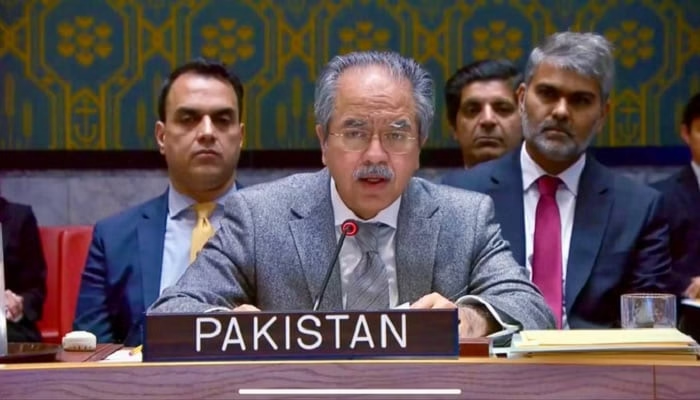
The growing UN liquidity crisis is raising serious concerns about the future of global peacekeeping missions, with top diplomats warning that financial instability could weaken the United Nations’ ability to maintain international peace and security. Pakistan’s Permanent Representative to the UN, Ambassador Asim Iftikhar Ahmad, recently cautioned that the deepening funding shortfall is directly undermining peacekeeping operations worldwide.
Speaking at the opening of the Special Committee on Peacekeeping Operations, Ambassador Iftikhar stressed that UN peacekeeping remains an indispensable tool for maintaining global stability. However, he warned that mounting political, operational, and financial pressures are limiting the organization’s effectiveness. His remarks echo concerns voiced earlier by UN Secretary-General António Guterres, who warned that the world body could face an imminent financial collapse if member states fail to pay their dues in full and on time.
The Scale of the Financial Shortfall
The UN liquidity crisis has reached alarming levels. By the end of 2025, the United Nations reported a record $1.57 billion in unpaid dues. This shortfall affects not only administrative functions but also the delivery of essential programs and peacekeeping missions across conflict zones.
Guterres has highlighted that the UN’s cash-flow problems stem largely from member states failing to meet their mandatory financial obligations. Without naming specific countries, UN officials have made it clear that delayed or withheld payments are pushing the organization toward a financial breaking point.
Adding to the challenge is a complex budget rule requiring the UN to return unspent funds to member states, even when it has not actually received the full contributions. The Secretary-General has described this requirement as a race to bankruptcy,emphasizing the urgent need for structural reform.
#PakistanAtUN
— Permanent Mission of Pakistan to the UN (@PakistanUN_NY) February 20, 2026
Pakistan Warns UN Liquidity Crisis Is Undermining Peacekeeping
Our Press Release today pic.twitter.com/dVklLlR5LP
Impact on Peacekeeping Operations
The consequences of the UN liquidity crisis are particularly severe for peacekeeping missions. Ambassador Iftikhar warned that funding gaps are affecting mandate delivery, civilian protection, deterrence against violence, and even the safety of peacekeepers on the ground.
Peacekeeping operations often function in volatile environments where rapid response, logistical support, and sustained presence are crucial. Reduced financial resources can limit troop deployment, delay payments to contributing countries, and restrict access to modern technology and equipment.
Declining financial commitments may also impact the readiness of troop-contributing nations. Standby arrangements, rapid deployment capabilities, and specialized units require stable funding. Without financial certainty, long-term planning becomes difficult, potentially weakening the UN’s ability to respond to emerging crises.
Pakistan’s Role in UN Peacekeeping
Pakistan has long been one of the largest and most consistent contributors to UN peacekeeping missions. Ambassador Iftikhar reminded the international community that Pakistan hosts one of the oldest UN missions, the United Nations Military Observer Group in India and Pakistan (UNMOGIP).
Over the past six decades, more than 250,000 Pakistani peacekeepers have served in 48 missions across four continents. Tragically, 182 Pakistani personnel have lost their lives while serving under the UN flag.
Such contributions highlight why countries like Pakistan are concerned about the UN liquidity crisis. For troop-contributing nations, financial instability within the UN system directly affects operational capacity and morale.
Calls for Reform and Collective Action
Addressing the UN liquidity crisis requires more than short-term solutions. Ambassador Iftikhar emphasized that peacekeeping must become more agile, focused, and better equipped to address evolving threats. This includes greater use of technology, stronger partnerships, and more efficient operational structures.
Meanwhile, Secretary-General Guterres has launched a reform initiative known as UN80, aimed at cutting costs and improving efficiency. The approved 2026 regular budget is about 7% lower than the 2025 budget, reflecting efforts to streamline spending. However, cost-cutting alone cannot resolve the crisis if member states continue to delay payments.
Guterres has urged countries to fulfill their financial obligations promptly. According to UN spokesperson Stéphane Dujarric, the organization’s cash-flow problems could be resolved if all member states paid their dues as required.
Broader Political Context
The UN liquidity crisis comes at a time of shifting global political dynamics. Reduced voluntary contributions and strained multilateral cooperation have compounded financial pressures. At the same time, humanitarian needs worldwide are rising due to conflicts, climate change, and economic instability.
In December, the UN appealed for a significantly reduced 2026 aid budget, acknowledging declining donor funding. This reduction underscores the gap between growing global needs and shrinking financial resources.
If unresolved, the financial crunch could undermine not only peacekeeping missions but also humanitarian programs, development initiatives, and crisis response operations.
The current UN liquidity crisis presents a critical test for multilateral cooperation. Peacekeeping operations remain central to the UN’s mission of maintaining international peace and security. However, without stable funding, their effectiveness is at risk.
Ambassador Iftikhar has stressed that the absence of political progress in conflict zones should not be used as a justification to withdraw peacekeeping missions. Instead, collective action is needed to strengthen financial commitments, reform outdated budget rules, and modernize operations.
The future of UN peacekeeping depends on the willingness of member states to support the institution financially and politically. Without that commitment, the UN’s ability to safeguard global peace could face unprecedented strain.