US President Donald Trump has said he is considering the possibility of a limited military strike on Iran after ordering a significant naval deployment to the Middle East, in a move aimed at increasing pressure on Tehran to reach an agreement over its nuclear programme.
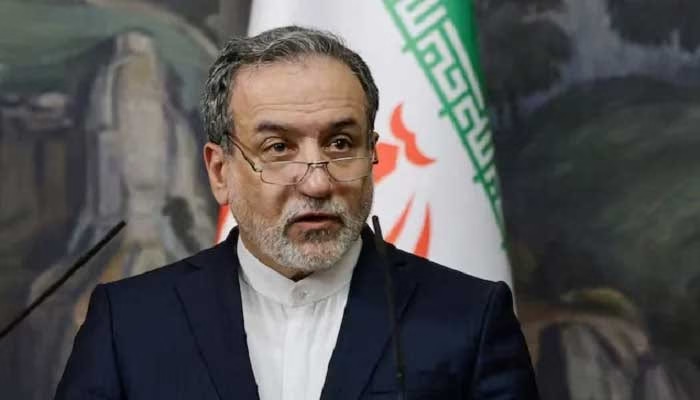
The remarks came shortly after Iran’s Foreign Minister Abbas Araghchi stated that a draft proposal for a potential agreement with United States could be finalised within days. His comments followed negotiations held between the two countries in Geneva earlier this week.
Speaking to reporters on Friday, President Trump confirmed he was weighing military options when asked if he was contemplating a limited strike against Iran. “The most I can say — I am considering it,” he responded, signalling that Washington is prepared to escalate pressure if diplomatic efforts fail.
A day earlier, Trump had warned that “bad things” could happen if Tehran failed to reach a deal within a specified timeframe. Initially setting a 10-day deadline, the US president later extended the timeline to 15 days, underscoring the urgency he attaches to securing a meaningful agreement.
Following the Geneva talks, Iranian officials confirmed that both sides had agreed to prepare and exchange draft proposals outlining the framework for a potential deal. Araghchi described this as the “next step” in the negotiation process, indicating that the draft could be ready within two to three days pending approval from senior Iranian leadership.
He added that the proposal would then be submitted to Steve Witkoff, who is serving as Trump’s chief negotiator for Middle East affairs.
However, Araghchi also rejected claims made by US officials that Iran had been asked to halt its uranium enrichment programme. In an interview aired Friday by US television network MSNBC, he stated that Tehran had neither offered to suspend enrichment nor been asked to completely abandon it by the American delegation.
“We have not offered any suspension, and the US side has not asked for zero enrichment,” he said, emphasising that ongoing discussions are focused on ensuring Iran’s nuclear activities — including enrichment — remain strictly peaceful in nature.
His comments appeared to contradict statements from senior US officials, including Trump himself, who has repeatedly insisted that Iran must not be permitted to enrich uranium at any level.
Western governments have long accused the Islamic Republic of pursuing nuclear weapons capabilities, an allegation Tehran denies. Iranian authorities maintain that their nuclear programme is intended solely for civilian purposes and assert their right to enrich uranium under international agreements.
At the same time, Iran is seeking relief from international sanctions that have placed severe strain on its economy. The country has faced growing economic challenges, which sparked widespread protests in December and evolved into a nationwide anti-government movement in recent weeks.
Earlier this month, the United States and Iran held an initial round of talks on February 6 in Oman — their first formal discussions since previous negotiations collapsed during last year’s brief Iran-Israel conflict, which reportedly included US strikes on Iranian nuclear facilities.
While diplomatic efforts continue, both sides have exchanged threats of military action in recent weeks. On Thursday, Trump reiterated that Washington could resort to force if Tehran fails to finalise a deal within the extended timeframe.
Meanwhile, Iran’s ambassador to the United Nations, Amir Saeid Iravani, warned that US military bases and assets in the region would be considered legitimate targets in the event of an attack.
Despite the escalating rhetoric, Araghchi maintained that negotiations remain constructive. “There is no ultimatum,” he said, adding that both sides are working toward a swift agreement that could lead to the lifting of sanctions.
“We are under sanctions, so obviously any day that sanctions are terminated sooner it would be better for us,” he noted, stressing that Tehran has no reason to delay the process.