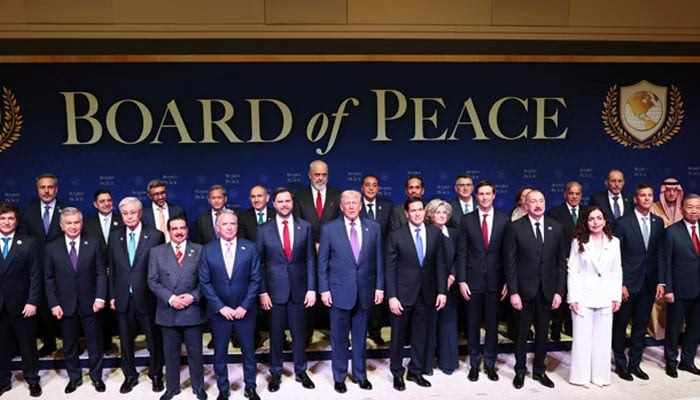
Pakistan’s role in Gaza stabilisation force discussions has taken global attention as Prime Minister Shehbaz Sharif joined world leaders in Washington for the inaugural meeting of the newly formed Board of Peace. The high-level summit, led by US President Donald Trump, is focused on finding long-term solutions for peace, reconstruction, and humanitarian stability in the conflict-hit Gaza Strip.
Prime Minister Shehbaz Sharif arrived in Washington, DC, on Thursday to participate in the crucial meeting. The summit is expected to shape the framework of a proposed International Stabilisation Force (ISF), aimed at overseeing post-conflict recovery and rebuilding efforts in Gaza.
Pakistan Seeks Clarity Before Commitment
As talks progress, Pakistan’s role in Gaza stabilisation force remains conditional. Islamabad has reportedly asked Washington for clear assurances before committing any troops to the proposed multinational force. Government sources have indicated that Pakistan is willing to contribute personnel — but only if the mission is strictly limited to peacekeeping duties.
Officials have emphasized that any deployment must not involve participation in disarming Hamas or engaging in military enforcement operations. For Pakistan, neutrality remains a key principle in any international mission.
The leadership is particularly interested in understanding the ISF’s operational structure, its legal mandate, and the chain of command under which the force would operate. Without this clarity, Islamabad is unlikely to make any immediate decision regarding troop deployment.
Focus on Reconstruction and Humanitarian Support
The proposed stabilisation force is expected to play a central role in Gaza’s reconstruction process. President Trump is anticipated to unveil a multi-billion-dollar recovery plan, which would include rebuilding damaged infrastructure and facilitating humanitarian aid to civilians affected by the conflict.
Pakistan’s role in Gaza stabilisation force could potentially involve assisting with:
- Maintaining ceasefire arrangements
- Supporting humanitarian operations
- Protecting reconstruction projects
- Ensuring public safety during the transition period
The ISF, according to early proposals, would likely include troops from Muslim-majority countries to oversee Gaza’s recovery and economic revival.
A Constructive International Role
Pakistan has consistently expressed its willingness to support international peace initiatives. At diplomatic forums, Islamabad has reiterated its readiness to play a constructive role in efforts aimed at resolving the Palestinian issue in line with United Nations resolutions.
However, Pakistan’s role in Gaza stabilisation force must align with its long-standing foreign policy commitments. Officials have stressed that participation would only be possible if the mission maintains a peacekeeping focus rather than becoming involved in political or military enforcement actions.
This stance reflects broader concerns among several countries that the Board of Peace initiative could eventually operate as an alternative to existing UN mechanisms.
Strategic and Military Considerations
Analysts believe that Pakistan could be a valuable contributor to the multinational stabilisation effort. The country’s military has extensive experience in both conventional warfare and counterinsurgency operations, making it well-suited for peacekeeping roles.
Pakistan’s role in Gaza stabilisation force might initially involve deploying a few thousand troops to assist in maintaining stability during the reconstruction phase. However, any such decision will depend on further consultations and guarantees regarding the mission’s objectives.
Officials have suggested that Pakistan’s involvement could strengthen diplomatic ties with the United States while contributing positively to regional peace efforts.
Diplomatic Engagement in Washington
During his visit, Prime Minister Shehbaz Sharif is also expected to engage in discussions with senior American leadership on the sidelines of the summit. These meetings may focus on broader cooperation in security, economic development, and humanitarian assistance.
Pakistan’s role in Gaza stabilisation force will likely be a central topic in these conversations. Islamabad’s participation could enhance its international standing as a responsible stakeholder in global peace initiatives — provided its conditions are met.
Challenges Ahead
While the proposed ISF aims to cement Gaza’s ceasefire and facilitate rebuilding, significant challenges remain. Key questions regarding troop mandates, funding mechanisms, and humanitarian aid distribution are yet to be resolved.
Additionally, the sensitive issue of Hamas disarmament continues to divide stakeholders. Pakistan has clearly stated that it will not support any mission aimed at demilitarising the group, highlighting the complexities involved in forming a unified multinational force.
As discussions continue in Washington, Pakistan’s role in Gaza stabilisation force remains under careful review. The country’s willingness to contribute underscores its commitment to global peace and humanitarian relief.
Ultimately, the decision will depend on whether the ISF offers a clearly defined, neutral peacekeeping mandate. If these conditions are met, Pakistan could emerge as a key participant in Gaza’s recovery efforts.
Islamabad appears focused on balancing diplomatic engagement with its core principles — ensuring that any future involvement contributes meaningfully to stability without compromising neutrality.