The Indus AI Summit 2026 has emerged as a defining moment for Pakistan’s digital transformation journey. Organized under the broader Indus AI Week initiative, the summit brought together policymakers, technology leaders, investors, and innovators to chart a unified national roadmap for artificial intelligence. With strong backing from the government and the private sector, the event signaled that Pakistan is ready to compete in the global AI-driven economy.
At the heart of the Indus AI Summit 2026 was the endorsement of the federal government’s strategic AI framework by Pakistan Software Houses Association (P@SHA). The association described the framework as pivotal for positioning Pakistan as a serious contender in emerging technologies while accelerating export-led growth.
Government and Industry Alignment
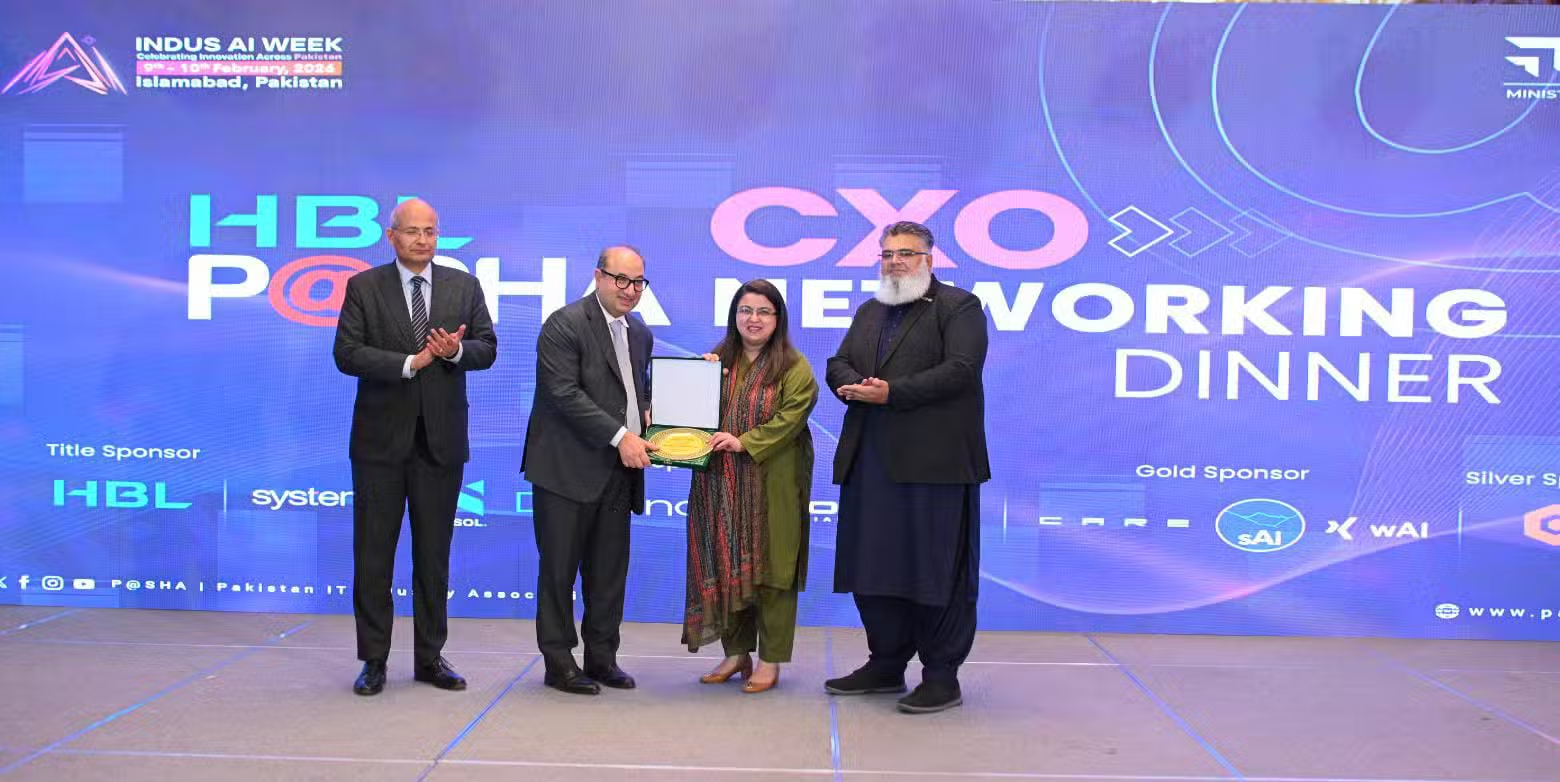
Federal Minister for IT and Telecom Shaza Fatima Khawaja attended the HBL P@SHA CXO Networking Dinner as Chief Guest during Indus AI Week. She praised the remarkable performance of Pakistan’s IT sector, which recorded $2.2 billion in exports during the first half of FY26, reflecting an impressive 20% year-on-year growth.
The minister’s presence at the Indus AI Summit 2026 underscored the government’s commitment to supporting innovation and strengthening collaboration with industry leaders. Her remarks reinforced the idea that technology exports are becoming a cornerstone of Pakistan’s economic strategy.
A Landmark $1 Billion AI Commitment
One of the most significant announcements linked to the Indus AI Summit 2026 was Prime Minister Shehbaz Sharif’s pledge of a $1 billion national investment in AI by 2030. This ambitious commitment reflects a long-term vision to build a sovereign AI ecosystem driven by private-sector innovation and public-sector support.
P@SHA welcomed the announcement, emphasizing that sustainable digital growth must be powered by industry expertise and entrepreneurial leadership. The newly introduced Islamabad Declaration, unveiled during the summit, further stressed the importance of establishing a private-sector-led AI ecosystem that protects national interests while promoting global competitiveness.
Massive Industry Participation
The scale of the Indus AI Summit 2026 demonstrated unprecedented national momentum. Sponsored by the IT industry, the event featured 25 major national and international tech companies as exhibitors and attracted around 100,000 participants across various engagements.
The summit was hosted at the Jinnah Convention Center, serving as the central venue for strategic discussions. Meanwhile, the Innovation, Learning, and Engagement Arena organized over 40 specialized tech events. Students, founders, investors, researchers, and developers participated in workshops, networking sessions, and product showcases, creating a vibrant knowledge-sharing environment.
This inclusive approach reflected a departure from traditional, isolated tech conferences. Instead of limiting conversations to policymakers and executives, the Indus AI Summit 2026 extended its reach to universities and tech hubs nationwide.
Human Capital at the Core
A major highlight of the Indus AI Summit 2026 was its focus on developing human capital. The National AI Training Bootcamp delivered intensive technical upskilling to more than 1,900 participants over two days. This hands-on training initiative demonstrated that AI adoption must be supported by practical skill-building.
Additionally, measurable national targets were announced, including funding 1,000 PhD scholarships in artificial intelligence and training one million non-IT professionals in advanced tech skills. These commitments indicate a comprehensive strategy aimed at embedding AI literacy across sectors rather than limiting it to specialized tech circles.
The Indus eSports Championship also added a dynamic youth engagement component, offering a prize pool of Rs. 4.5 million to encourage digital participation and competitive excellence.
Industry’s Role in Execution
During the summit’s closing panel discussion, titled Next Steps: Impact of the Week, P@SHA Chairman Sajjad Syed joined Secretary IT Zarrar Khan and global experts to outline a roadmap for implementation.
Sajjad Syed emphasized that the IT sector is no longer just a contributor to Pakistan’s economy but a primary engine of growth. He highlighted that integrating AI into business operations is not optional; it is essential for global competitiveness and economic sovereignty.
P@SHA’s collaboration with the Ministry of Information Technology and Telecommunication and the Special Investment Facilitation Council further demonstrates a coordinated approach to transforming policy commitments into tangible results.
A Nationwide Digital Movement
Beyond the main summit, Indus AI Week included decentralized events at universities, tech hubs, and the Innovation Arena at the Islamabad Sports Complex. This nationwide rollout ensures that AI awareness and opportunities are accessible to innovators across all provinces, not just those in the federal capital.
P@SHA commended this inclusive model, noting that true digital empowerment must reach grassroots entrepreneurs and students. By connecting academia, startups, and established enterprises, the Indus AI Summit 2026 created a comprehensive ecosystem that supports long-term innovation.
The Indus AI Summit 2026 represents more than a high-profile event; it marks a strategic shift in Pakistan’s economic trajectory. With a $1 billion AI commitment, ambitious training goals, and strong public-private alignment, the country is laying the groundwork for a technology-driven future.
As Pakistan accelerates its digital pivot, sustained collaboration between government bodies, industry leaders, and educational institutions will determine the pace of progress. The momentum generated by the Indus AI Summit 2026 has positioned Pakistan as a credible emerging player in the global AI landscape — one that recognizes innovation not as a choice, but as a national imperative.