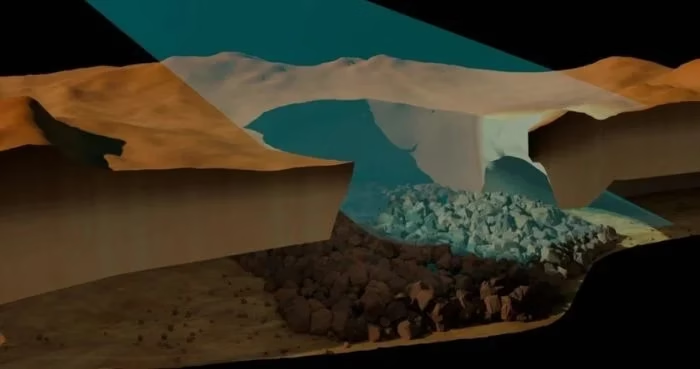
Scientists have uncovered the first compelling evidence of a massive underground lava tunnel beneath Venus, confirming long-standing theories about the planet’s intense volcanic past.
A research team from the University of Trento identified what appears to be a collapsed lava tube near the Nux Mons volcanic region. The discovery emerged from a fresh analysis of archival radar imagery captured by Magellan, which mapped Venus in the early 1990s. By searching for subtle signs of surface collapse, scientists detected a structure consistent with a vast subterranean cavity — something never before confirmed on Earth’s so-called “evil twin.”
The scale is extraordinary. The tunnel is estimated to be about 1 kilometer (0.6 miles) wide — far larger than typical lava tubes found on Earth or Mars. Researchers estimate a roof thickness of roughly 150 meters and an internal chamber soaring hundreds of meters high, suggesting enormous volcanic flows once carved out the void.
According to co-author Lorenzo Bruzzone, the find is a major validation of decades of theoretical modeling. Venus is believed to be the most volcanically active planet in the solar system, yet its crushing pressure and toxic atmosphere have made subsurface investigation extremely difficult. The identification of a volcanic cavity demonstrates that large underground lava networks likely exist beneath the planet’s crust.
Lava tubes form when fluid lava continues flowing beneath a hardened surface layer. When the lava drains away, it leaves behind hollow tunnels. On Venus, such structures may be widespread — potentially forming a hidden labyrinth shaped by ancient mega-eruptions.
The discovery also strengthens the case for future exploration. Upcoming missions like VERITAS and EnVision, planned for the early 2030s, will carry advanced radar capable of probing beneath Venus’s surface. These missions could reveal how extensive these underground volcanic systems are — and reshape our understanding of how the planet evolved.
In short, what was once theoretical is now measurable: Venus may conceal colossal volcanic architecture beneath its hostile exterior, opening a new frontier in planetary science.