The Asim Munir Munich Security Conference meetings marked a significant moment for Pakistan’s military diplomacy, as the Chief of Army Staff (COAS) and Chief of Defence Forces (CDF), Field Marshal Syed Asim Munir, engaged with global leaders on regional and international security challenges. Held on the sidelines of the 62nd Munich Security Conference in Germany, these high-level discussions focused on evolving security dynamics and counterterrorism cooperation.
The annual Munich Security Conference is widely regarded as one of the world’s most important forums for dialogue on global security policy. Against this backdrop, Pakistan’s top military leadership actively participated in discussions shaping the future of international peace and stability.
Talks with US Secretary of State
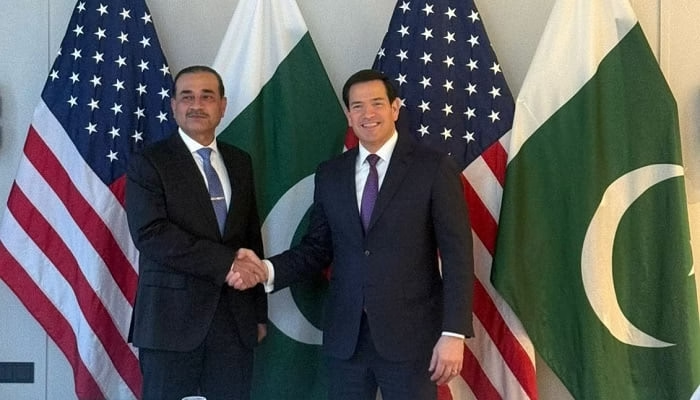
A key highlight of the Asim Munir Munich Security Conference meetings was his engagement with US Secretary of State Marco Rubio. According to the Inter-Services Public Relations (ISPR), both sides discussed matters of mutual interest, including regional security developments and enhanced anti-terrorism cooperation.
Counterterrorism remains a shared concern for both countries. Pakistan’s longstanding role in combating militancy, combined with evolving geopolitical challenges, makes continued collaboration with the United States strategically important. The dialogue signaled a willingness to maintain open channels and strengthen cooperation in addressing global threats.
Engagement with German Leadership
During his visit from February 12 to 14, Field Marshal Asim Munir also held meetings with senior German officials. These interactions formed a vital component of the Asim Munir Munich Security Conference meetings, underscoring Pakistan’s efforts to broaden defence and diplomatic ties in Europe.
He called on Alexander Dobrindt, Germany’s Federal Minister of the Interior, and Günter Sautter, Foreign Policy and Security Policy Advisor to the Federal Chancellor. Discussions revolved around contemporary security issues, bilateral defence cooperation, and the broader need for global peace through dialogue.
In addition, General Carsten Breuer, Chief of Defence of the Federal Armed Forces, met with Pakistan’s army chief. These talks emphasized strengthening institutional collaboration between the armed forces of both nations.
Expanding Multilateral Military Cooperation
Beyond engagements with the United States and Germany, the Asim Munir Munich Security Conference meetings included interactions with military leaders from Brazil and Lebanon. Such engagements reflect Pakistan’s expanding defence diplomacy and commitment to multilateral cooperation.
Admiral Renato Rodrigues de Aguiar Freire, Chief of the Joint Staff of the Brazilian Armed Forces, held discussions with Field Marshal Munir on enhancing bilateral military collaboration. The talks focused on areas of mutual interest, including defence exchanges and security cooperation.
Similarly, General Rodolph Haykal, Commander of the Armed Forces of Lebanon, met with the COAS to discuss the global and regional security environment. The interaction explored opportunities to strengthen defence ties and promote stability through coordinated efforts.
These multilateral engagements highlight Pakistan’s broader strategy of maintaining active defence diplomacy with countries across different regions.
Focus on Global Peace and Stability
A recurring theme throughout the Asim Munir Munich Security Conference meetings was the emphasis on dialogue as a pathway to peace. The discussions consistently underscored the importance of bilateral and multilateral engagement in addressing emerging threats.
In a world increasingly marked by geopolitical competition and regional conflicts, forums like the Munich Security Conference offer critical opportunities for leaders to exchange perspectives and identify common ground. Pakistan’s active participation demonstrates its intent to contribute constructively to global security debates.
The meetings also reflected the interconnected nature of modern security challenges. Issues such as terrorism, cyber threats, and regional instability require coordinated responses rather than isolated actions.
Strengthening Pakistan’s Global Role
The Asim Munir Munich Security Conference meetings also serve to reinforce Pakistan’s role in global security conversations. By engaging with key international stakeholders, Pakistan aims to position itself as a responsible and proactive partner in maintaining regional and international stability.
Such diplomatic outreach can enhance mutual understanding, build trust, and create avenues for practical cooperation. For Pakistan, maintaining balanced relationships with major powers and regional partners is essential to navigating complex geopolitical dynamics.
The army chief’s engagements signal a broader commitment to strengthening institutional ties and promoting collaborative security frameworks. In an era of shifting alliances and evolving threats, sustained dialogue remains indispensable.
As global security challenges continue to evolve, high-level engagements like the Asim Munir Munich Security Conference meetings play a vital role in shaping cooperative responses. From counterterrorism discussions with the United States to defence cooperation talks with Germany, Brazil, and Lebanon, the visit highlighted Pakistan’s active diplomatic engagement on the world stage.
The Munich Security Conference once again provided a platform for constructive dialogue among global leaders. For Pakistan, the meetings reaffirmed its commitment to promoting peace, strengthening partnerships, and addressing shared security concerns through sustained diplomatic and military cooperation.
By prioritizing dialogue and collaboration, Pakistan seeks to contribute meaningfully to international efforts aimed at ensuring a safer and more stable world.