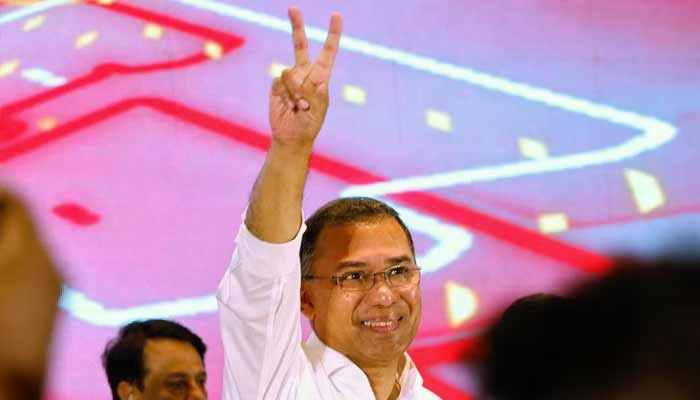
Bangladesh’s prime minister-in-waiting Tarique Rahman on Saturday dedicated his sweeping election victory to those who, he said, “sacrificed for democracy,” urging unity as the country prepares to enter a new political chapter following the first general elections since the deadly 2024 uprising.
Rahman, 60, chief of the Bangladesh Nationalist Party (BNP), is set to lead the South Asian nation of 170 million people after his party secured a commanding majority in Thursday’s polls. The vote marked a turning point in Bangladesh’s turbulent political history, coming months after a student-led uprising brought an end to the long and controversial rule of former prime minister Sheikh Hasina in August 2024.
“This victory belongs to Bangladesh, belongs to democracy,” Rahman declared in his first public address since the results were announced. “This victory belongs to people who aspire to and have sacrificed for democracy.” He began his speech in English before switching to Bangla, reinforcing his message of gratitude and reconciliation.
According to the Election Commission, the BNP-led alliance won 212 seats in the 300-member parliament. In comparison, the alliance led by the Jamaat-e-Islami secured 77 seats. Voting was held in 299 constituencies, with one seat remaining uncontested. Turnout stood at 59 percent, reflecting significant public participation in a crucial post-uprising election.
Rahman will assume office from an interim administration headed by Nobel laureate Muhammad Yunus, who has overseen the country’s transition since the 2024 unrest. Yunus earlier congratulated Rahman, expressing hope that the incoming leader would guide Bangladesh toward “stability, inclusiveness, and development.”
The victory represents a dramatic political comeback for Rahman, who returned to Bangladesh in December after spending 17 years in exile in Britain. For nearly two decades, he remained distant from Dhaka’s intense political scene. His return and subsequent electoral triumph signal a remarkable shift in the nation’s political landscape.
Meanwhile, Jamaat chief Shafiqur Rahman initially alleged “inconsistencies and fabrications” in the voting process but later conceded defeat. He pledged to serve as a “vigilant, principled, and peaceful opposition.” He noted that his Islamist party, which had been severely suppressed under Hasina’s administration, had quadrupled its previous best representation in parliament. He described the outcome as laying “a foundation” for future political growth.
The Awami League, led by Hasina, was barred from participating in the election. Hasina, 78, who was sentenced to death in absentia on charges of crimes against humanity, issued a statement from India, where she has been residing since her removal from power. In her message, she denounced the polls as “illegal and unconstitutional.”
Despite the controversies, international observers largely endorsed the process. The European Union described the election as “credible,” and the United States embassy congratulated Rahman and the BNP on what it termed a “historic victory.” India, whose ties with Bangladesh had grown strained after the uprising and Hasina’s departure, also praised Rahman’s “decisive win.” China and Pakistan, both of which strengthened relations with Bangladesh following the political upheaval, likewise extended congratulations.
Rahman called on political rivals and citizens alike to unite after a period marked by unrest and division. “Our paths and opinions may differ, but in the interest of the country, we must remain united,” he said, emphasizing reconciliation and collective responsibility.
The BNP leader inherits a complex legacy. His father, former president Ziaur Rahman, was assassinated in 1981, while his mother, Khaleda Zia, served three terms as prime minister and dominated Bangladeshi politics for decades. Rahman described his victory as a reaffirmation of the party’s enduring support among “freedom-loving, pro-democracy people.”
Voters also endorsed sweeping democratic reforms through a referendum held alongside the parliamentary elections. The proposed charter, backed by Yunus, aims to overhaul what he called a “completely broken” system of governance. Key reforms include term limits for prime ministers, the creation of an upper house of parliament, stronger presidential powers, and enhanced judicial independence to prevent a return to one-party rule.
However, Rahman acknowledged the challenges ahead. “We are about to begin our journey in a situation marked by a fragile economy left behind by an authoritarian regime, weakening constitutional and structural institutions, and destroying law and order,” he said.
As Bangladesh prepares for a new administration, the election signals both a political transformation and the beginning of a demanding effort to rebuild institutions, restore stability, and strengthen democratic governance in the country.