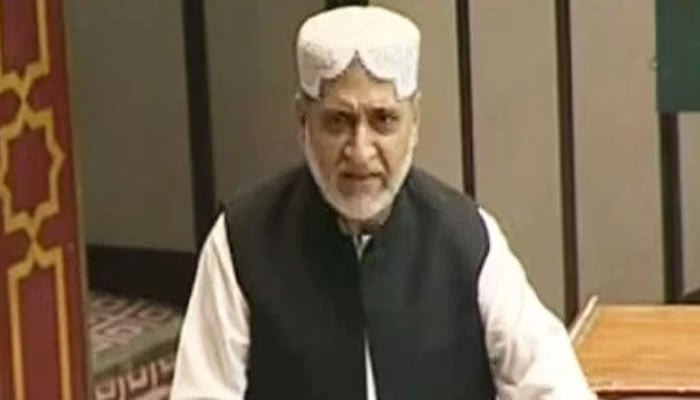
The Akhtar Mengal resignation has finally been accepted by National Assembly Speaker Ayaz Sadiq, bringing an end to months of political uncertainty surrounding the Balochistan National Party-Mengal (BNP-M) chief’s status in parliament. According to sources, the resignation was approved after a significant delay and will take effect from the original date it was submitted.
Sardar Akhtar Mengal, who was elected from NA-256 (Khuzdar) in the February 2024 general elections, had tendered his resignation on September 3, 2024. At the time, he cited the worsening security and political situation in Balochistan and declared a lack of confidence in the state system. His announcement came during a National Assembly session, where he openly expressed regret over what he described as his inability to deliver meaningful change for the people of his province.
Background to the Resignation
The Akhtar Mengal resignation did not come in isolation. It followed a turbulent period in Balochistan marked by a series of violent incidents. In August 2024, the province witnessed multiple attacks that claimed more than 50 lives, including 14 security personnel. Militants linked to the banned Balochistan Liberation Army (BLA) targeted civilians, police officers, and security forces, intensifying concerns about security and governance in the region.
In his address to the National Assembly at the time, Mengal expressed frustration over what he termed the denial of the right to rule and a broader failure of the political system to address Balochistan’s long-standing grievances. His resignation was presented as a protest against these issues, signaling deep dissatisfaction with the prevailing circumstances.
Delay in Acceptance
Although the resignation was submitted in early September 2024, it was not immediately accepted. The delay extended for several months, during which Mengal continued to technically hold the status of a Member of the National Assembly (MNA). Sources indicate that during this period, he retained the perks associated with the position, including accommodation in the Parliament Lodges.
The eventual acceptance of the Akhtar Mengal resignation has raised questions about why the process took so long. Parliamentary procedures often require verification and confirmation before a resignation is finalized. However, in politically sensitive cases, delays can also reflect ongoing negotiations or attempts at reconciliation.
Attempts at Dialogue
Following his resignation announcement, efforts were made by the federal government to engage with Mengal. A delegation led by Prime Minister’s aide Rana Sanaullah reportedly met him to address his concerns and explore possible solutions. The aim was to persuade him to reconsider his decision and remain part of the parliamentary process.
Despite these efforts, Mengal remained firm in his stance. His consistent position suggested that his resignation was not a symbolic gesture but a reflection of deep-rooted frustration with the political and security environment in Balochistan.
Political Activism Beyond Parliament
The Akhtar Mengal resignation is part of a broader pattern of political activism by the BNP-M chief in recent years. In July 2024, he was offloaded from a Dubai-bound flight from Quetta after being informed that his name had been placed on the Provisional National Identification List (PNIL). The incident drew attention and sparked debate over travel restrictions imposed on political figures.
In 2025, Mengal staged a 20-day sit-in at Lak Pass in Mastung, protesting the arrests of Baloch rights activists and police actions in the province. His party also launched a long march from Wadh to Quetta on March 28, which lasted nearly three weeks. The protest focused on the detention of leaders and activists of the Baloch Yakjehti Committee (BYC), including Dr. Mahrang Baloch and Sammi Deen Baloch, and demanded their release.
These actions underscored Mengal’s continued engagement with political issues outside the parliamentary framework. Even after stepping away from his legislative role, he remained active in voicing concerns related to rights, governance, and security in Balochistan.
Implications for Balochistan Politics
The acceptance of the Akhtar Mengal resignation could have significant implications for the political landscape in Balochistan. His departure from the National Assembly creates a vacant seat in NA-256, potentially leading to a by-election. More importantly, it signals a widening gap between certain regional political leaders and the federal system.
For many observers, the development highlights the persistent challenges facing Balochistan, including security concerns, political representation, and trust between provincial and federal institutions. Mengal’s resignation serves as a reminder that unresolved grievances can have lasting effects on parliamentary participation and democratic processes.
As the Akhtar Mengal resignation officially takes effect from its original submission date, attention now turns to what lies ahead for both the BNP-M and the broader political environment in Balochistan. Whether this move will lead to renewed dialogue or further polarization remains to be seen.
What is clear, however, is that the resignation marks a significant chapter in Pakistan’s current political narrative. It reflects ongoing tensions, complex provincial dynamics, and the evolving relationship between regional leadership and the central government.
In the coming months, developments surrounding NA-256 and the response from political stakeholders will offer further insight into how this decision shapes the future of Balochistan’s representation at the national level.