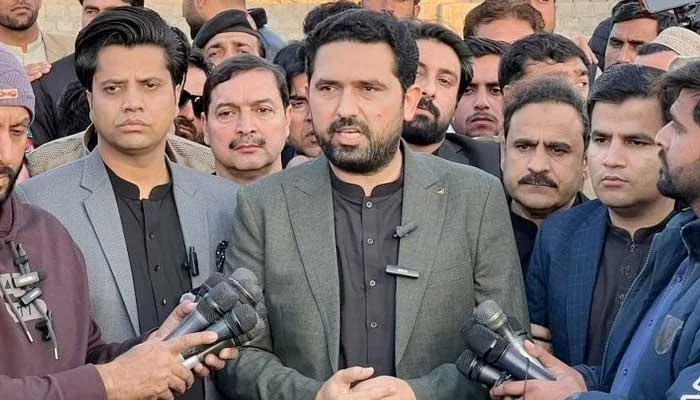
The political and legal landscape in Pakistan witnessed another major development as an Islamabad court issued a KP CM non-bailable warrant against Khyber Pakhtunkhwa Chief Minister Sohail Afridi in a case related to the alleged defamation of state institutions. The warrant was issued after the chief minister repeatedly failed to appear before the court despite multiple notices, further intensifying his ongoing legal challenges.
The order came from a district and sessions court in Islamabad, where Senior Civil Judge Abbas Shah was presiding over the case. According to court officials, the judge directed law enforcement authorities to arrest and produce CM Afridi before the court. Following the issuance of the KP CM non-bailable warrant, the hearing was adjourned, with the next date fixed for February 21.
The case was registered by the National Cyber Crime Investigation Agency (NCCIA) under the Prevention of Electronic Crimes Act (Peca). Authorities allege that CM Afridi used electronic platforms to level misleading allegations that harmed the reputation of state institutions. The prosecution maintains that such statements fall within the scope of cyber-related offences, making the matter both politically sensitive and legally significant.
This is not the first time the court has taken such action. Last month, the same court had issued a similar KP CM non-bailable warrant after the chief minister failed to comply with court summons. His continued absence has raised questions about his legal strategy and has drawn criticism from opposition figures, who argue that public office holders should be held to higher standards of accountability.
The latest warrant adds to CM Afridi’s mounting legal troubles. Earlier this month, reports from the Punjab Forensic Science Agency and Nadra allegedly linked video evidence from the May 9 riots to the chief minister. In response, the court sought a complete forensic and identification report, which is expected to be presented on February 14. These developments have further complicated Afridi’s position, both legally and politically.
The May 9, 2023, riots marked one of the most turbulent episodes in recent political history. The unrest erupted following the arrest of Pakistan Tehreek-e-Insaf (PTI) founder Imran Khan from the Islamabad High Court premises in a graft case. During the protests, several civil and military installations across the country were targeted, leading to widespread damage and numerous arrests. Any association with these events has serious legal implications, making the KP CM non-bailable warrant part of a broader and more complex legal narrative.
Despite these challenges, CM Afridi has continued his public engagements. On the same day the warrant was issued, he addressed a convocation ceremony at the University of Engineering and Technology (UET) Peshawar. In his speech, he stressed that he was willing to engage in dialogue with all stakeholders when it came to the interests of Khyber Pakhtunkhwa. He emphasized that personal differences would not stop him from sitting with anyone for the sake of the province.
The chief minister also touched upon the province’s law and order situation, revealing that he had recently met Prime Minister Shehbaz Sharif. He confirmed that a session of the Apex Committee had been convened to discuss security concerns. According to Afridi, peace and stability remain the top priorities for Khyber Pakhtunkhwa, as sustainable development cannot take place without a secure environment.
Addressing broader governance issues, Afridi warned against what he described as closed-door decisions imposed through intimidation. He argued that institutional overreach had become a systemic problem in Pakistan, contributing to political instability and economic uncertainty. While he did not directly reference the KP CM non-bailable warrant during his speech, his remarks highlighted ongoing tensions between political leadership and state institutions.
The unfolding situation places Khyber Pakhtunkhwa’s leadership under intense scrutiny. Legal experts note that a sitting chief minister facing repeated non-bailable warrants creates a constitutional and administrative dilemma, especially if enforcement actions are pursued. Politically, the case could further polarize the environment, while legally, it underscores the judiciary’s insistence on compliance with court proceedings.
The issuance of a KP CM non-bailable warrant against Sohail Afridi marks a critical moment in Pakistan’s current political climate. With multiple cases converging and court deadlines approaching, the coming weeks will be crucial in determining both the legal outcome and its broader impact on governance in Khyber Pakhtunkhwa.